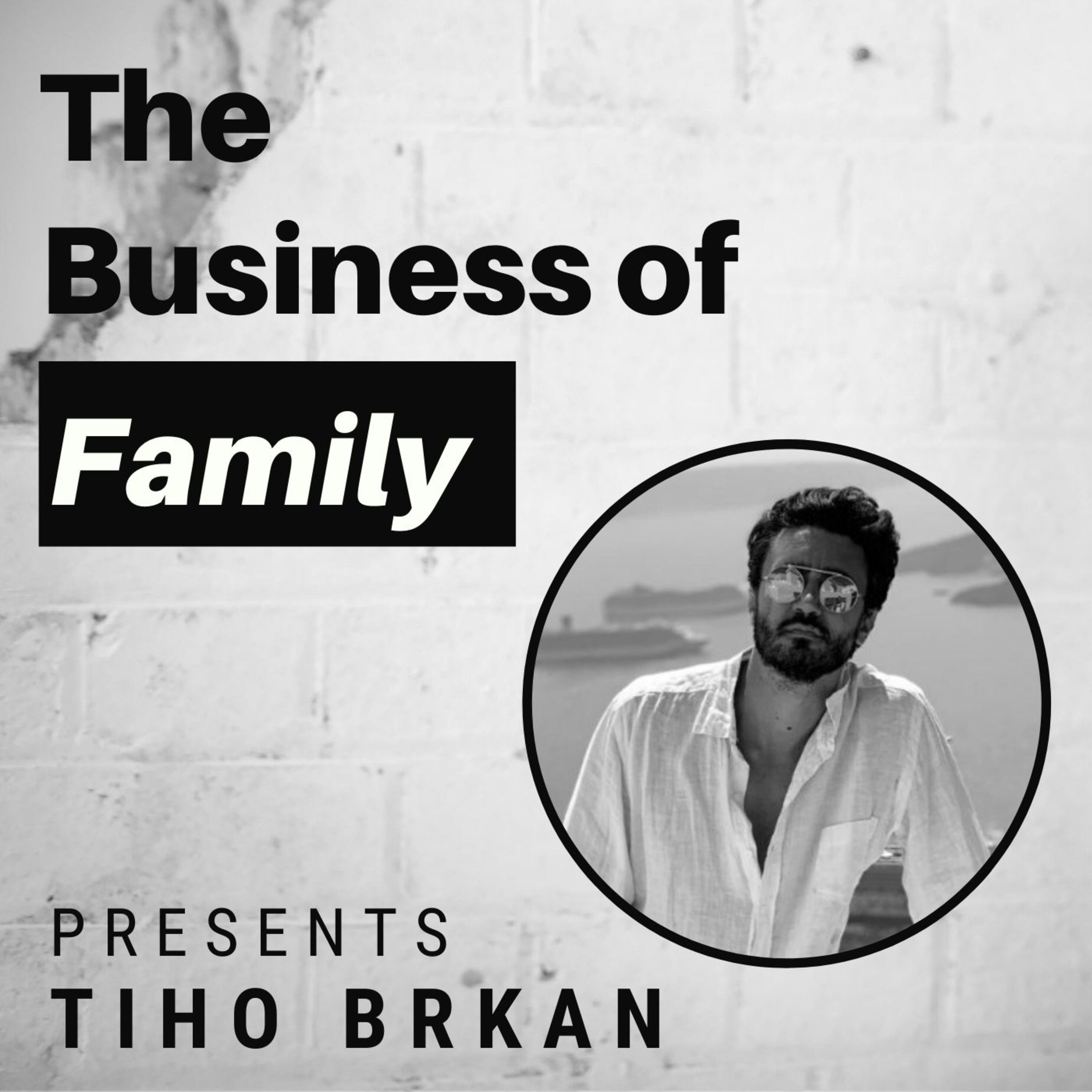
Episode 3 · Season 1
Global Deal Flow for Family Office Investors
Read the full show notesBio, standout quotes and the episode timeline
Our guest this week is Tiho Brkan, a successful trader, portfolio manager and investor, Tiho today runs the multifamily office, The Atlas Investor on behalf of his family and other high net worth families and individuals.
Tiho is known to visit up to 20 countries per year, all the while observing global economic trends, purchasing offshore real estate and executing investments on behalf of his clients.
Standout Quotes:
- “The margins in luxury real estate can be insanely profitable as long as you know what you’re doing and as long as you choose the right deal.” - Tiho Brkan [21:24]
- “Asian millennials are now becoming the most important demographic for the whole global economy.” - Tiho Brkan [35:27]
- “The beautiful thing about mezzanine debt is that it has equity-like returns and bond-like downside protection or margin of safety, and that’s why we like it. ”- Tiho Brkan [42:02]
- “Focus on learning from the right source and really moving the needle on what’s important and what counts.” - Tiho Brkan [1:03:52]
Key Takeaways:
- How to master the blend between an entrepreneur and an investor
- Learning world cultures through travel
- The importance of diversifying your capital into alternative assets as a high net worth individual or family office
- Understanding the global tax scene when investing across the world
- Capital Stack and the difference between senior and mezzanine debt
Episode Timeline:
[1:32] Tiho shares his background both personally and professionally
[4:02] He shares the reason why he travels and how it has changed the way he views the world
[8:59] How Atlas Investor helps investors gain access to extremely attractive private deals plus using the mastermind model with their investors
[13:47] He talks about his clientele and how COVID-19 has affected the investing world
[16:15] The five strategies they use when investing in real estate across the globe
[24:12] The experience of buying and selling luxury real estate
[27:41] He explains how he handles tax when he lives and conducts business globally
[35:09] The macro view, why the Asian millennial will play a big role in the future global economy
[38:34] The advantages of real estate mezzanine debt investment and why real estate investors prefer it over senior debt
[46:46] Tiho explains what they look for when investing in real estate developments
[54:24] How mentors that included his father played a huge part in his success
[1:00:30] He explains the involvement of his family in the business and the importance of learning from the right sources as a younger person
Links:
- Book: Think and Grow Rich: Napoleon Hill : In the original Think and Grow Rich, published in 1937, Hill draws on stories of Andrew Carnegie, Thomas Edison, Henry Ford, and other millionaires of his generation to illustrate his principles.
- Tiho Brkan (@TihoBrkan) / Twitter
Read the transcript
This transcript was generated automatically and may contain errors, including in names. Listen to the episode for the exact words.
MikeWelcome to The Business of Family. I'm your host, Mike Boyd. Multigenerational wealth creation involves so much more than capital accumulation. The most successful families cultivate values, stories, knowledge and resources to pass on to the next generation, and they do it very intentionally. On this show I sit down with members of some of the world's most interesting business families to hear how they do it. To see where your own family stands, take the Business Family Diagnostic at businessoffamily.net.
Our guest this week is Tiho Brkan, a successful trader, portfolio manager, and investor. Tiho today runs the multifamily office, The Atlas Investor, on behalf of his family and other high net worth families and individuals. Tiho is known to visit up to 20 countries per year, all the while observing global economic trends, purchasing offshore real estate, and executing investments on behalf of his clients. With a keen belief in living like a global citizen, Tiho takes pleasure in unearthing rare business opportunities worldwide, building strong connections in the fields of accounting, banking, taxation, and law in each jurisdiction.
I hope you enjoy this wide-ranging interview.
TihoWell, first of all, thank you for having me on your podcast. Absolute pleasure to be on here, And I'm looking forward to listening to many podcasts as you do them in the future. And also, it's always a pleasure to sit down and have a conversation with another countryman. So originally, I was born in Croatia. My family has been living in Australia for almost three decades, though.
I finished high school in Australia. I finished university in Australia. I majored in accounting and finance. A family business of ours has been a supply of high-end materials for the purpose of renovating high-end real estate. And we have focused mainly on doing it in our part of the world where we live. So that's basically Brisbane, Australia and surrounding regions. You're basically on the north. You have some very nice luxury real estate in Sunshine Coast and Noosa. And down south, you can go to Gold Coast and all the way to Byron Bay. So we have kind of worked within that range.
personally, I left Australia about 10 years ago. First few years, it was on and off where I would spend a lot of time outside of Australia, but I will come back. And then last seven years, I basically left permanently and I've just been doing a whole lot of stuff for our family abroad and for myself included too. I see myself not as an entrepreneur and not as an investor.
Maybe a blend of the two is the best description. So maybe somebody like an opportunist. So a blend of a business person, I wouldn't call myself an entrepreneur because you entrepreneurs are incredibly smart, incredibly gifted, and I can't compete with you guys. And then on the other side as well, a private investor because there are so many incredible public investors who run these great funds and hedge funds from New York to Los Angeles and London and Hong Kong and so forth.
So I'm not as good as those legends either, but I just focus on my own private stuff. So, you know, a blend of those two is where I really found my niche and where I have been able to excel to a degree.
MikeMy understanding is that you're now starting to manage a multifamily office, which we're going to get into. I want to hear a lot more about it. But before we do, your background to me is fascinating. And I remember when we first connected, I discovered you're a man of the world. You were saying that you've been, was it to over 70 countries?
TihoYeah. So I'm not so sure how many. I think I lost the count around 70.
MikeWhat spurred that on for you? Why is that important? And what have you learned from it?
TihoSo in reality, travel is like my second degree, because the first one was accounting and finance, as I said. But if you cut out the theory, travel is the only degree that I ever got in life. It's like the university of life, right? So first of all, I've been to over 70 countries and majority of them have been Asia Pacific, Europe and Middle East. So let's call them the way that Christopher Columbus would call them, the old world, as opposed to the new world, which is a North and Latin America, which was colonized by Europeans back in the day. I'm a huge fan of history as we'll probably get into it. So travel teaches us, I think, a lot. It taught me about the
world, how the world works, about different cultures, how different people think, as opposed to where I came from and where I lived. Because I was born in the Mediterranean and I moved to Australia. So I grew up in Southern Europe, Eastern Europe, border of those two, let's say. And then I moved to the Western culture, which is predominantly influenced by, let's say, UK and the US. And then when I started traveling, I started to learn about all different kinds of mentalities relative to our own. And it doesn't happen when you go there for seven days and take a few photographs that you're going to put on your Instagram in front of a central part of the city
with like a monument, a church or something like that. Instead, it happens by trying to get real relationships with people and staying there for a prolonged period of time. That's one of the things that I've done. I'm a slow traveler, minimum three to six months per country sort of thing, and get really immersed in it. The life that I led for the last, let's say, half a decade or so has been one of Sunseeker, where I would always be in Asia Pacific during European winters, and I would always be in the Mediterranean during European summers. I think as you get older, what travel also does, as I said, it teaches you about the world, but also makes you appreciate
where you came from, right? I was forced to leave one country due to a war and go to another, then migrate to the other side of the world. And my father sent me to live in Japan during high school as an exchange student. So many different things happened to me and travel was basically injected into my bloodstream very early on. And then finally, I think what travel has done now, and I don't think I'll ever stop traveling, but travel has completely changed me as a person.
I mean, honestly, because I'm not the same person as I was once when I left Australia a long time ago. I just think differently to the friends that I have in Australia, because how can you not, after you see so many things and experience so many different things. I mean, I rode a motorbike through Cambodia and I saw so many poor people everywhere that I went.
I mean, one of the pit stops I made in a restaurant, as I was telling you a story a while back, I ended up paying for everybody's lunch that day. It didn't cost me a lot of money, but everyone came to shake my hand. And just having a look at a smile on these people's faces and going through an experience like that and seeing how they struggle in life and where they live, how can you not come back and be changed?
It was much more important to focus on, let's say, the core parts of the life.
MikeYou're absolutely talking about a passion of mine as well. I love that we're both from Brisbane, Australia, but we're recording this call from my home in Singapore. And I believe you're currently in Malta. Is that right?
TihoI'm not yet in Malta. On my way to Malta, currently in Croatia. Malta is my current home, but I've lived in eight jurisdictions over my lifetime. And when you say you lived in them, I mean like as in a proper resident, having a resident card and clocking your time there and spending majority of the year there and so forth. So not only did I travel to various places, but I lived in a lot of them as I was trying to say.
And that's when you really get to understand life that those people, the local people live. And I think that changes you because I never really wanted to have just one life. I never wanted to just be an accountant that lives in Brisbane, Australia and drives from my home to my office. And, you know, that suits some people, but that's not what I wanted.
I always wanted to be, I guess, a little bit like I loved Indiana Jones when I was young. So I love the fact that he was a teacher during the day, you know, and during a normal week, Monday to Friday, and he was dressed in a suit. And he was so well versed in history and understood everything about the past and all the artifacts and everything. But then come the weekend, he'd put on his leather jacket, his whip and his hat, and he was off on a horse or a motorbike.
And he was having adventures around the world. Just incredible.
MikeIt certainly sounds like you have lived multiple lives at the same time and squeezed the most out of it. I want to get into a little bit about what you're doing with your time now. the Atlas Investor. Tell us what it is, who's it for, what you're focused on. Let's hear the story.
TihoSure. So Atlas Investor is basically a service for high net worth individuals, funds, family offices, and accredited investors. And I think I've started that service in a very important infliction point. I'm not going to get into it too much, but the infliction point basically is one that central banks have created. I believe that they have wheezed just about every ounce they can out of asset prices. And of course, over the short to medium term, anything can happen in those asset prices that could go up or down over the next few years. But over the long term, let's say the next 10 to 12 years, I believe the future expected returns of traditional portfolio assets like stocks and bonds will probably disappoint after we've seen this money printing go on and
on and on. So I think it's become increasingly important to diversify your capital as a high net worth individual or a family office into alternative assets. And industry trends have revealed that the number one headache for these people has always been finding the right partners who can provide them with the right deal flow, basically attractive deals and opportunities they can participate in. Just because stocks and bonds might not deliver very high returns going forward doesn't mean alternative assets will either. Risks are also very high there too, Just like in any asset class, there's also risk holding cash.
Just ask people in Iceland after 2008 who had cash at bank or just ask people in Cyprus. It even came to that in the UK where the government had to step in and bail out the whole banking system. Same in the US. So any asset class cannot be a safe or a safe haven. But definitely, I think when it comes to alternative assets, what's very important is just making sure that you have the right deal selection.
finding those attractive deals that have high probability of succeeding. So today, direct investing was accessible to only the wealthiest individuals, billionaires, centimillionaires, like 100 million over, who had these extremely close private relationships and could meet very large investment amounts with their private banks or merchant banks. But that's not the case anymore. So the alternative asset sector is becoming more and more accessible.
And as I said, still, the most important thing is finding great deal selection and you have to do thorough due diligence. That's the key to achieving performance. So Atlas Investor is basically a personalized service helping those investors gain access to those attractive, extremely attractive, I should say, private deals. And not only do we help do that, but we also invest in these deals ourselves.
So we mainly focus on real estate strategies on the alternative side. and that's an area that we specialized in for over a decade. The family has over two decades and then we allocate our own personal capital towards these deals. We like the deal so much that we're probably the first investor and sometimes even the biggest.
MikeWhat a fascinating structure. So you're not raising funds, you're not really managing other people's money, but it sounds more like a partnership, a cooperative, a group of family officers or a group of high net worths pursuing interesting deals together? Is that a fair summary?
TihoYeah, that's a fair summary. You know how I would put it if I was asked on the spot, and I just kind of thought of this. One of my favorite books is Think and Grow Rich. And obviously, Napoleon Hill wrote a lot of the systems and tools that are needed towards success built on Andrew Carnegie's success. And I think Andrew Carnegie attributed almost all of his success to the principle of the mastermind. The mastermind principle basically means surrounding yourself with other like-minded individuals that can elevate you today or that you can help elevate them to your height. And everybody has a mutual beneficial outcome and an alignment of interest in the mastermind group. You co-invest together, you share due diligence strategies and potential
risks together. Two heads are always going to be smarter than one, especially if the two heads have a lot of experience and they've succeeded in their life. Usually people who are successful tend to be, not always, but more often than not, especially if they're self-made, they tend to be very, very objective, clear, critical thinkers. And those people tend to be able to deal with successes and failures, more importantly, much better than most other people.
So I think it makes a lot of sense having those people in the mastermind and everybody benefiting from each other.
MikeSounds incredible and quite a unique model from my understanding. Tell me, how far into this journey are you with Atlas Investor? Is it something that you've been doing for a while or are you just getting going? Are there other families involved already?
TihoI've made it a little bit more public in recent times, but I've been doing this for quite a while already. And there are other families involved, including a partner family of ours from Australia and another partner from Hong Kong recently that we've also worked with. And then several others, one from Germany, one from the UK, an investor also from Malaysia that we've helped a lot.
So over the last, let's say, four to five years, I helped raise over £50 million and allocate towards various deals, on top of which we've already invested another £10 million of our own capital, us and other partner families that we're in close relationship with. So look, we've done a lot of work and we've taken on a lot of deals and we've had all great performances so far.
So knock on wood, it continues. Obviously, the business cycle has been propelled by the recent euphoric, let's say, boom that's been going on until the coronavirus crash came. And then are we having a downturn now due to quarantine and the lockdown of the economies? And also, we've been very fortunate collectively as investors around the world that we've benefited from very low rates and we've benefited from globalization of capital and basically a lot of capital just sloshing around looking for a home. So I have to be honest and admit those things because the real test will come on the other side of the cycle. A cycle is not just one part of it where you're investing in the upturn. A cycle also has what we call a contraction
or a real recession, if not a recession in economic terms, which is basically you get bailed out by central banks to a degree like we're seeing now, a real contraction is when you have contraction in valuations and contraction in price of assets. And that is a moment in time when everybody's tested. And as Warren Buffett famously said, that's the time when we'll see, when the tide resides back, we'll see who's swimming with their shorts on and who's swimming naked.
MikeI would love to get into some examples of the types of deals that you're playing with Atlas. I understand that you've got a number of strategies across alternatives. And I'll preface this by saying, I think this whole space is fascinating. Being an entrepreneur myself, businesses make the most sense to me. Then I can wrap my head around real estate and other alternatives just pique my interest.
But you take things to a whole nother level. I'd love you to expand on some of the deals that you've participated in so far.
TihoThank you for a nice compliment. I don't think I deserve it, but I'll try to take it to the first level. So real estate strategies that we focus on, well, there are a handful that you can really focus on, but I'll explain it in the way that we do it. So there's four mainly that we focus on.
Maybe you can even throw in a fifth, which I'll leave to the end. But first of all, we focus on development projects. And that's where we provide our clients or partners with an attractive opportunistic strategy. So opportunistic strategy for those that know, know, that's like growth in the stock market or private equity. That's the growth strategy, the growth model.
And opportunistic strategy in real estate includes development projects, distressed equity or credit, and potential repositioning, like taking a certain building and rezoning it, or if it's already rezoned, and then repositioning it towards creating apartment blocks out of it or vice versa or something like that. So it's the riskier version or strategy of investing, but it has a very, very high reward if you know what you're doing.
So we focus on development projects, and that's kind of like one of our bread and butters. That's half of the sandwich, let's say. And that's where we team up and co-invest with experienced developers. And we tend to focus on ground-up developments or repositioning of buildings from one use to another, as I said. So that's number one. Number two is also opportunistic.
That's called distressed opportunities. That's where we invest our capital or our clients' capital towards purchasing assets at bargain valuations. And we tend to, without making it too complex, we're looking here for assets that are below market price or below the cost of replacement that tend to have a very high margin of safety. One asset might have been discounted because the developer has made a mistake in a project or he's going through a divorce or something wrong has happened on the site or he's misplanned his budget and therefore he's having a distress.
And if we can come over and take that asset at 70 cents for every dollar and then have a recovery of that asset back to 100 cents on the dollar, not only will we benefit from naturally the asset rising in price over a long period of time, but we also bought it in that drawdown or that discount phase below the cost of replacement or below the cost of construction in some cases.
And then we bring it back to par. The thing with this asset strategy, however, is that investors need to act swiftly and they need to have a large amount of capital. This is not somewhere that you're going to be able to just, let's say, wait for a loan and twiddle your thumbs for three months until you get an approval of financing and then you kind of go in because somebody else will just buy it like that within a week or within a day.
So you have to act swiftly and also you have to be very, very open to doing due diligence at a fast and rapid pace. Last thing I would like to mention is that these discounts tend to occur usually during recessions. And that's when a lot of people don't have the cash and they're strapped for cash. And that's what they're all saying comes about.
Cash is king. So distressed opportunities are usually for people who have not been speculating a lot during the last phases of the boom, have kept their cash on the sidelines. And then when things go upside down, as we say in Australia, that's when you're ready to act and when you're ready to get some bargains. The third strategy that we focus on is multifamily syndications.
Multifamily is a very interested asset class that you have in some pockets around the world. But predominantly, this is a US, a very specific asset class to the US. And that's when we gain exposure to high-quality syndicated residential apartment blocks or garden variety, let's say, semi-detached housing. That's how we would understand it in the UK or Australia.
And what we're looking on is capitalizing on favorable demographic shifts that are happening, let's say, out of California, out of New England, the whole Boston, New York area, and moving towards Florida, Texas, Idaho, some other parts of the United States. And also, we are also doing a value-add strategy there. So we're trying to improve the assets via renovations by bumping up the rents, which without complicating the thing too much, you get an NOI increase, similar to the way that you were talking about business.
It's basically like running a business. NOI meaning net operating income. And once the income goes up, well, the business is probably valued a little bit more than it was before. So that's the third one. And then the second part of the bread and butter that I said, the other half of the sandwich is luxury residential rehab. Now, this is our family business of ours in Australia, and I've taken that a little bit more global now.
So this is what we do directly with our own family office as well as the other three strategies. But we really focus on this on our own. But from time to time, we even have our trusted clients or family partners come in and do a 50-50 joint venture with us. This is where we're looking to buy direct residential real estate, let's say single family mainly.
places like London, Prague, Brisbane, and Sydney, even some other pockets around there. Let's say Byron Bay and Gold Coast, we also like too, as I mentioned before. And that's where we're focusing on adding a lot of value. We're not speculating on the price, but we don't actually mind if the market stays flat or goes down a little bit.
We are going to be taking in a prime location, high-grade residential piece of real estate that's a single family, might be a waterfront, it might be elevated views. And we're going to turn the old house or an old apartment into a beautiful living space and then try to sell it for a premium. One great thing about luxury real estate, especially if you're the right time in the cycle, if you find the right deal, is that the margins on luxury real estate can be insane, insanely profitable, as long as you know what you're doing and as long as you choose the right deal. So those are the four strategies. The fifth one I would throw in is that from time to time,
we don't mind investing in some private equity real estate funds. If we wanted to focus on some industrial or some, let's say, logistics or something like that, we've considered that from time to time and we diversified, but we don't do that too much.
MikeI have to ask, what is an insane margin in luxury residential? Do you mind sharing?
TihoOf course, at least a double. Straight out. So at least you double your money in 18 months to 24 months. And some people would think you must be doing that with an incredible amount of leverage. Real estate, ooh, and spooky music. The X-Files music comes in the background. No. I mean, if you double your money using 50%, it should be easy. I've made a return of 70% with no debt, just all equity, all cash deal. Obviously, it was a bit distressed. I bought it below market value, put my own cash to buy it, made a decision over the fortnight, ended up renovating it with my own cash and ended up selling it. The whole thing took about 18 months.
Luxury takes a bit, it's a bit slower, I think, at times. There's planning state. You can go faster, but also sourcing of materials. We're looking at high-end parquetry. We're looking at marble slabs from Italy. You're looking at high-end appliances from, let's say, Miele or even higher up like Gaggenau. You're looking at planning beautiful kitchen living spaces. You're focusing a lot on bathrooms and then finally flooring and then other special pieces that go throughout the apartment.
Generally speaking, if I'm not going to make 50%, then I'll be like Sidney Crawford. I'm not going to get out of bed.
MikeYou make it sound so easy, but I imagine this is a niche where you have deep expertise. I think you said the family's been in it two decades already. Is there a key area where novices to the luxury real estate space always make the same mistake? Do they overcapitalize? Is there a room or a fixture or fitting that's always a waste of money or any examples you can provide there for us?
TihoSo it really depends. For high end, you could overcapitalize. But for luxury, I would just say for novices, you should not be going there. It's a very difficult market to do. You have to have a lot of connections and you have to really be ingrained in the industry. You must know the trends. You must be in connection with the architects. You have to offer what luxury, at least to me, is about and what I noticed a lot of successful people in this part of the industry that do well, what they are doing is they're offering one-off unique products. There are no comps. That's why the margins are. And by comps, I mean, comparables. Real estate is usually done on comparables. So we compare apartment A to
apartment B. They might be 50 meters apart or two houses across the road from each other or something like that. There are no comps for luxury real estate because they can have all kinds of things in there. So you really have to know what you're doing. It's not necessary to do for most people. I wouldn't recommend it. We fell into it because that's what we do. And I grew up on a building site. When I was 15, 16, 17, 18, 19, 20, I was always going to sites with my father who was doing that business. And now my brother is running that business really, really well.
He's the new El Chapo. So he's the new boss. He's a semi-architect, semi-accountant, one-man band kind of a guy. And his designs are incredible. He always is designing the apartments that I'm doing or the houses that he's doing. But the thing is, will the market accept it? Can you push it at high? At that point in time, is the confidence high? Do you time the exit right? Because luxury real estate is also emotional. Do you connect with the buyer on an emotional level? Do they fall in love with the property and that's exactly what they want? And they know they've got a one-off that's unique and there's nothing else like it.
MikeYeah. You're no longer selling a five-bedroom house or a fancy penthouse. You're selling an experience, an emotion, a connection at that luxury level.
TihoAnd I can tell you honestly, it's the women who are making most decisions because they fall in love with the kitchen and the bathroom. They fall in love with the living spaces. And most times they fall in love with envisioning themselves living there and raising their kids there. Well-to-do people, they're buying a lifestyle. It's a unique way to live.
And for them, they don't mind if they're paying a premium because how can you put a price on having 30 years of living in a beautiful house while you raise your kids and you watch them leave? And then later you can sell it, downsize, as many people in Brisbane, as you know, Melbourne and Sydney are doing right now.
And they're now in this baby boom and downsizing phase. The memories always come from that initial house where the whole family grew up.
MikeOne thing that fascinates me, as you just jumped around providing examples, you've mentioned Brisbane, Sydney, Melbourne, London, Prague, the US. Obviously, we've touched on Vietnam, Hong Kong. I believe you spent some time in Shanghai, Singapore.
TihoSingapore, I lived for a year, yeah. I live in Bukit Timah Road.
MikeIs that right? Not far from me. So with all of this global experience, you're incredibly worldly. But one topic keeps coming to the top of my mind, which is tax. How do you play the tax game in such a global environment? So many cross-border transactions, I imagine, different tax jurisdictions, withholding tax. How do you do it? And as a result, where do you domicile yourself in order to make the most of that?
TihoSo that's a fantastic question, by the way. And I focus a lot on taxation, probably just as much as real estate. I'm one of those boring... I might sound exciting to you on podcast, but I actually read Ernst & Young and Price Waterhouse Coopers. I know every one of their texts off by heart. And I read the corporate and individual text structures quite a lot. And I focus on that. And then obviously, I connect to the right accountants, attorneys, and so forth. But if we take a step back, first of all, domicile, the question you asked, domicile is different to a text resident too.
Probably, I would be domiciled in Australia, or maybe Croatia, because on the common law, it's where your father was born or where your majority of your family, your center of vital interests and all your connections and where you spent maybe over 20 years living. So maybe I'm domiciled in Australia or Croatia, but I'm a tax resident of Malta. And Malta is a very opportunistic spot for investors and business people. They have great taxation. If you think about all those countries that you said, each one of them, and I think a lot of jurisdictions around the world, they all have some kind of interesting tax structures or tax codes or legal loopholes in them. Investing in the United States, there's a 1031 exchange for real estate investors,
and it gives them approximately 90 days to defer capital gains indefinitely. So you sell a property, you have to buy another one and put all of your proceeds as well as the initial capital into the new one within 90 days. You can keep doing that forever. I have a friend in the United States that's 68 years old, hasn't paid a dime of tax his whole life, and he's a multimillionaire.
Now, as he tells me, these are his words, not mine. If the bus was going to hit me tomorrow and my will stated that all of these properties goes to my kids, well, then I never paid any tax ever, and all my kids are going to get all those properties. So that's the United States, a high-tax country.
Australia also has a capital gains exemption on primary properties. So whenever we're doing these properties, they're usually, one of the family members is holding the property and then you live there officially and you do all the stuff correctly. And then you have to clock a certain amount of months or years. We know the rules in Australia. I'm not going to get into it. And then you can exit with a capital gains tax exemption. Prague has interesting, incredible taxation. UK, I think they're slashing their corporate rate down to 17%. So for foreigners, you can just own and do real estate through a company. UK has no withholding tax on dividends, which is ironic because basically you can pay 17%
like Singapore and then you can pay yourself a dividend out of your company from your property project and that's tax-free. Vietnam has incredible taxation. Most people don't know that. But locally, all sourced income made in Vietnam, you have to pay taxes on. But any foreign income, there is no taxation on it as long as you don't remit it to Vietnam. Same with China. Most people don't know that, but expats can get a five-year, let's say territorial kind of a tax exemption as well, where local income made in China, you pay taxes on. Anything that happens outside of China is not remitted to China tax-free. Other places like Singapore and Hong Kong, obviously, they've been tax havens, known ones, and financial hubs around the world. So I think you live there as
well. And that's a good one. When it comes to the other question of cross-border transactions and so forth, you have to make sure you have good banking relationships and a good banking manager. You have to, I guess, have decent deposits and you have to be a high net worth individual to do that. So you have to work your way up and you have to have some charisma. In Asia, as you know, banking relationships are much more important than just banking numbers, like in Europe or United States, where you're just another number in the system. So I have a very good banking manager and he takes care of a lot of my stuff. And then how do you do the compliance and everything
else? Well, you have anti-money laundering, AML. You have common reporting standards. For the US investors, you have FATCA, FBAR rules. You have to make sure you do everything legally. So you have to have good advice and so forth. But the benefits are enormous because a lot of real estate investors will claim that you just want to get to know your little dirt patch and you want to be the best at that dirt patch. I agree with that, but I disagree what they're trying to tell you.
Once you get really good at your dirt patch and there's nothing in your dirt patch to buy anymore, that's a good deal. Why don't you go have a look at another dirt patch? At the beginning of the podcast, I said I was opportunistic. So I did warn you, I go wherever I think capital can be treated well, wherever capital will have the biggest returns and wherever taxes or other advantages, factors would come into play. There are some jurisdictions that I mentioned, which I think are doing really well. Vietnam is one of the hidden secrets of Asia, the fastest growing, ultra high net worth individual population there. So many people improving. And I think Vietnam is
where China was, let's say, 15 to 20 years ago. So it's China urbanized. And China went from having a lot of people below poverty rates and in the agricultural sector, moving towards cities, getting better jobs, better healthcare, better living standards. Now it's happening in Vietnam as well. And I was watching it firsthand. So wherever I went, I tried to make sure I picked decent countries as well, which have some kind of, let's say, future ahead of them that you can benefit from.
MikeI've spent a little bit of time in Vietnam myself, and I lived in the Philippines for a couple of years. And witnessing firsthand what they describe as the emerging middle class in Asia is just an incredible growth story. I mean, there's pros and cons to it and there's all sorts of friction with such a large population of people trying to expand to the next level at the same time. But the rate of growth and the rate of real estate development and the expansion of the economy is just mind boggling. I know the things that I saw in the Philippines in the space of just a couple of years. I mean, the entire city skyline changed in that time. Buildings were going
up.
TihoIncredible. I mean, I used to come outside of my condo and outside there were people wheeling and dealing free market capitalism everywhere. Everyone's doing whatever they want. There is no bureaucracy. There's no restrictions. You don't have to get permits. I mean, just to feel that like when people tell me, United States or Australia or UK or continental Europe is growing at 2% and I just walk around, I'm like, I can't see it. Maybe the tech space, it's hidden from me, but I can't see it with my own eyes. I can't feel it on my skin. Walk outside of my own apartment when I've lived in Vietnam, first corner around the road, I just felt that 8% GDP growth. I saw
it firsthand and it's real. Even if all the statistics are not reported correctly, I know what's growing and what's not growing. It's that simple.
MikeSpeaking of all of this world opportunity, you're currently doing some deals, but you talked briefly about business cycles earlier. Coronavirus has just hit. The world's in disarray. Where are you seeing opportunities now? What sort of opportunities are you looking for? And I'd love for you to touch on the debt versus equity piece. I know we briefly touched on that last time when we're talking about some of your real estate deals. And I thought some of the things you're involved in was fascinating.
TihoSo where I see opportunities away, even from what I'm doing right now, basically where I want to shift Atlas Investor Service towards even more so is towards Asia. I think Asia is really coming into its own. And I really see a lot of opportunities there. So I think, Mike, you're at the right place at the right time.
Asian millennials are now becoming, I think, the most important demographic for the whole global economy. Before the driver was the US consumer, I think it's going to be the Asian millennial consumer. Let me just give you a couple of examples of where I think that there is opportunity. US and European Union together will have around 125 million millennials.
And while China and India have cumulatively together a 660 million, while the whole Asia has 830 million. So that's about six and a half to seven times EU and US combined. and probably you know just as well as i do that these guys are nothing like their parents they're spending like crazy while their parents were saving majority of their income for the rainy day during the difficult times but now asia's really developed and internet's everywhere everyone knows how we lived in the west last two or three or four generations everyone's watched tom cruise and michael j fox videos in the 80s you know corporate america So everybody wants to have that same lifestyle. And if various think tanks estimate that Asian
millennials spend some three to five times more of their income on entertainment and leisure relative to their parents, and they save far, far less. So the way that I see that, our Western economies eventually progress from manufacturing towards consumer-driven economies like Australia or America. And they have some 60 to 75, even in some cases in Europe, some countries have 80% of the GDP is based on services. So I think Asian millennials could make this happen for their own economies over the next two or three decades. And there's going to be a vast fortune spent for the right entrepreneurs on the right real estate, buying the right products from the right businesses. There's so much there that's happening. And I think generally, Asia and Asian millennials,
that's the way that I would play it. I think that's my macro kind of a thinking process. So whether I'm investing in agriculture, because we invest in agriculture in Australia, in beef and chicken farms, and main buyers are Asian millennials. You have the Asian middle class rising from some 1.3 to 1.5 billion towards over 3 billion in coming decades.
And the world food demand is growing rapidly. And Australian agriculture, Australian beef has a tremendous amount of respect on the global market. and it has a very strong popularity, whether it's in Singapore or whether it's in Chinese cities like Shanghai or Beijing or something, you always see Australian beef. And yeah, I guess we're part of that story and we're investing there. So that's kind of like my macro anchor when I'm thinking about anything.
MikeI think that macro view is very difficult to argue with. You've got a very clear view of the world there. And certainly as someone living here in the center of it now with many friends that are Asian millennials, I can certainly concur with all that you're saying. I see it every day. So you said that that was the macro and we can go micro. Why don't we do that now and zoom in? I believe you've been into some deals in London or the UK more recently. I'd love to hear a little bit about those.
TihoWell, let's talk about how we, for example, invest. You asked me also the back end of the last question was equity versus debt, I think, as well. So most people are very much familiar with investing with equity only, and they don't really understand what the other side of it is. But if I could actually touch upon it really quickly and explain it to everyone in a simple terms, it's, you know, your bank is an investor with you in a real estate. So when you go and buy a real estate and you put 20% down, that's your equity portion, your down payment, and the bank will lend you the rest of the money. The bank is not lending you the money.
The bank is lending the money to buy the real estate and it's actually giving it to the seller. And that money didn't disappear from the bank. What they actually got is a lien or a title, you know, a first charge in the title. So in case something happens, you have to understand the so-called capital stack or the capital structure.
So, you know, banks lend money and they have a first priority. So they have less risk, but they take less reward. You take the equity portion. you have higher risk, but you also have higher reward. Equity is associated with unlimited potential or returns where you invest your capital and then debt is associated with very low returns and banks kind of clip away at the coupon and so forth. But each one of those has their own purpose, has their own advantage and disadvantage. The way that we like to invest in development projects, which was if you remember the four strategies, that's our, I guess our first strategy is we like to invest in the middle of that capital structure.
And that's called a mezzanine debt or a junior debt. So if the bank gives a construction loan, that's a senior debt. And then we like to invest in a junior debt or mezzanine debt. So just to backtrack a little bit of how these opportunities came about, we all know about the GFC in 2008. And we also know that real estate was probably the most important asset class to bring the whole global economy down.
Speculation of real estate and the chopping up of those CDOs and debt obligations and so forth, I'm not going to get into them right now. And then shoving them around, selling them to investors and banks taking huge amounts of speculation and leverage on real estate and the whole economy and the credit bubble came down. As a result of that, we had a lot of regulation that happened afterwards, in particular famous ones like Dodd-Frank and Basel III and many others, which said the banks cannot have trading desks anymore and they just need to be depositors.
And when they're lending for real estate construction, they need to reduce their leverage by a huge margin and so forth. So if the project is 100% and the banks are now only allowed to lend up to 60% or 65% of the construction, there is a gap in between. And we call that the sweet spot. And that's where hedge funds and private equity funds and high net worth individuals, accredited investors, basically Atlas investor clients and partners, we are looking for the golden opportunity in between where we can come and lend money for attractive terms and conditions and returns.
and we can have a second charge on the property. So if something goes wrong, the bank will be the safest, but we'll be second safest and still the developer or the equity holder will be the first to go. That's the buffer that absorbs the losses before it comes to us, if that makes sense. The beautiful thing about mezzanine debt is that it has equity-like returns and a bond-like downside protection or a margin of safety, and that's why we like it.
So it's not perfect and it cannot make as much as you can on a real estate luxury project that I talked about before. But regular returns that we're looking at, we won't do mezzanine debt unless we're getting at least 14% to 15% per annum. And in particular, one of the advantages also about real estate mezzanine debt investment is that unlike equity, which is taxed at capital gains level, mezzanine is an income of interest and that's taxed at a withholding level.
So if you look at tax codes around the world, and we talked about this before, usually what you'll find is that interest withholding is always either same as dividends or lower, but far lower than capital gains. A great example is Australia. In Australia, we can do our own deals and get a capital gains exemption if it's a primary property under a personal name.
or if we're doing a mezzanine investment into a development project, then the withholding taxes are only 10% as opposed to withholding on dividends for entrepreneurs, which are 30%, which is meaningful.
MikeHuge.
TihoExactly. So you get tax breaks and benefits as well. So I just want to run through maybe an interesting project that we just did here in northern London. We started about a year ago now, and it's all sold out basically, but there's also this construction aspect of it still going. So how do we really look at these deals and what's important for us?
Well, we'll look at the business cycle and I'm not going to get into that too much but you basically have the mid-cycle, late-cycle, contraction, recession and early-cycle. So it's usually around the mid-to-late cycle when the economy starts to get overheated and the cycle is aged, we tend to start switching from equity to mezzanine debt And that's what we did a year ago because we were already feeling we're in late cycles.
Maybe the Fed can extend the cycle further despite the fact that we've had a really strong recession right now. But generally speaking, we're happy to be there in a mezzanine position. So when we're lending, we want to make sure that we have at least a 20% to 25% buffer. So that means that we don't take deals that are higher than, let's say, loan-to-value on the gross level of more than 80%, which gives us a 20% buffer.
So that means that depending on how much equity the developer has invested and how much profit he has, basically all the profit could disappear and all of the investment by the developer could disappear before even a cent of our interest is touched. And then we can go through our own profits. And that can also be absorbed before we start losing our principal.
So we want to make sure that our principal has at least 20% to 25% downside buffer. So if the property declines, if something goes wrong with the project, if something goes wrong with the development, we have that downside. And if you do the mathematics and if you look at the price sensitivity and the time sensitivity, as we do in our due diligence, there are times when a 15% drop in, let's say, in local real estate or in the project would mean that we get a full rate of return. There is not many asset classes that you can invest in where you say, I don't mind if prices go down a little bit. And that's sometimes when I tweet
on my social media profile and people kind of scratch their head and say, our favorite way to invest in real estate is investing in places where we'll get a full rate of return, even when prices decline a little bit. As a matter of fact, when they decline a little bit, it makes it easier for a developer to sell that inventory because people think, gee, well, property prices are a bit soft. We get a bit of a discount. We might as well buy this apartment before the property prices go back up. So then it makes it actually easier for us to exit. Does that mean it makes it easier for the developer? No, it doesn't. But you can see
when you're playing a more defensive side of the equation, the capital stack, it makes sense to get a full rate of return and your whole principal back, even if the market is soft or flat or something like that.
MikeSo it's a defensive strategy, but the returns don't sound too defensive to me. It's fantastic. Exactly. Tell me, when do you actually get a full return of your principal in a deal like that. You said you've got a current deal underway. The development is almost sold out, but it's still in a construction phase, I think you said. So when is your principal returned and when does this mezzanine debt actually come to a close? Does the developer have an option to pay that out early once they've covered their risk or are you in it until the project is completely sold out? How do these things usually get structured?
TihoYeah, well, we're not in it until the project gets sold out because the developer can actually refinance and then we can be taken out. But basically, let's say there's 20 apartments in a deal and we are up to 80% LTV. That means that we will be exiting a 16th apartment. So the remaining four apartments can stay there and that's developers' equity and profit. So those last 20% of the apartments, those last four apartments or if you have a building of 100 apartments, those last 20, oh, bloody hell, as we say in Australia, those are the hardest to sell, right? There can be the basement floor or it can be a penthouse, which is a little bit more expensive. And those kinds of things is what
the developer has to deal with. We don't. But yes, depending on various deals, we can sometimes exit early if the developer refinances and he could refinance if, let's say, construction is finished ahead of schedule and the apartments are there, he can refinance on the value of those newly completed apartments, he can buy us out and then he can have a very low paying debt on those apartments until he sells them all off. That makes sense for them too. But usually we have to wait for X amount of apartments to be sold after they're completed in construction. Construction takes about a year, sometimes less, sometimes more, depending on the project. But the generally duration of developments is anywhere between 18 to 30 months with a sweet spot around 24 months,
six for planning, 12 for building and six for selling. That's your basic thing. And when we do our due diligence, we usually focus on first and foremost, the developer, their profile, their track record. It's incredibly important. And we don't really invest with developers that haven't had a two cycle track record. In other words, they didn't just start at the bottom of the current cycle. And as my mentor used to say, don't mistake a bull market for brains, right? You didn't get lucky by catching the bottom and the rising tide lifts all the boats. So we want to see how they handle the GFC. Even better, if they were around during the savings and loan crisis, maybe a lot of the youngsters wouldn't know what that is.
But that was a hardcore recession in the 1990s. And then we also focus on location. We want to make sure the location is prime. It's in central parts. We love investing in prime locations. on a macro scale. I'm talking like London, or I'm talking about New York, Manhattan, or something like that. And also, we don't mind investing in second-tier cities as well, places like Brisbane Gold Coast, places like Prague or Lisbon, places like Manchester or Leeds, Nashville, San Antonio, Dallas, Austin, Texas, so forth. We don't mind investing in those places as well. We want to make sure that those second-tier cities are benefiting from something important, like a demographic and economic booms. And also regarding location, we do not want to
invest in places that have cranes in the air. As my mentor used to say, cranes in the air, you better run away, better beware. So hyper supply, common terminology in real estate or oversupply, you don't want to be competing against that. What's the point of being the greatest builder and contractor and underwriter and everything. But when it comes to judgment day, and you have to exit and you have hundreds of other stock and inventory, thousands of things on the market competing with you, all being discounted all the time.
You want to be in places where there's a very high barrier of entry. So that's what's important for us in the location aspect. Then we really get into the, on the due diligence side, we get into the project plans and we have a look at what the developer is doing. And we kind of think because we have the experience of doing our own projects on a smaller scale.
as I was talking about single family luxury or renovation of units, we look at what they're offering basically. And we look at what their value proposition is relative to other things within a kilometer, two kilometers, or even 500 meter radius. We want to have a look at who's going to be competing with our stock that we're investing in here. And are we offering more value for money? Are we offering more square meters or square feet? Are we offering for the similar amount of price, right? Are we offering something better so that our project will sell faster?
So we were looking at project plans, which is very important. Finally, then you get into the underwriting, you look at the financial summary, you're looking at the GDV, gross development value, you're looking at the GDC, gross development cost, you're looking at all of the subcomponents of that, you're looking at the target profit, then you're looking at the capital stack and you know, where the senior debt will exit with their principal, with their interest, and then with their fee, then where the mezzanine will exit with their principal, and then their interest. And you work back from that. Like if you exit at 80%, as I said, that means you're exiting in the 16th apartment sold out of the 20 apartment block. And that means
the last four apartments you don't have to worry about. So generally speaking, we focus on all those things. And I think one of the most important things is we travel to all the locations, whether it's London, whether it's Prague, whether it's Brisbane, whether it's somewhere in the US, whether it's elsewhere that we're investing, we will go and walk the real estate. You got to go there and feel it. The development that I'm talking about here is in North London. It's near Finsbury Park, Arsenal Stadium. So I spent a week walking around that place.
I just went there and I just pretended I was a local for a week. I just wanted to live there and I got an Airbnb there. So I just saw where the metro stations, the tube stations were, as they call them in London, where the cool cafes are, what I could do with my kids, what I could do by myself, what I could do with my girlfriend and my wife. If I was a kid, where I could ride my bicycle, I wanted to have a look at crime rates. I wanted to have a look at the way of living, the demographics of people, what it's like on a Monday night, what it's like on a Saturday or Friday night, all those kinds of things. So you make it also personalized.
That's the way we look at development.
MikeYou're a wealth of knowledge. I do have one just clarifying question there. You mentioned early on that the developer might refinance the deal sooner if they can access a cheaper form of debt. What happens to your mezzanine investment if it's refinanced perhaps before the initial term that you underwrote the deal on? Is there some sort of balloon payment?
Is there an early break fee?
TihoMike, that's a fantastic question. So in my opinion, real estate is about so many things, but one of the key aspects is actually negotiations. And that falls into covenants or terms and conditions of the contract. And it depends on what you can negotiate or what's up for negotiation and depends on what kind of levers you can pull and so forth and so on.
So generally speaking, we like to be in deals where we would earn a full rate of return even at an early exit. There is no way that we would be cut off earlier. But sometimes there have been deals where we've decided, okay, that's fair enough. It's very unlikely that the gentleman will exit at 12 months when the deal needs to be done for 30 months.
So it's fine. But always, always, always, we have been in all kinds of deals where late exit, we've been able to charge penalty. And every month that passes by, that's an additional expense to a developer. So his profits will be smaller and smaller every month that he doesn't sell. So yes, he has the capacity to refinance, to reduce his cost and buy us out and so forth.
And then we can exit properly. But we always try to negotiate very good terms and conditions.
MikeI'd love to ask you about your mentor. I think I've heard you mention him or her a few times now. They sound like they've played an important role. What were your formative years? How did you become the encyclopedia that you are today?
TihoI had a handful of mentors, actually. I feel blessed that I had some of those great mentors, starting with my father. My father, he's the entrepreneur of the family that basically failed two times and succeeded three times in life. The first time in the 80s before the war in former Yugoslavia, he became a self-made millionaire there. Incredible achievement in the 80s.
anywhere in the world, let alone in like Eastern Southern Europe, and then lost everything due to war and then did it again. And same thing in another part of that region of the world in Southern Europe, and then migrated to Australia and did it all again in a new language without understanding the language and coming there with nothing but five Australian dollars in its pocket.
And I got to live through all this and I got to watch it, you know, and feel it. And when I was 12, we moved to Australia. We got to watch the previous ups and downs. And then later on, understanding this capitalistic free market economy and this new country that we moved to, and then participating in it and working alongside my father. Obviously, young kids learn the language faster than adults. So I was my father's translator. So I was always with him doing stuff. And so was my brother, who's a little bit younger, straight away as well.
So he's an incredible internal flame of optimism. That guy can fall down and get knocked down like five times and stand up like six times. He just keeps getting up. I just don't understand how my father is that strong internally. It's incredible. And obviously, as he always said, if just 20% of that rubs off on you, anytime you fail, and I love to talk about my failures after, but anytime you fail, you just got to learn to get up. So yeah, that's one of them and the one that I really have to mention. And then I also had two other mentors, one for the stock market, which I'm not going to get into now. He's quite famous in the world of finance, and I learned a
lot from him directly and directly. But the second one is a gentleman in real estate, actually in the eastern suburbs of Sydney. He was one of the kingpins of real estate. His name was Maury. And funnily enough, he was a landlord of mine. The first business that I opened up with my best friend, which failed, he was a landlord of mine. And he took a liking to me. I don't know why. I don't understand how it happened. But when I was signing my contract to get this little space rented for him, my lawyer warned me and she said, you know, this gentleman called Maury, he owns the whole building. And I was like, oh, okay. Okay, that's great. And I was
like this 22-year-old guy, 23-year-old guy. I was like, what does that even mean? I don't even mind. Good for him. I'll own my own one day. You know how we think at 21? And she told me, but Tiho, you have to understand, he doesn't have any debt on it. And not only that, but he owns the building next door and the one next door and half the bloody street and half the bloody suburb.
And later on, I found out when he passed away, he was already old at that time. And I found out later that he was worth $150 to $200 million worth of real estate. Incredible achievement. So yeah, I mean, every day we would hang out, we would walk around these areas. Some of the Sydney people might know them like Double Bay and eastern suburbs areas.
He had a lot of holdings and I would learn a lot from him. He had commercial. He had residential. He was doing developments. He was looking at renovations and rehabs of buildings. you know i was sitting around with him and listening to him negotiate rents with people negotiate oh my god i negotiate deals be on the phone Tiho i'll be back in a second and just jumps on a phone and you know i'm sitting in a coffee shop next to my front row yeah and i'm just he doesn't mind half the time later he just put it on a speaker and he go don't say anything just listen to this and i was just it was like university you know it's like you learn more in
three months or nine months with him than you're working, you will do in 90 years in university.
MikeThere's quite a few people out there that would kill for such an opportunity. It sounds amazing.
TihoYeah, I fell into it by an accident. I have to say, the guy did not know any of the fancy terminology. He kept everything so simple. And as long as he got a deal, he would always say, people were asking, like, Maury, what market are you looking to buy? What strategy or stuff like that. He goes, what's the price? If I can get the deal, then I'll probably think about doing it.
Because he would say, if I can get it for X amount per square meter, and it hits the fan, I'll still probably break even. He was always wondering what his break even was and how to protect himself. I always remember his words. And I always think to myself, if I focus on the downside, what my break even is, where do I feel the pain? And also, what will happen when I do feel the pain? How will I act? And what levers can I pull? He was always looking for a deal.
And that's why I understand how he bought his real estate. He bought them all on 70 cents or 40 cents or 80 cents on a dollar, whichever deal it was. And that's why he didn't have a lot of debt. He didn't need the debt. He'd be just saving his cash flow until somebody would break and make a mistake. And then he'd get the first phone call from all the brokers. He was incredibly connected.
that everyone knew to call Mori because Mori always had a pocket full of cash. So if anyone needed a bailout, he was your central bank back in the day in that area. If you needed a partner because you made a mistake developing a project, he'd come in and he'd buy half of the joint venture, but he wouldn't buy it at 100 cents on a dollar.
He'd buy it for 50 and he'd say, I'll save you, but it ends up owning 75% of the deal when you recover it. So yeah, incredible. incredibly shrewd businessman and basically an opportunist. He made his investments not by constantly being forced to invest like today's investors in the stock market or somewhere else. He made his investments only when they came to him.
MikeHaving such incredible mentors in your life, how does it make you look towards mentoring in your own capacity? This is the business of family. One thing that I love to explore is how people think about the next generation or their own family or legacy. Do you have any thoughts around this with your own kids or if you are to have kids?
Are you going to pass some of these lessons on to them? And if so, what's meaningful to you?
TihoOh, definitely. First of all, I'm a family man being born in the Mediterranean part of the world. That's naturally you're very close-knit and very family-minded person. And we have a very big family. So when we travel, I don't just travel by myself. A lot of the times my family will come and visit me. Last year when we were traveling quite a lot, we spent two months in Greek islands as a family. There was about 10 of us going, or even 12 of us at one point, traveling from island to island, island hopping and just taking it easy. And so I think it's very, very important to spend a lot of time with family. Everything that I learned and everything that my mentors have taught
me everything that I've learned from my failures and experiences. And I just want to say that I failed at about everything that I've tried. I failed subjects in university in my first degree, never really enjoyed theory. I was always the kind of a guy that felt that knowing isn't doing. And I noticed that my lecturers and tutors weren't very successful. So I didn't really listen a lot.
As my brother says, thank goodness, right? I failed my first business. I failed my first property deal. I failed in my first relationship. The first country that I was born and lived in failed. The first job that I got, I was fired from. I think I failed with just about everything. So all of the knowledge that I've learned from those failures, I always share with my mastermind group, in particular with my family. And I work very close with my brother and my father.
My mother is also in the family business. We all work together. So I share that a lot. And any kind of new knowledge that I gain. And anytime that I've had growth phases in my life, I bring that into the mastermind. So the whole family benefits and we're all thinking on the same level. That's kind of how we are doing it in the multi-generation. So I think planning stages of the family. And I think that I would love to do the same thing one day in the future when I have my own kids as well. I think that's very important. Maybe I could share one important thing with you that I would pass on.
MikePlease. Yes. In fact, the question that we always ask at the end is, imagine you're writing a letter to your future son or daughter. What is one lesson or idea that you don't think many parents would mention, but you consider important to understand?
TihoYeah, that's a fantastic question. And there are so many things, right? But if I had to choose just one, it would be learning from the right source. And let me explain that a little bit. I think this is a huge thing. Today, I think it's more important than ever before because we live in a world of information over abundance.
We are bombarded with news and info and data and social media feeds and everyone's an expert on anything. Google is at your fingertips. You can search anything and everything that you need and you don't even have to click the links anymore. These days, Google gives you the top reference and they tell you straight away. So people Google something and then five seconds later, they already know it.
And then they're teaching you about it as if they're an expert. It's become a ridiculous world in some senses. And also, when you look at YouTube and social media, you have these platforms now where others are coaching everyone on everything. But here's my question. How do you know who to trust or who to listen to? Who's going to be your Mori the way that I had mine?
If I was writing a letter to my future son or daughter, focus on learning from the right source and really moving the needle of what's important and what counts. That's how I would say it.
MikeI love that learning from the best sources, finding the best of the best in each industry or each discipline. And I think that's exactly what we're trying to do with this podcast. And you're a great contributor to the best of the best up there, Tiho. This has been a pleasure. Thank you so much for sharing your wisdom with us. There'll have to be another go at this at some point in the future. Thanks again.
TihoThank you for having me on and I hope it's been as pleasurable for you as for me. I'm sharing my thoughts and my experiences and would love to be on again. Thank you, Mike.
MikeThanks for listening to The Business of Family. You'll find the transcript and key ideas from this conversation at businessoffamily.net, along with the Business Family Diagnostic. It's free, and it shows you where your own family stands. And if someone in your family should hear this episode, please send it to them too. I'm Mike Boyd. Until next time, take care.
Keep listening
If this one landed, start here next.


The Business Family Diagnostic
Where does your own family stand?
Most of what holds a family together is never written down. Thirty-three statements across eleven areas show you where yours is solid and where to start. About twelve minutes, free, and you choose whether to save your result.
See where you stand
Every family wishes someone had recorded the generation before.
I built Enduring Stories to do it for yours: a guided voice conversation, from home, that keeps your family's voices, values and history.
The newsletter
The most useful things in these conversations are the things families rarely say out loud.
I share them in my newsletter once a week. Sign up to receive the ideas directly and start building the foundations for your family today.