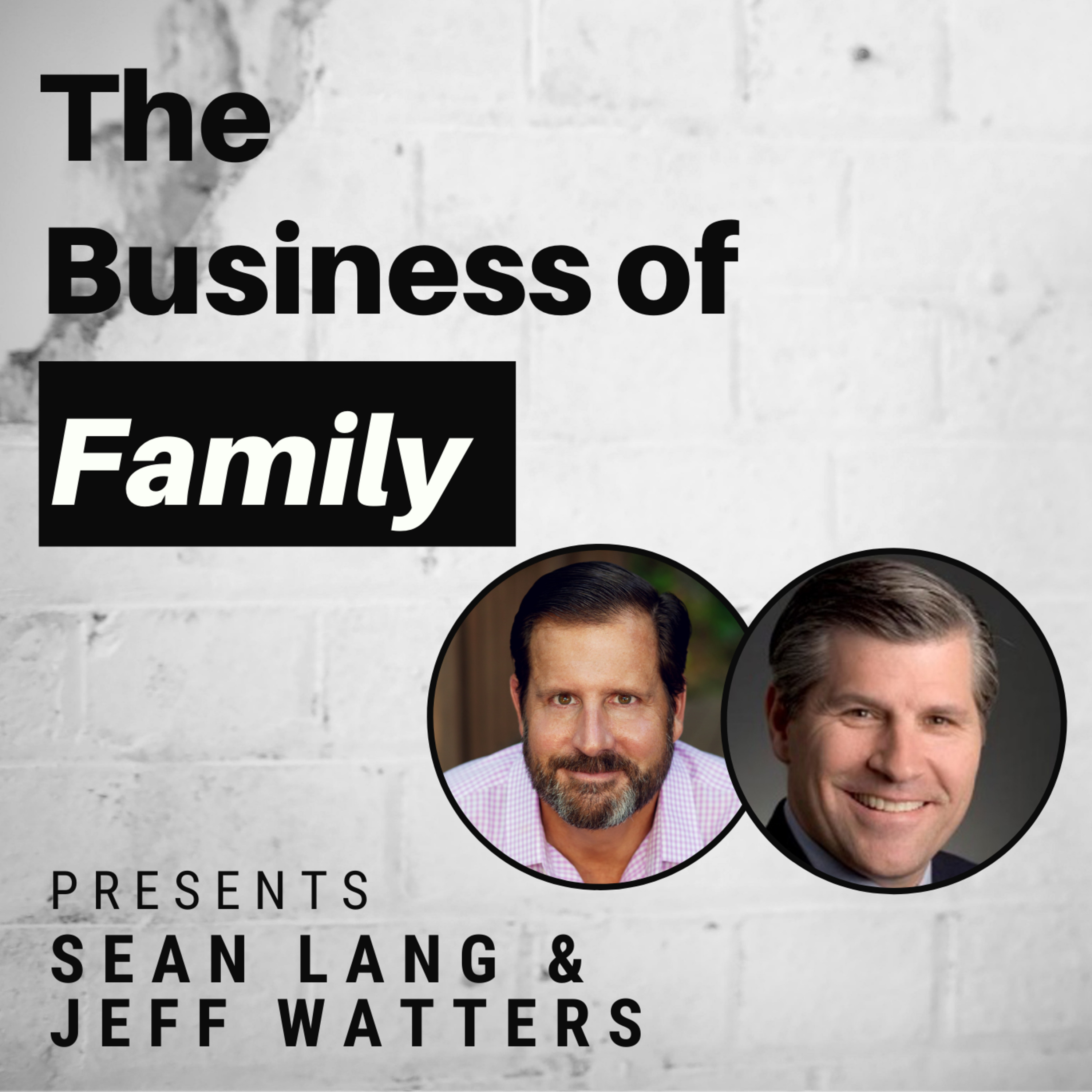
Episode 38 · Season 2
Appointing a Non-Family CEO & Selling a 5th Generation Business
Key ideas from this conversation
Close to three years of courtship and vetting, in both directions, before the first outside CEO in five generations joined.
If the chairman gave input inside the business, he emailed the CEO straight away with the subject line "swoop alert".
After the sale, the family office has about 70 relatives meeting every 18 months instead of every ten years.
Read the full show notesBio, standout quotes and the episode timeline
The Lang family recruited Jeff Watters as the first outside CEO to lead Ainsworth Pet Nutrition in it's 5 generations. Sean Lang and Jeff Watters worked together, partnering with a private equity firm to scale the $100m per year business into a $2 billion dollar exit over the space of a decade.
This story covers not only leadership succession within a family business but also ownership succession and how the family have stayed together and united around a family office in the absence of an operating company.
Standout Quotes:
- "What's gotten us here, isn't going to necessarily get us there" - [Sean]
- "As a family, we realized that we would have to make a pretty major change in the journey... And we made the choice to start that journey from family-owned and family-run, to family-owned and professionally-run" - [Sean]
- "I think in any family business, there's a certain level of distraction or disruption that comes from the family, and if you can move that into the family council and outside of the board room, it seems to be better for everybody" - [Jeff]
- "The family office is being driven by a stewardship theme; Leave it better than you found it" - [Sean]
Key Takeaways:
- Sean Lang and the Lang family represent a 5th generation business family who owned Ainsworth Pet Nutrition, while Jeff Watters is the first outside professional CEO recruited by the family to lead the business till it was finally sold.
- The business started small, with deliveries made to "mom and pop" stores, expanded over the years, and all interested family members worked in the factory. After school, Sean started as a sales manager and worked his way up to be president.
- The family realized that there was a need to make a major change to move with the competition and this would require great talent, moving from family-owned and family-run, to family-owned and professionally-run
- Although Jeff was in a place where he wanted more in his life personally and professionally, his relationship with Sean was initially not a professional one. Following further interaction, Jeff realized the family was committed to the business, and they were authentic and intentional about their growth.
- The average tenure of a Public Company CEO is about 4 years, and a Family Business CEO is about 6years, even if you think you're going to be there longer than that, you have to plan according to the statistics.
- The introduction of professional leadership after 5 generations took some time, however, this had been tried previously and even though it failed, the family had started to get used to the idea. The goal had become to keep the family culture but adopt the benefit of big company thinking and growth capabilities.
- The notion of an organic, natural but very transparent onboarding process is extremely helpful for professionals outside looking to join a family business.
- Jeff also encourages professionals considering entry into a family business. You just have to bet on yourself to a certain extent. Once you're satisfied that the other party has high integrity and will deliver on their promises, have the conviction that you're going to deliver on yours, and if it doesn't work out, it doesn't work out. There will be other opportunities.
- While Jeff's transition into the business had its hiccups, there was a lot of intentional effort from all sides to communicate effectively and create ways to tackle arising issues. This was made easier by the family culture of transitioning where the older generation completely let go of the business which allowed Sean to give Jeff the space needed.
- Working with a Private Equity Company was pivotal in driving the rapid growth of the company moving from a 200 million-dollar company to a 2 billion-dollar company in 4 years.
- Jeff describes that the main factor that drove growth while working with the PE Company, was a deep cultural alignment
- Between the family and the company. It was all about a long strategic view of the business.
- The family council was started by Sean's father, and one of the policies laid down was that incoming family members needed to work somewhere else for 2 years or until their first promotion whichever came later, before joining the business.
- In the absence of an operating company, Jeff wanted to still have a family enterprise that could act as glue for the family, and help be a driver for education for the rising generation. This would also foster the creation of mechanisms to share the family history and culture with coming generations.
- It's not always easy to leave it better than you found it, given the mathematical fact that families almost grow faster than businesses and assets, that means each family member needs to be self-sustaining and look at any help from the family later in life as icing on the cake, not the cake itself.
- Sean shares he now has more time for family and personal relaxation, while also finding businesses to invest in. Jeff also tries to have fun, works with his wife on philanthropic projects, and serves on a number of boards.
- Jeff's letter to his kids: Jeff tells them to be bold in the pursuit of what they love, hopefully, it will be something that allows them to leave this place a better place. He encourages them to take a leap of faith, the financial fortune is an opportunity for them to invest in their future in a way that can be fulfilling for them and differentiating for their community.
- Sean's letter to his kids: The family business cocktail of money, love, and power is trouble. It can rip families apart easily and needs to be proactively managed within the family with the help of professionals.
Episode Timeline:
- [00:52] Introducing today's guests, Sean Lang and Jeff Watters.
- [02:30] Sean shares the history of the family business.
- [08:00] What was the reason for bringing in outside leadership?
- [10:00] How Jeff got involved with the business.
- [15:18] Were there any surprises while bringing in the idea of getting professional leadership after 5 generations?
- [20:21] Jeff describes his transition into the role of CEO.
- [29:30] Discussing the growth of the business, involvement of a Private Equity, and the decision to exit rather than transition to a 6th generation.
- [42:02] When did the Family Council begin?
- [52:25] What was the transition like after the final decision to sell the company?
- [01:00:22] Before the company was sold, there were plans to continue the Family Council?
- [01:03:51] What Next?
- [01:06:00] In a letter to your children, what is one lesson or idea you don't think many parents would mention but you consider important to understand?
Links:
- L Catterton and the Lang Family to Sell Ainsworth Pet Nutrition to The J.M. Smucker Company
- The J. M. Smucker Company to Acquire Ainsworth Pet Nutrition, LLC, Maker of Rachael Ray™ Nutrish® Pet Food; Company to Explore Strategic Options for U.S. Baking Business
Read the transcript
This transcript was generated automatically and may contain errors, including in names. Listen to the episode for the exact words.
MikeWelcome to The Business of Family. I'm your host, Mike Boyd, and this is my look into the world of multi-generational wealth creation, family enterprise, stewardship, family office investing, and the curation of a legacy. On the podcast, I interview members of some of the world's most interesting families to hear how they pass knowledge, resources, values, and wealth to the next generation.
I hope you will enjoy sharing this learning journey with me and would greatly appreciate any feedback or referrals you have to offer. To sign up to my weekly Business of Family newsletter, go to businessoffamily.net forward slash newsletter. You're in for a real treat with this podcast today. Sean Lang and the Lang family represent a fifth generation business family who owned Ainsworth Pet Nutrition.
And Jeff Watters also joins us as the outside professional CEO that the family recruited to lead the business, the first outsider to lead the business in its five generations. Sean and Jeff worked together, ultimately partnered with private equity and took the business from $100 million a year to a $2 billion exit in the space of around a decade.
This is a fairytale ending success story of not only transitioning leadership, but also transitioning ownership in a really healthy and successful way. I hope you enjoy this story as much as I did. Sean and Jeff, it is absolutely fantastic to have you with us on the podcast. This one's been a long time in the making and I'm really excited about it. Thank you both for making the time today.
SeanYeah, good to be with you, Mike.
JeffYeah, thanks very much, Mike. Happy to be here.
MikeNow, this is a really interesting story of Ainsworth Pet Nutrition, a fifth generation family business that has not only brought in outside leadership in the CEO form, Jeff, and the role you've played, but also gone through a transaction with private equity involved and ultimately exited in a really successful way, which is not always the story we hear with PE. So I'm really excited to unpack all of this and learn how it played out. But Sean, I might defer to you first to tell us a little bit about the business and its history. How has it arrived at this point today and prospered through five generations before it was ultimately sold?
SeanYes. So we were manufacturers of dog food and cat food. And the business started my great-great grandfather in the early 30s. And it was kind of the beginning of dog food at all, because before that dog food didn't really exist. It was all table scraps. But 1933 was the same year that Walter Gaines started in the pet food business as well. So it was kind of the very beginning of pet food. We were based in Western Pennsylvania, a little town called Meadville, in between Erie and Pittsburgh, and delivered dog food directly to ma and pa stores and feed mills in the area and slowly grew the business that way. And it was all under a brand called Dads.
And it was just within 100 miles of Meadville that was being delivered. And that footprint slowly got larger and larger to a point where we were basically delivering Dads to about five states in the area. So a small regional brand with a nice share. The company continued to grow as the category grew. I worked in the business growing up, spent summers in the factory, stacking dog food and pushing meat into the meat grinder in the cannery and all those good things.
And everybody in the family that wanted to work in the business had to work there in the summers, and everybody did. And the business continued to grow, and we veered away from private label for many years. But around the late 90s, started to do some private label business selectively, which took us from more of that regional footprint to more of a national footprint, which set the table in terms of distribution-wise for us to launch a brand nationally, which we eventually did in 2008 with a brand called Nutrish by Rachael Ray.
And that was a project with Rachael Ray, who's a celebrity chef from the Food Network and syndicated talk show. And Rachel's very active in animal rescue and wanted to have an ongoing funding for animal rescue. And that really drove her interest in the project. And from 2008 to 2018, that brand continued to grow and grow and really transformed the business instead of that small regional brand into a high-end, upscale national brand.
MikeIt's an incredible growth story. And I just want to clarify, you were fifth generation growing up in this business. Is that right?
SeanThat's correct.
MikeAnd so when you first got involved in the business, what other family members or what other generations before you were still involved in the leadership of the business?
SeanSo while I was working summers, my grandfather and his brother, and the two of them really built the business. They're the ones that went from spending their evenings making dog food and delivering dog foods and having a real job during the day to going in it full time. But my grandfather was still there when I was working summers. And then when I came into the business after college and after going to New York City to be a banker for a few years.
So we had six partners. It was my father and I. And then on the other half of the family were my four cousins, which were the four of them are brothers. And they're actually my father's first cousins.
MikeInteresting. Okay. And then did you grow up into leadership roles with the company? What was your journey in growing up and moving towards the top of the business?
SeanWhen I came back from New York, I came in as a marketing analyst and then became a sales manager. And then I ran sales for a number of years and then stepped off the org chart for a while to head up our new ventures group to look at innovation and look at ways we could launch a higher-end brand and do a lot of research around that. I then headed up our national accounts group and became president and then president and CEO. And then we appointed our first non-family CEO, which is my friend on the podcast here with me, Jeff Watters.
and he took over in 2014.
MikeI'm really interested in bringing Jeff into this conversation. I want to hear this story. But before I do, just one final question, Sean. What was the impetus to bring in outside leadership? Did you go searching for it? Was it a need? Did you hit a growth ceiling? Was there a lack of skills or understanding in the next journey within the family?
Or was it always part of the plan? What drove that decision?
SeanWe brought in some outside help to facilitate us through strategic planning sessions and brought in some really impactful outsiders to talk to us about the changing landscape of retail and the consolidation of the retail merchandising functions. And through that process, I think we took a pretty dispassionate view of the fact set. And that was with the whole family. So all the shareholders and all the senior execs and quite an extensive planning process to look into the mirror and say, the dad's brand, it's driven the business, it's gotten us here, but what's gotten us here isn't going to necessarily get us there. And it was more of an opening price type brand.
And with the rising quality of private label brands, store brands, it was getting harder and harder to grow. And more and more of the growth of the whole category was on the upper end. We knew we needed to do something in there. I would say that as a family, we realized that we were going to have to make a pretty major change journey and that we were going to need some great talent to help us do what we needed to do. And we made the choice to start that journey from family owned and family run to family owned and professionally run.
MikeFantastic. So Jeff, from your perspective, how did you get involved in the business? And And when you ultimately did come on board, what was your mandate from the family to grow the business?
JeffWell, Mike, I was a longtime big company, Fortune 500 consumer packaged goods guy. I spent 20 years or so with the likes of Kraft, Heinz, Clorox, and then ultimately Del Monte. I was running as the senior most pet guy, the Del Monte Pet Products Division at that time, which is about a $2 billion business. So this was 2006, 2007, halfway through 2008.
And through that point, there were lots of great professional opportunities for me, but I also started to see the downsides associated with corporate America and the runway beginning to limit, the autonomy, the creativity, the entrepreneurialism, not what I had hoped for. And I was beginning to look for something more in my life, both professionally and personally, frankly.
At about that time, Sean and I had hooked up and become first professional colleagues, albeit rivals in the context of professional boards. And then ultimately over the course of several quarters, we became friendly. And I look back and I think it was a very organic and natural friendship, but I also think that there was real intentionality there on Sean's part and the family's part. And I look back at those surprise bump ups at Pittsburgh Steelers games that in retrospect, maybe weren't such surprises after all, at least for the Lang family. But yeah, I, you know, Sean caught me at a point.
In fact, the story goes, it's true that my wife and I and Sean's wife, Beth and Sean, and we're all in Cabo San Lucas together, literally in a hot tub overlooking the beautiful ocean. And Beth looked at the two of us who were having a great time on this little multi-day junket post one of those industry conferences and said, you know what?
Life is too short. You guys should really get together and make something of it professionally. and we kind of looked at each other quizzically. And I remember saying, whether I said it out loud or to myself, why would I ever join a much smaller organization when I'm sitting in my cushy corner suite overlooking the three rivers in Pittsburgh and these guys are up there in Meadville, who knows what they're up to.
But one thing led to another and sure enough, Sean and I think took that little kick in the tail from his wife Beth more seriously over the course of the intervening months. And to answer your final question, And by the time we started to engage in deeper conversations about the art of the possible, it was pretty clear to me that this was a business that the family was truly committed to transforming.
They had a remit for themselves and for the organization more broadly. I think, as Sean just suggested, they saw some gaps in terms of the skill sets, both kind of the hard technical skill sets and maybe the software required to drive a change journey like the one that Sean touched on. but they were committed to doing it. And I felt as though I had a remit from the family and the support of the family to do the things that had to happen to really fulfill the potential of this business over the course of five to 10 years. I also felt importantly, maybe most importantly, that this was a high integrity, very trustworthy, very real set of family members that I was
engaged in. At every turn, there was authenticity. I just felt comfortable with them. And I think More than anything, I placed a bet on the combination of the Lang family and to some extent myself and figured we would kind of work our way through the rest. And hopefully, all would go well by the time that five to 10-year run was over.
And as they say, the rest is history. It was a pretty good run.
MikeIt's a fantastic story. Go on, Sean, please.
SeanI had the good fortune of working with John Davis from the Family Studies Division of Harvard Business School. He's now heading up family studies at MIT, but he was HBS at the time. And he had some pretty powerful advice at the time, which was, you know, he would ask, how long do you want to be CEO of your family business?
And I had only, I'd probably been president for two or three years and CEO for a year. And I was convinced I wanted to do it until I died. and his point was, hey, listen, the average tenure of a public company CEO is about four years and family business CEO is about six and a half years. He said, so even if you think you're going to do it beyond that, great, but you absolutely have to plan according to the statistics because it's a big job and everyone gets burnt out. And if you're going to do succession planning the way it should be done. It's going to take you five years to align the family, find the person, onboard them, have them work their way up through a couple rungs of the business.
So it's going to take you five years. So it's time to get cracking. And although I didn't think I was going to get burnt out in six and a half years, I took his advice and started on that journey.
MikeIt's wonderful advice. The follow-up question I have for both of you, I guess from two different perspectives, is this question around culture and family dynamics. I mean, coming from corporate America into a fifth generation family business must be a little bit of a culture shock. And obviously, there's risk there as well in being able to assimilate into that. And then Sean, I guess, from your perspective, from the family's perspective, getting the collective family on board with the idea of professional leadership after five generations, you know, must have raised some questions internally, even if, you know, the vast majority were on board with the idea and wanting to drive growth. So just a broad question about
dynamics and culture. How did that play out? Were there some surprises along the way? What was that experience like?
SeanWell, I think creating the family alignment took some time, Although I would say that my cousin, who was CEO in between my father and I, paved the way to some degree by bringing in a high-level guy from a large competitor. And it kind of got the family used to it in some ways. It was incredibly disruptive, caused a lot of family strife.
But I think, and although that didn't ultimately work out, I think that scenario, I think that guy took a lot of the early arrows to kind of get the family starting to get used to it. And I think once the family met Jeff, I think it went a long way towards everyone being willing to lean in. Because the last thing we wanted to do is end up having a culture like Del Monte Foods, where Jeff was coming from.
It's just too big and, in our view, too slow. And we had some Del Monte folks in our company that would describe the culture to us. So we wanted to hold on to our family culture, but get the benefit of big company thinking and national brand development and growth capabilities. Yeah.
JeffAnd then, Mike, from my part, stepping back, I mean, I did have the benefit of probably close to 36 months worth of courtship and vetting with Sean and other members of the Lang family. So I felt as though there's probably been nobody in the world that's done that kind of due diligence, or certainly I hadn't in my career up until that point, right? You make professional calls on the basis of two or three touch points, and you're either a yay or a nay.
Sean and I spent a lot of time together. He was very deliberate and intentional in unpacking the facts set in a very candid way. I think the reality helped that I came from the industry, so he knew he couldn't bullshit me about the pros and cons associated with the business model at the time. But he was very straightforward with me, gave me an awful lot of time to wrap both my head and heart around what it was that he was proposing.
And beyond that, the other folks, in addition to Sean, that were making the promises were all the people with last name Lang that I'd had plenty of interactions with facilitated by Sean through that three-year journey. Beyond that, he exposed me to a lot of the senior level decision makers, not family members, but the talent that I'd be coming in and inheriting. So I had a pretty good sense of the legacy capabilities, which were rich for a company of that size and where both the people and process gaps might be. So I felt as though I was pretty eyes wide open. And I'd share maybe two perspectives related. One, for those of you that are listening in as family members, the notion of an organic, natural, but very transparent
onboarding process or even courtship then onboarding, I think is super helpful for people like me on the outside looking in of your business models. And then I will address those like me 10 years ago that are considering the leap into family businesses. In the end, I got myself comfortable not only with the Lang family and the opportunity, but I said, listen, you've got enough confidence in yourself, Jeff. You've got enough of a toolbox. What's the worst that can happen? Well, the worst that can happen is that we would part ways. I knew it would be amicable if we did, but I'd find another job. And so I've kept coming back throughout my career to the notion
that you just have to bet on yourself to a certain extent. Once you're satisfied that the other party is of high integrity and will deliver on their promises, have conviction that you're gonna be able to deliver on yours. And if it doesn't work out, it doesn't work out. There will be other opportunities for people like me or like you, whoever you might be listening in those podcasts, wondering whether a move from a corporate environment to a family environment is the right move for you.
I would say a wholehearted yes, given my data point of one.
MikeJeff, did you come in and step straight into the CEO role? What was the transition like? And I guess a follow-up to that is, did the family let go? Did Sean let go? Or did you have to sort of wrestle control and make your mark early on?
JeffYeah, so the first one's easy, Mike. The second question is, it'll take a while for us to unpack that one. That'll be a tag team. I'm looking at Sean here. I hope it's an appropriate question to ask. Yeah, I came in at essentially a lateral position to the one that I left at Del Monte. I recognized that it was a portfolio of responsibilities that though a lateral on paper was probably actually even a step back in terms of what I owned in that big corporate environment.
But you have such deep and wide bandwidth in corporate America like that, that I realized pretty quickly that portfolio A is not like portfolio B. it's a little bit of a mixing of metaphors. So I came in on a lateral, as Sean indicated, there was a real desire to kind of test the cultural fit. I think both kind of the EQ and the IQ, frankly, and I appreciated that. There was also checkpoints along the way where it became clear even before I joined that if I were to deliver against the remit, there was plenty of runway ahead for me professionally. And importantly, I was a big stakeholder, not only in the change journey intellectually and emotionally, but the Lang family took care of me in terms of an equity
stake. So I felt as though all things being equal, it was a very fair kind of entry in with a recognition that there would be more to come if I held up the promises that I had made at the outset. And then as far as your second question and the way that Sean and I engaged, I mean, I would say that the family was very humble, very self-aware of what was going on, that this new guy was coming in and there needed to be degrees of freedom afforded me to make the right calls, the tough calls on people and process, et cetera. Sean and I had weekly interactions. We had a weekly one-on-one and regardless of what swanky location he would be calling in from, I'd be up in Meadville,
Pennsylvania where it snows 365 days. Sean would be in Palm Beach or Nantucket or Vail or Yellowstone Club. But we'd always connect. And I always felt like I had his ear. We ultimately arrived at a shorthand for if he was going to dip into the organization and perhaps create a little bit of decision compression challenge for me, he would give me the heads up in advance. We came to some codes of conduct, for lack of a better term, some, it wasn't quite so fancy as a decision matrix, but we, you know, we stepped our way through scenarios that bothered me or bothered him in very transparent ways. And I think we arrived at agreements and language that allowed us moving forward to kind of shorthand our way through
what might've been some early days, you know, decision compression that created a little bit of dysfunction down through the ranks. And I think we quickly cleaned that up with the help with some thought partners that Sean will probably touch on here. But yeah, I think that when I compare the integration of me into this company to my onboarding in other roles where I'd already been in the company, whether it's Del Monte or Clorox or Heinz and had been promoted, this was more seamless than those were, interestingly enough. And yet there was so much more change for me to contend with and for the family to contend with. But I think it was brilliantly handled. And I think in part, and we'll probably come back to this theme too,
it's because the Lang family had done the heavy lift way in advance of my arrival and had begun to anticipate where those pain points might be. And they were really, as I said, self-aware and even proactive in helping to steer clear of most of those landmines. Not all of them. We had our bump ups for sure. And some of those were philosophical and strategic. Some of those were more process or procedure oriented.
But I think we found a way to work through them very productively. And it started with just ongoing, you know, grunt work-like connection on a weekly basis, just plowing through the hit list on his side and on my side. And inevitably what would rise out of that was, you know, kind of a shared commitment and conviction for the cause.
And occasionally, you know, the transparent reveal of a couple of, hey, by the way, this has been gnawing at me. Can we go here for a couple of minutes?
MikeIt sounds very, very healthy. Well done. Sean, do you want to add to that? I'd love to hear about the heavy lifting that the family did before Jeff's arrival too.
SeanYeah. In terms of staying out of Jeff's way, got two comments there. One would be that to the degree that I was able to do it, I think is due to our heritage, which has been when the older family members are in their mid-50s, they kind of throw the keys on the desk and say, call me if you need me to the next generation. I've come to realize how incredibly rare that is.
I think one of the most painful things in most family businesses, and I've seen this in hundreds of businesses in YPO, is where the senior family members are unable to let go. And it really creates a lot of distraction, dysfunction in the family and in the business. And I think we were very lucky from that standpoint that that's kind of how we were brought up.
So when it was my turn to do that with Jeff, I had a pretty good model for that. I also wouldn't recommend that you go from CEO to chairman without professional help. having a third-party thought leader that is used to transitions like that and facilitating two guys like Jeff and I into those new roles, giving clear guidelines for how decisions are going to get made and how vetoes, if any, that might come from the family are going to get handled. And it's a difficult shift to go from CEO to chairman. And you're still walking the halls, you're still running into all these people that you've worked with for many years. And you're getting a coffee in the morning and next thing you know, you're in a conversation about
our biggest customer and something that's going on there. And so if that happened and I broke our rules of engagement and gave that person some input about that biggest customer, then I'd have to send Jeff an email immediately that the subject line said swoop alert and then I would post him on that conversation and how I broke the rule of giving input to that person about an item that was going to get presented to that customer or whatever the case may be but that way he wasn't getting that way he wasn't getting broadsided.
MikeSwoop alert that's fantastic. One question now just because I'm sure lots of people in the audience are wondering, and please only answer as much as you're comfortable with. But a question about the compensation plan for Jeff and how the family considered it in bringing on outside expertise. Jeff briefly mentioned equity there before, and this is a business that's been within the family for five generations.
Was that a difficult conversation or did you create a sort of shadow equity type, you know, parallel profit share scenario or some other system?
SeanYes. I had created a phantom stock plan prior to Jeff coming in for a couple other senior key folks that were not in the family. And when Beth first suggested that Jeff and I figure out a way to work together, I kind of laughed it off in the hot tub, too, of, you know, we can't ever afford this guy.
He's making big bucks, and there's not an appropriate way to bring him into our comp structure. But the Phantom Stock did allow us to get creative in that department and give a lot of stock appreciation rights to Jeff as part of the package so that, at least on base comp, he wasn't so far out of whack with the whole business.
And I think that equity tool was a powerful component and really ended up delivering and rewarding Jeff for an amazingly job well done by he and his team.
MikeIt's fantastic. I want to get onto the business itself now because the journey of the business and its growth is also pretty amazing in my opinion. can we touch on the growth of the business under your dual leadership and the contribution you've made revenue wise headcount wise whatever you feel is most appropriate but then also where does private equity get involved and and where does this conversation about a potential exit rather than a transition to a sixth generation ultimately get contemplated
Seanyes uh so we continued to grow and I'm going to talk about the 10-year period between 2008 and 2018, where Jeff and I were leading the business together. We launched the Rachael Ray Nutrish brand at the beginning of that time frame. And it was one of those brand new brand, new concept, and was received with mixed reviews by retailers.
Some loved it, some didn't. So it was slow going to get it sold in. But lucky for us, Walmart took it right off the bat and did a pretty major launch with it. And that business, that brand continued to get traction. We knew we were in for five years of upfront investment where we weren't going to make any profit on the brand for those first five years. And so we just kept investing. It kept growing. And in the meantime, our co-munufacturer business, making other high-end brands and making store brands selectively for certain higher capability retailers, that business was very strong at the time, luckily for us. And it helped us to be able to invest in
the Rachael Ray brand. The business continued to grow. I would say that from a product concentration and customer concentration standpoint, it bothered me. Back to the old Jim Collins adage of your number one job as CEO is to make sure that the ship can't take a hit below the waterline. And in my mind, if for some reason we had to recall an item that was on the wrong product and the wrong customer at the wrong time, that our balance sheet may or may not be able to handle it.
And one thing you learn the hard way about a business that's growing 40% a year is it doesn't really generate a lot of cash. it all gets sucked up quickly by capital investment and inventory and working capital, all those good things. So I started to consider bringing in a financial partner. I had talked to a lot of private equity firms, but we had not talked to L Catterton yet. And when we met with L Catterton, we were very, very impressed with their intimate knowledge of manufacturing, of the retail landscape because Pet Food had a lot of channel-specific brands.
And so they're pretty complex retail landscape. And they really understood that. And they really understood the consumer and the nuances of the brands that made the category tick. So they were pretty impressive guys. They had some success in pet already. and so we ended up bringing them in for a third of the business and it allowed us to do some other things that we'd been wanting to do which was bring some outsiders onto our board some independent parties onto our board of directors and separate the family council from the company board which proved to be, I think, a great thing for the business and the family because there's, I think in any family business, there's a certain level of distraction and disruption
that comes from the family. And if you can move that into the family council and outside the boardroom, it seems to be better for everybody. And it certainly served us well. In terms of size, So the company was roughly $200 million when Catterton came in in 2014. And we ultimately sold for 10 times that four years later.
Catterton came in and helped what already was a very capable team, helped us even upgrade that team further and really allow us to lean into the business much harder than we would have without them. Heavy, heavy investment in marketing, even though we already thought we were investing very heavily. They would ask the question, well, Jeff's team would come in with a base case marketing, an aggressive case, and they would say, hey, what if we double the aggressive case? And so it was leaning into the business more than we would have done on our own. They were able to help us improve manufacturing costs dramatically.
And also investments in the business and cleaning up outside shareholders and some of our subsidiaries. They took what was a young growing brand and really poured gasoline on it.
MikeIt certainly sounds like a rocket ship with the growth. I can't wait to unpack this a bit further. I'm curious, just one very quick follow-up, Sean. Did the family take any cash off the table with that transaction or was that a purely financial investment into the growth of the business when they took a third share?
SeanSo that was two-thirds cash into the business and one-third cash to the family. So we took some out. And Catterton was really the only private equity partner we'd ever talked to, which was willing to have a board philosophy of build a great company for the long term and run the company debt-free. So those weren't two things we had heard before.
MikeAnd in a minority position too, which I think is rare.
SeanYep, absolutely.
MikeJeff, what was your experience like working with PE? Had you worked with PE before or was this a learning curve for you as well? And I mean, that growth is just incredible.
JeffRight. So yeah, just to put the icing on the growth cake. So to Sean's point, we had exited that 10-year period having put a 5x on the revenue line for all intents and purposes over a 10-year horizon. And adjusted EBITDA grew probably closer to 10 to 12x over that horizon as a result of portfolio mix shift to this more high margin, super premium business that we had launched in the form of Rachael Ray Nutrish back in 2008.
So just incredible. And to answer your question, this was my first experience with working for and with private equity. I had actually had a couple of interactions with Catterton back in an earlier stage of my career and met a couple of the key principles that ultimately and coincidentally joined our board. So kind of a small world. one of the things that Sean alluded to towards the end in his description of that relationship, which I think was key. I don't think any of the hard metrics would have mattered. I don't think the growth capital would have mattered. I don't think their differentiating technical value add would have mattered as much or enough if they hadn't been in such deep cultural alignment with
the family and the company. It was all about a long strategic view of the business. They walked that talk from day one. And it was, I think, one of the key differentiators for a super strong relationship was the notion that we're all in this together and let's build this for the next 75 years, knowing full well that there was probably going to be a monetizing horizon, at least for them. But they wanted to leave a real marker down in terms of a really successful pet sector investment. And they did it with very little of the traditional barbarians at the gate, private equity, value and cost engineering. It was all about building a better business model
in a way that was very much culturally in keeping with the way the Lang family had built dads and then Ainsworth for the previous 75 years. So a really terrific run. I would partner up with those guys in a minute. But I applaud the Langs for having done really good work on the cultural fit front. That tends to be softer and you get wooed by the shiny object that is the growth capital and the ability to monetize. But they really stepped back, they being the Lang family, and thought deeply about what the right partner profile would look like vis-a-vis the integration into the family, the broader family, not just the Lang family, but the Ainsworth family.
Will these guys fit our operating culture, our mores, our values? And they did to a T. I mean, we were beyond fortunate. It was a heck of a, well, hell, it was less than five years when all was said and done. They came in in May of 2014, and we exited via a Smucker acquisition of the business in roughly May of 2018.
Right, Sean? I think I have those dates, right?
SeanThat's right.
MikeIt's a wonderful success story. We don't hear enough of these.
SeanYeah. From the time we launched Rachael Ray Nutrish, it would have been 20X from 2008.
MikeJust amazing. And so when you first engaged PE, was an exit on the horizon or did they put it on the horizon? I mean, naturally getting involved with private equity, I would imagine this is bound to be a conversation about how they're ultimately going to get their return. But was the family already contemplating that or was it all about growth, knowing that you still owned the majority share of the business, I think is interesting too. How did those discussions or decisions play out? Was it partnered with PE knowing that we were heading for an exit or was it partnered with PE to get to the next level and then decide?
SeanI think it was partnered with PE to get to the next level and then decide. Although I wanted to socialize in the family to make sure everyone understood that a full exit was squarely on the table and that if you couldn't accept that, that we shouldn't bring in the Capitol, not knowing what form an exit would come in. So that was a lot of discussion.
And I would say that Catterton was very respectful of the family's priorities and really trying to understand what we wanted to do and whether that was continue with the business and how we wanted the legacy of the business, what we wanted that to look like. Did we want to take it public so that Ainsworth was still out there and on the stock market and still out there as a big name in pet food or was rolling up with a strategic company okay. And I would say that the family's number one concern was the extended Ainsworth family. All the family members that we'd been working with for so long, the 700 people at Ainsworth, making sure that they were in a position where
we were putting the business in a position where we felt it had the best chance of success was our biggest concern.
MikeAnd I think it's really important what you mentioned earlier, the separation of the family council and the corporate board. I imagine that these types of discussions were considered at the family council first and then at the corporate level. Is that a fair?
SeanAbsolutely. Yes.
MikeAnd when did the family council begin? When did the family actually form a formal governance process. Was that prior to your generation or it was something that you had driven as well within the fifth generation?
SeanIt was prior to my generation. I believe my father kicked off the family council probably in the late 90s. And we didn't use it that extensively. It was more of an annual meeting with the shareholders. But it set the table. in a nice way. And it's a great place to discuss family policy on incoming family. We had decided that incoming family members needed to go work somewhere else for two years or until their first promotion, whichever comes last, before they come into the business.
And so that's where guidelines like that were hatched in that early family council.
MikeAnd you mentioned, just back to the exit, you mentioned a strategic. Was there ever an ongoing public? Was there ever a complete financial exit considered to the likes of PE or someone else as a financial buyer? Or was it all about preserving the capital in the brand and the wider Ainsworth family, as you said? Was it always going to be strategic or public?
SeanI think we, just from understanding the marketplace of buyers, we felt like it was going to be either a strategic or a player that was either going to be a strategic pet player or a big food company that wanted to get into pet because pet continued to outperform all the other categories in the store. And so at the time, there were big businesses like General Mills looking for their entry into pet food. So we felt like it was going to be them or a strategic buyer.
And we started to have some inbound interest and that kind of kicked off the process for us.
MikeI'd love to hear about that process from one or either of you. Did you run a formal campaign to shop the business? Did you appoint bankers or did Catterton lead? How did all of that come together and ultimately lead to the strategic exit to Smucker?
SeanYeah, Catterton recommended two banks. And so representatives from the family, plus Catterton went and interviewed those banks and listened to their pitches for running a process and what they thought that would look like. We ended up hiring Goldman Sachs to do it. And they ran a formal process that I would say was fairly targeted. We wanted it to be quiet and reach out to a short list of potential buyers that we saw, that Catterton saw, and that Goldman saw.
MikeJeff, what was that experience like for you? were you involved in the process that was run and how intense was it?
JeffYes. So I was, Mike. I was deeply involved. I was part of that auditioning, if you will, the capability presentations that Sean alluded to. In fact, there's a photo behind me on the wall of Sean and his dad, Tommy, and I coming back on the company plane from a whirlwind tour with a couple of those bankers and big smiles on our face knowing that we're now in go time.
And I would say, before I get to the heart of your question, we also were pretty deliberate about keeping open the IPO options. So we were beginning a lot of the work for dual track readiness. We had brought PWC, our accountant, in to help identify what aspects of the organizational structure would need to be fortified. So general counsel, audit, we were in the process of beginning to at least preliminarily market for new recruits in those positions.
And I think the intent was genuine. If we didn't feel like there was a valuation to be had in that more narrow strategic exercise, we were prepared to at least consider going public given the multiple premiums that the public markets were paying for pet sector properties for the reasons that Sean has touched upon earlier. I also think that there was some important symbolic leverage that we could sort of through the whisper campaign signal to those shortlist strategic types that, oh, they're not just pretending to go IPO.
They're actually organizing around the possibility of going IPO at some point downstream. We ended up making the right decision in our collective estimation. And I think the valuation was a fair one and a good one for both parties. So everything went to the final stage and all was good. But to answer your original question, it was a ton of work. I mean, it was essentially a second job for my management team and I to get ourselves ready working daily, literally daily with the Goldman team, oftentimes face-to-face, sometimes on big video screens.
But we spent a lot of time in their lower Manhattan offices, wargaming out the very best way to tell a then roughly 85-year-old story, right? And make it compelling and contemporary, but also honor and celebrate the important through lines culturally that we all represented in the modern era. So it was a real effort. I would describe it.
In fact, we ended up putting this all together in the form of a Northwestern Kellogg School of Business case study. And I described this component of our work as one of the most challenging exercises of my life, both intellectually and emotionally. And you can appreciate the emotional component of that. But intellectually, unpacking this story in language that would resonate with really smart by-side strategics that were paid to be cynical, skeptical, and probing. It was an interesting exercise. It was a three or four-month process.
there were probably only 10 people beyond the board in the entire company of roughly at that point, close to a thousand that knew that there was any exercise underway. And it was frankly, and Sean can comment on it, but at least in my 10 years at the company, we had never really differentiated ourselves as a place that kept secrets well. That one we kept super well and never did it get out. In fact, one of the more difficult days of my career was literally ripping the white tablecloth off of the Smucker portfolio of products next to ours in a massive meeting room and announcing to the Legacy Ainsworth folks that we had just been acquired by
Smucker. And people in the room were absolutely shocked. And it took a while for shock to turn into frustration, some anger, the typical journey to ultimately satisfaction and excitement with what next was going to look like. But yeah, that was quite a run. And I'd say probably end to end, heavy lifting for four months or so. And then a lot of show and tell for my leadership team and me interacting with our equivalents on the other side of the desk with four or five, six other companies and multiple steps in each of those interactions.
and a lot of jockeying and maneuvering and positioning of both our business to them and them back to us. It was quite a ride, but it was in the end a successful and productive one. And I certainly learned a lot about our business, frankly. I thought I knew everything about the business. It's not until you're staring down the barrel of your counterpart that's been in pet for as long as you have with probing questions that you're tested on just how much content mastery you own.
MikeIt certainly does sound like a ride. And I mean, it's a fairytale ending, if I can call it that, from what was approximately $100 million to approximately $2 billion exit. In really not that long a time period, it's just incredible. So congratulations to both of you and the Lang family. I want to come back to Smucker. How did they ultimately take number one position? How did you choose or how did they win the bid, whichever it was? How did they come out on top and ultimately clinch the deal to buy the company?
SeanI had reached out to Mark Smucker. We had met 20 years earlier, briefly at a Wegmans event. But I had reached back out when they bought Big Heart Pet to kind of welcome him to the category and reconnect. And we really hit it off and ended up spending some time together once or twice a year for the following two or three years. I felt like it was probably of all the strategic buyers that we were probably the best fit for them in terms of a brand portfolio. And the more I got to know him, it seemed like a better and better fit in terms of family culture and company culture. He's the same age as I am. He's fifth generation. And
so we had a lot of similar stories and challenges. And I spent some time down on their campus at Smucker in Orrville, Ohio, and was really impressed by what I was seeing down there. So I would say that as we went into the process, they were probably our favorite. There were, you know, at times during the process that Goldman was running that we really thought it could have gone another way.
But in the end, it felt like the best fit.
MikeAnd what was the transition like, ultimately? I mean, this is a business that's been in the family for five generations. Sean, did you step away from the business at the time of the exit and other family members? Was there anyone else still in operational roles? Jeff, were you retained in the CEO role leading the business? Or did they want to bring in their own leadership?
What played out when ultimately you got pen to paper?
SeanWell, selling the business was extremely bittersweet. Just a really heavy, heavy time for everybody in our business across the extended Ainsworth family. It was very difficult. We knew from a business asset standpoint, it was time, it was the right thing to do, but it's still a very difficult thing to do. I told Mark Smucker early in the process that I was not going to stick around, and the same went for the rest of the shareholders.
Jeff had been running the business for four years already, so that was easy. And so we stepped away completely after the sale. And Jeff and his team stayed on for a while. Let him talk about that a little bit.
JeffThat's right. So, Sean and Mike, we ended up, first of all, having the good fortune of finding productive roles for a very high percent of Ainsworth legacy employees. In fact, I think it was something on the order of magnitude of 75% of legacy Ainsworth folks were at least given an offer. Now, they might not have all accepted.
In fact, they didn't, but a bunch did. And so we had a nice transition and cultural integration opportunity there. My leadership team and I were asked to stick around at least through the end of that year. So deal closed in May of 2018. Over the course of the intervening few months, a few of my senior executives that were perceived to be a bit more redundant were phased out and they were just happy to be on their way.
They had Life 2.0 staring them in the face, and they were looking forward to getting after it. I ended up sticking around through the end of December and then came back on a consulting retainer several quarters thereafter to help onboard, or in this case, he was inside the company, but bring a new pet president into the C-suite on behalf of Smucker and helped him get indoctrinated into the language that is the pet sector and helped get him grounded in this new portfolio that he's just come into in the form of Ainsworth, let alone the legacy Smucker pet portfolio, which was already a beast at $3 billion plus. So I've had, I guess, over the course of the
last two and a half, three years, a lot of time via transition, either as an employee of the company through the end of 2018 or thereafter as a strategic consultant to the C-suite, for lack of a better term. So I've had the good fortune of spending a lot of time with the Mark Smuckers of the world, gotten friendly with Mark's uncle and father and some of the other senior leaders there. I have a really good relationship. I feel as though we've got a vested interest in seeing this acquisition work hard for them, in part because we like the Smucker family, both the capital F and small f, And in part because we have a whole bunch of former legacy Ainsworth folks there, and we want to see those people flourish.
So it's been, I think, a really good relationship for all the reasons that Sean called out at the outset. Had we had our druthers, we would have bet on Smucker to win it. We needed to be dispassionate through the process. But fortunately, that's the way this thing ended up bouncing. And I think it was the very best outcome it could have been for both the business and, importantly, the people.
And I think that the story is obviously still unfolding there. And Sean and I have audiences with key decision makers, and we continue to remind them that Rachael Ray Nutrish should be job number one. All the other opportunities in your portfolio should take a distant backseat. Sometimes we break through and sometimes not so much, but we're still doing what we can to shill on behalf of the Ainsworth Legacy Portfolio.
SeanIt was also pretty compelling to us that Smuckers has a big food business with their jams and jellies and at the time baking products, big coffee business, big pet business. And with the addition of Ainsworth, it was going to make the pet division their largest division and Rachael Ray Nutrish be the largest brand within that division. So having that kind of priority spotlight on our baby, we really liked that and what it meant for the extended Ainsworth family.
MikeMakes it a pretty substantial acquisition for Smucker then by the sounds of it. And now motivated to see it through. That's excellent. Jeff, one question just back on mechanics. Were you tied to the deal with golden handcuffs to stick around for a certain period of time to ensure a smooth transition for both family businesses, one into the other?
JeffSo with respect to Ainsworth, I monetized alongside the owners. So technically, no, but Smucker had stepped in in advance of deal close. And that's where the handcuffs were applied. but it was a different set of handcuffs. The handcuffs, there was a transition services agreement and they made it financially compelling for me to stick around for another six to eight months.
And the work was gonna be value added and I was absolutely keen on making sure that that business, which was gonna be the centerpiece of their newfound pet portfolio, was gonna get its just desserts and that the people were gonna end up from Ainsworth getting the right positions given their skillset and talent. So, yeah, so that's kind of how that played out.
MikeExcellent. Thank you. And Sean, I'm curious now, just on the ownership side of things, earlier you said that Catterton came in for a third of the business, I think you said. The family still owned majority. Is that the shareholding upon exit or were there further changes before you actually ultimately got to that point?
SeanAbout a year before the exit, Catterton increased their stake from roughly 33% to 41% about a year before the exit.
MikeSo you still went to exit as the majority shareholders and ultimately had decision-making power as to if to exit and to whom? Or was Catterton really influential in that process?
SeanI thought Catterton was incredibly considerate of the family's wishes in that department. We didn't vote along shareholder lines at any point in the whole partnership. We had a board philosophy that Catterton asked for, which was that we would agree to agree. and they were incredibly considerate of the family's desires in terms of how the business would get sold and to whom.
MikeAnd what did the post-sale or the financial exit really mean for the family? I think you mentioned earlier there was six or seven shareholders within the family of varying generations. when you achieved the exit, you stepped back fairly immediately. I think the other shareholders did too. Was that the end of the story for the family enterprise or had things been put in place to continue the family council legacy and perhaps transition into a family office or some other management structure?
SeanSo there were some younger family members that were not shareholders that stayed on with the business for a while, some six months, some a year, some a couple years. Prior to the exit, probably two years prior, I had begun to create a family office and start the basics of the family office in that I really wanted to have, in the absence of an operating company still have a family enterprise that could act as glue for the family and help also be a driver of education for the rising generation on financial literacy, philanthropy. And as time would go on and we'd get further away from the wealth creation, that we'd have mechanisms in place to talk about the family story and the way we roll as a family and try to pass that
down to the next generations.
MikeThat's something I'm particularly passionate about, the storytelling and particularly generational storytelling and keeping the stories alive for the next gen. And as you say, the way we roll, celebrating the family's unique culture and and differentness. How does that storytelling evolve for you now as a family enterprise without the single generational asset at the heart of it? Having sold the family business, and perhaps it's too early to ask this question, but is the family enterprise or the family office working as you had envisaged in being the glue that keeps the family together or brings the family back together on a regular interval?
SeanWell, it is still early days, but it has created a new practice in the family where all 70 of us are getting together every 18 months instead of every 10 years because it's being driven by the family office and making sure that it happens and putting educational programming into the fun activities as well. The family office is really driven by a stewardship theme of leave it better than you found it. And that includes the family enterprise. Our family gathering shirts say, leave it better than you found it underneath the picture of my grandfather and his brother, the colonel. And it's not always easy to leave it better than you found it given the mathematical fact that families almost grow faster than
businesses and assets. And so that means each family member needs to be self-sustaining and look at any help from the family later in life as icing on the cake and not the cake itself.
MikeA fun follow-up question for both of you, if you'll indulge me. What's next?
SeanWell, for me, Mike, I'm now an amateur investor and trying to make the world a little bit better with our foundation. I'm continuing to look at other businesses to invest in. And it's very difficult to have the discipline to remain on the sidelines and not jump back in. But I've just absolutely loved getting my calendar back for the first time in 25 years. And that's been a real gift so I can be present with my kids and be around more for them and spend more time with my family. It's really been terrific and some extra time for snowboarding and hydrofoiling as well.
MikeHydrofoiling. Good fun. What about you, Jeff? What's next?
JeffYeah, the hydrofoiling is a little sexier than my answer, Mike. But so I'm trying to take my shitty golf game to just horrible. That would be a nice start. I'm also spending a fair amount of time working with my wife on some philanthropic work in the, let's call it the ESG and sustainability realm. And I'm also at this point serving on three boards.
A couple of them are for-profit boards. And then the other is actually my local school board where I've served for now going on seven years and an opportunity to pay it forward and give of myself in ways that when Sean had me nose to grindstone, I just really wasn't able to contribute in a meaningful way in that kind of sphere.
So a lot of fun. I don't think I see myself diving back in an all-consuming operating capacity anytime soon. But if my buddy Sean taps me, it'll be difficult to say no.
MikeWell, congratulations to you both. Well-earned success. Gents, it's time now for our final question. And it's a question that I ask every guest. Imagine you're writing a letter to your children. What is one lesson or idea that you don't think many parents would mention, but you consider important to understand? Jeff, I'll let you go first.
JeffSo, Mike, I think it would have to be around the concept of wanting them to be bold in the pursuit of what they love. Hopefully, what they love will be something that allows them to leave this place a better place, much like the old Lang family adage. And attached to that, the notion that through my good fortune of being associated with the Langs, we have now the financial wherewithal to allow them, my kids, the next generation or generations to dream a little bit more creatively, a bit bolder, a bit bigger, take a leap of faith, look at this financial windfall as a springboard in the glass half full parlance or perhaps a safety net.
if your pursuit of your dreams doesn't go the way you wanted it the first time around. So we continue to impart upon our kids that they're not going to turn into trust fund babies by any stretch of the imagination. But the flip side, I don't want to be too rigid. I want them to see that this is actually an opportunity for us and for them to invest in their future in a way that can be really fulfilling for them and hopefully differentiating for the community and the world in which they live.
And I'm hoping that they place a really big bet on themselves, just like I did when I joined the Ainsworth Pet Nutrition team about a decade ago.
MikeBeautiful answer. Thanks, Jeff. How about you, Sean?
SeanWell, in addition to the leave it better than you found it rule, I would want to impress upon them that the family business cocktail of money, love, and power is trouble with those three components. It can rip apart families so easily, and I've seen it over and over again. I think that mix of money, love, and power needs proactively managed within the family with the help of professionals.
MikeExcellent lessons. Gentlemen, this has been so, so enjoyable. I've greatly enjoyed hearing these stories. I wish we could go on for hours, but I appreciate the valuable time you've already carved out for me. Thank you again for being here and so generously sharing your wonderful success story. Congratulations again on the journey.
SeanThanks, Mike.
JeffThanks very much, Mike.
Mikeand then one email per week. You can also follow me on Twitter using at Mike Boyd. If you enjoyed the show, please tell a friend or leave a quick review on iTunes, which will help more people discover the business of family. Thank you so much for listening.
Keep listening
If this one landed, start here next.

7th Gen Hollingsworth & Vose - Manufacturing Innovation Since 1728
A seventh-generation company that alternates family and outside CEOs.

Billionaire Diamond Owner & 4th Generation Co-Guardian
Brothers who govern while professional managers run the business.

Increase the Value and Maintain the Values
A succession roadmap, and a next role for the outgoing leader.
The Business Family Diagnostic · Succession
Choosing a leader from outside the family is one of the hardest calls a business family makes.
The Lang family made it, and then a harder one. Has yours agreed how the next leader will be chosen, before it has to?
“The family has talked openly about when leadership will pass on.”

Every family wishes someone had recorded the generation before.
I built Enduring Stories to do it for yours: a guided voice conversation, from home, that keeps your family's voices, values and history.
The newsletter
The most useful things in these conversations are the things families rarely say out loud.
I share them in my newsletter once a week. Sign up to receive the ideas directly and start building the foundations for your family today.