Episode 21 · Season 1
7th Gen Hollingsworth & Vose - Manufacturing Innovation Since 1728
Key ideas from this conversation
The mantra: the best product in the market today, a better one with customers, and a still better one on the bench.
Family members who work in the business go the extra mile, an unwritten ethic the board is now writing down.
Most of the good work is done by people outside the family. The family's job is to set the tone that attracts them.
Read the full show notesBio, standout quotes and the episode timeline
It's not often we get to hear from a 7th generation American manufacturing family with a company that dates back to 1728 and in their family since 1793. The Hollingsworth & Vose Company is a technical manufacturer with a rich history of R&D and innovation.
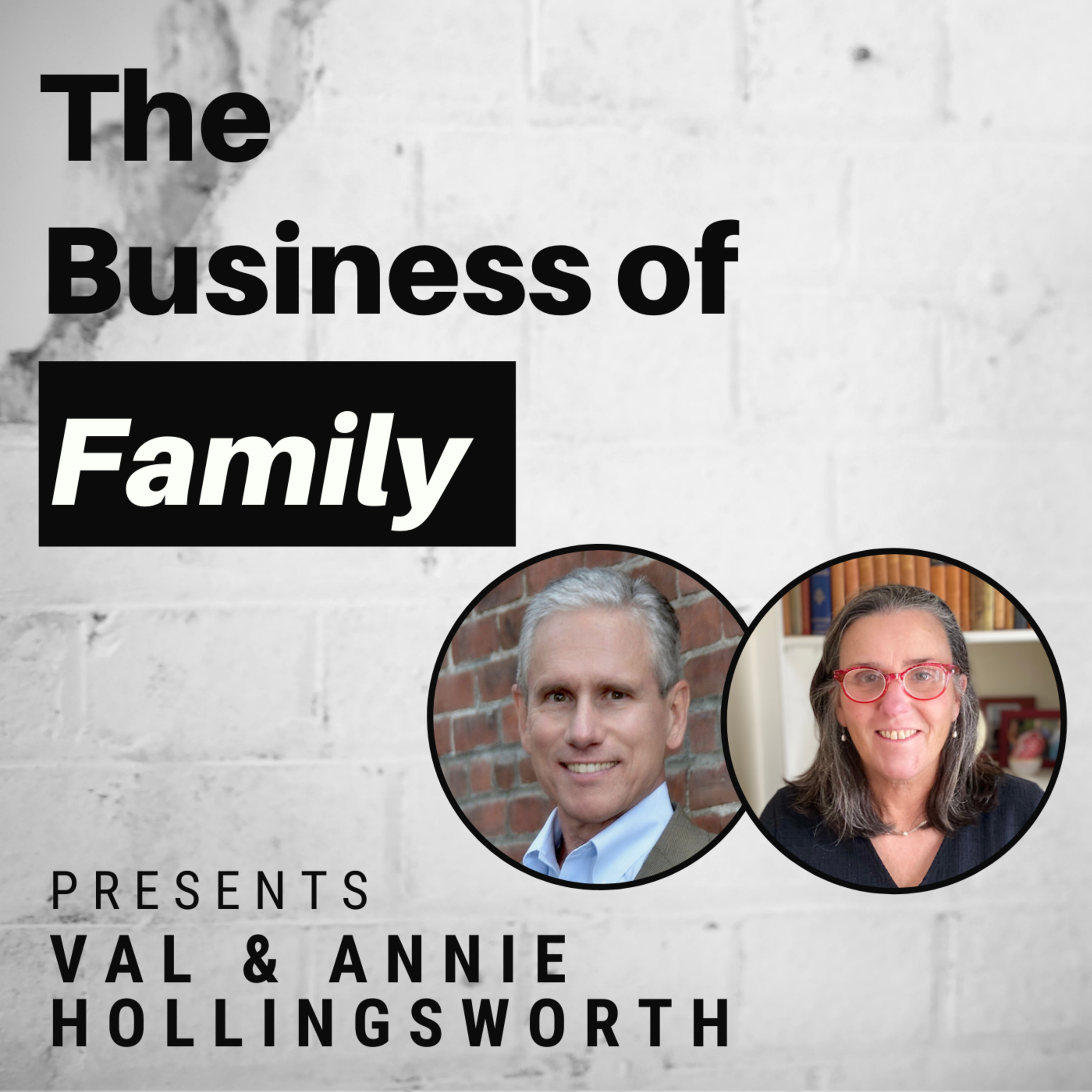
Here to share their story with us are Val & Annie Hollingsworth, first cousins and both members of the 6th generation, stewarding this incredible and impactful company to the next generation.
Val Hollingsworth has served as President of Hollingsworth & Vose Company since January 1997, and added the title of Chief Executive Officer in January 1998. He began in operations, working as a Shift Supervisor and as a Production Manager, then held a series of manufacturing, sales, and marketing positions. He served as Mill Manager of our West Groton Mill and General Manager of the Battery Separator Business Unit. While the majority of his career has been at H&V, he also spent two years in the Investment Banking Division at Lehman Brothers in New York. Val earned a BA from the University of Pennsylvania, and an MBA from Dartmouth's Tuck School of Business.
Annie Hollingsworth was elected to the H&V Board of Directors in 1997. She currently serves on the Nominating & Governance and the Executive Compensation committees of the Board. Prior to joining the Board, Annie worked at H&V starting in 1984. She held several positions in Sales and Marketing including Product Manager, Battery Separator and Marketing Manager, Nonwovens. She was instrumental in getting H&V into the battery separator business. Annie’s father, Mark was the CEO of H&V from 1963 – 1983.
Standout Quotes:
- "Our company's history has been one of finding new and more technically oriented products in order to replace products that are maturing and obsolescing… Because the family had so much invested in this, we couldn't take the risk of being obsolete" - [Val Hollingsworth]
- "If you're trying to optimize profitability, which we all are, how do you start to invest in things that may cannibalize an already existing product?" - [Val Hollingsworth]
- "If we could be a good company.... that would attract good people, those good people would do good work" - [Val Hollingsworth]
- "Ultimately, you have to trust other people to become the real experts and get in-depth, so it's more a matter of helping find and develop the right people and giving them what they need" - [Val Hollingsworth]
- "There has always been an unwritten ethic of having to go the extra mile if you're from the family and you're in the business" - [Val Hollingsworth]
- "If the family can contribute in helping set the right tone, and helping nurture the sense of purpose and values that are relevant, both for the family and ultimately for the company… that's invaluable in creating the atmosphere and dynamic that attracts good people" - [Val Hollingsworth]
- "Be a good steward, Don't take it for granted" - [Val Hollingsworth]
Key Takeaways:
- Annie highlights that the company's resilience over the decades comes from a strong focus on customer relationships as well as Research and Development.
- Val notes a conscious intent in the company from the beginning to continually reinvest, describing some of the intricate planning involved in the company's production line.
- The business tries to keep up with a mantra of having the best product in the market, a better one in customer evaluation, and an even better one in the labs.
- Val also describes the role of the workers in building the company's resilience, stressing the importance of having and keeping good people.
- Trusting the employees plays a vital role in creating a balance for Annie and Val, between having knowledge of the technical expertise required in the family business and the job of stewardship.
- Unlike Annie's Father who had to step up to the needs of the company without having much of a choice, Val and Annie were not under any pressure and joined purely out of interest.
- The challenge for the older generation (6th generation) is to be open to change, to understand the important things that can make the company relevant to the next generation, and to know how to communicate with them.
- Annie shares that she would encourage her kids to pursue their passion, as there are many ways to be a good family member or stockholder, but to ensure they continue to honor the company.
- Val points out that with good stewardship, the family business could give meaningful contribution to the world.
Episode Timeline:
- [00:49] Meet Val and Annie Hollingsworth, as they share the early origins of their family business dating back to the late 1700s
- [07:17] What is it about this company that has allowed it to remain so resilient for so many years?
- [14:55] Val points out that the business also has multiple generations of employees
- [16:42] Can you share some of the more notable products that the company is known for manufacturing today?
- [22:14] Annie and Val each highlight events leading up to their entrance into the company and the journey so far.
- [29:35] How do you balance understanding the depth of the technical expertise in the business with your stewardship role as a family member?
- [33:33] Some of the strategies employed in keeping all the various stakeholders up to date with happenings in the business
- [39:04] The business has an associate development program that exposes workers to the different areas of the business so that they can make a good match.
- [43:38] Val describes the role of non-family members in the success of the overall business.
- [46:30] How does the governance side of the family business work?
- [54:24] Does the family do anything to ensure that the business's history is documented over time?
- [55:50] The future of Hollingsworth and Vose.
- [59:44] Annie's letter to her children
- [01:00:40] Val's letter to his children
Links:
- H&V - Hollingsworth & Vose : Hollingsworth & Vose Company (H&V) is a global manufacturer of nonwoven materials and engineered papers used in filtration, energy, and industrial applications. The firm is a privately held business founded in 1843; its headquarters are in East Walpole, Massachusetts, USA.
Read the transcript
This transcript was generated automatically and may contain errors, including in names. Listen to the episode for the exact words.
MikeWelcome to The Business of Family. I'm your host, Mike Boyd, and this is my look into the world of multi-generational wealth creation, family enterprise, stewardship, family office investing, and the curation of a legacy. On the podcast, I interview members of some of the world's most interesting families to hear how they pass knowledge, resources, values, and wealth to the next generation.
I hope you'll enjoy sharing this learning journey with me and would greatly appreciate any feedback, resources, or referrals you have to offer. To sign up to my weekly business of family newsletter, go to newsletter.mikeboyd.com.au. We are so fortunate to hear the story which will unfold over the next hour or so. It's not often that we hear from a seventh generation American manufacturing family with a company that dates back to 1728 and in their family since 1793.
The Hollingsworth and Vose Company is a technical manufacturer with a rich history of R&D and innovation. Here to share the story with us, Val and Annie Hollingsworth, first cousins and both members of the sixth generation stewarding this incredible and impactful company through to the next generation. I hope you enjoy this conversation as much as I enjoyed recording it.
Val, Annie, it's terrific to have you on the show with us today. Thank you both so much for joining.
ValWell, thank you, Mike. It's great to be with you.
AnnieIt is. Nice to be with you.
MikeI'd love to start with the early history of the company, please. Hollingsworth and Vose dates back to 1728, pre-independence in the United States, which is really quite extraordinary. Can you share with us the origins of the company and some of the early history and how it has all unfolded, please?
ValIt started with an act by the Colonial Congress in Massachusetts in 1728, where a group of local business people wanted to start making paper because they were importing it at a very high price from England. And they obtained this colonial patent and they started a company and they started producing paper, mainly for writing, for printing in the Boston area.
And they sold it to people, famous Americans like Paul Revere and Benjamin Franklin were printers back in those days in colonial currency. And the company operated, our family wasn't involved at that time, but it operated through that time period. And then in the 1790s, around 1793, our ancestor named Mark Hollingsworth had been an apprentice papermaker in Pennsylvania, was a Quaker.
For some reason not fully known, he was invited to leave that group and move to Boston and went to work at this place and was very dynamic. and partnered with a man named Talston and married Mr. Talston's sister, whose first name was Wait Still unto the Lord. And they had a large family and they ultimately bought out the business.
And the family continued through those sons through generations.
MikeAnd this was the late 1700s?
ValYes, in the 1790s.
MikeOkay. And so from that point on, was the company still primarily just in paper? When did it start to introduce other product lines or start diversifying with other technologies?
ValRight. So it was entirely in paper through that time. And then in the 1830s, Mark, at that age, approaching 60, gave the original mill to one son. Then he mortgaged his home and bought the Revere Copperworks from the Paul Revere family and started another mill with two younger sons. and that became eventually Hollingsworth and Vose and they had great difficulty in economic collapse around seven around 1837 and for years they would buy sales from the port of boston and they would take the cotton rag material material and they would costasize that and make fine writing paper out of it but during this depression they didn't have the money they couldn't get cotton but they had a big pile of rope in the back. They'd cut off the edges of the sails and they said, wow,
well, we can't, you know, we can't buy any rag material. Let's try the rope. And they did. And they got the original patent on manila paper. And that was, you know, a real boon and they grew. And then later on, sometime around the 1870s, 1880s, when electrification came upon, fortunately, manila paper was the original material that was used to insulate copper wiring.
And so that was a transition away from paper into technical products. And that kind of got us on that path towards technical products.
MikeI'd love to hear a little bit more about that, Val, if you don't mind, because I think the transition of the company out of paper and into technical products is quite interesting. My understanding is that you're in some pretty interesting technical products today. But that evolution in the 18th, 19th century, what does that look like? What are those first jumps in terms of industries look like?
ValWell, I know that this manila paper, electrical insulating paper, was the main business for some period of time. And then there were different applications for that, but there was always a heavy focus on technology. And the two brothers that invented manila paper were very creative and tried many different things. And I think that spirit was in there. And then as time went on, different products came up. And then a big step happened in World War II when H&V partnered with what became Arthur D. Little to make the first HEPA filter materials for the Atomic Energy Program, Manhattan Project in the United States.
And so that was a material that was made all out of nanofiber glass material. And that was a critical product for H&V and still is. It's evolved a lot over the years. But that really led us into high-end filtration. And then one thing led to the next. And when Annie and I first got involved in the company, we were making many different products.
Now it's really zeroed in. Our focus has really been on filtration, but many different types of filtration and also battery-separated materials. but it was this constant evolution to focus on technical products and industrial products.
MikeI'm definitely going to dive in there in more detail later. I want to hear all about what the company's doing today. But before we get there, I'm curious, you touched on World War II and something that's top of mind when we're thinking about very old companies like H&V is how they've weathered these major periods of crisis over the years and continued to prosper.
H&V's been through the Industrial Revolution, the American Civil War, the Great Depression, both world wars. What is it about this company that has allowed it to remain so resilient for so many years?
AnnieWell, I'll take that one. I think big picture, I think the reason that we've been resilient is that we've always focused on our strong customer relationships, taking care of our customers, and also our focus on R&D. That's always been number one. So in good times and in bad times, we're there for our customers and we're working on making the next great modification to our products. And I think that's really been sort of the big picture. It's also allowed us to move into some of these new areas, for example, moving out of making papers and into non-woven materials, and also helping us move into the international markets.
MikeSo do you think that this, you mentioned R&D, the strong reinvestment, do you think that this constant reinvention of the company, is that a fair statement to make? Constantly reinventing the product categories, keeping up with technology? Is that the theme that I'm hearing? Or is it more a cultural aspect of the values and principles of what you stand for and how you approach business?
ValYeah, that would be a long conversation for us to sort out all of that, because I think there's really important elements to that. I found a quote that Andy's father, who was CEO of the company for a very long time, he wrote in one of the annual reports in 1981, he said, our company's history has been one of finding new and more technically oriented products in order to replace products that are maturing and obsolescing.
And so I think there was a very conscious intent to try to stay on the front end of that. And I think that he felt that because the family had so much invested in this, that we couldn't take the risk of being obsolete. And I think that also fit with this big emphasis on technology. And he had a formula that I remember hearing him talk about where he said he wanted us to focus on products that are critical components of a larger system, where we're dealing with industrial companies and products that have a high technology component and one where the technology is continually changing.
So that was, I don't know, that must have been in the 70s that he articulated that. Maybe that goes back before him. I don't really know. But it was a very conscious intent to continually reinvest. And it's always hard to do that. There's, of course, all kinds of studies and things that you see. Well, how come so many companies only make it through one or two generations or only make it through typically one, two, maybe three product life cycles?
And we've looked at that. We've kind of tried to sketch out our own history. And we've had a lot of different product life cycles and lots of products that came and went. We were the world leader in making the insulation material for floppy disk liners. That came and went in a big way. And it's similar to this well-known book of The Innovator's Dilemma, Clayton Christensen, that poses that elemental problem of, gee, if you're trying to optimize profitability, which we all are, how do you start to invest and put the money into and invest in things that may obviate or cannibalize an existing product?
And I think that in kind of this summary that was partly written, partly articulated, but partly just kind of built into the shared judgments, a willingness to invest and to, We've got a big R&D group, as Annie said, 50-plus PhDs, very involved with our customers, continually evolving, tweaking, adjusting products, but frequently looking to come up with products that are better.
One of Annie's father's names was also more true, as with the original founder, but he had a key lieutenant named Frank Fry, who was the chief technology officer for a very long time. And he had a mantra that we remember to this day of wanting to have the best product in the market today, a better one in customer evaluation, and a still better one on the bench or in our labs that we're working on.
Now, we don't always pull that off. But aspirationally, and I think a lot of that's kind of built in the feeling of, hey, don't mess this thing up. Don't fail to have a way to survive if there's some disruptive new product technology or application.
MikeAnd I think that partly answers the question about how the company has prospered and remained resilient for so long. Because while you can't anticipate what the next crisis will be, you are constantly thinking one or two steps ahead. And it's evident in your product lifecycle by the looks of it.
ValYeah, we attempt to do that. I can't say that we always do it perfectly, but we're always trying. And it's often, we've got a lot of failures too, of things we thought were really great, but the customers didn't quite see the value. That's going to happen.
MikeI think it's aspirational too, as you said, to focus on, or as Mark said, sorry, Annie's father, to focus on high technical innovations, effectively increasing barriers to entry and obviously requiring a serious investment of R&D and intellectual property and trial and error too, I imagine, that would help stay ahead of the game as well in the industry.
ValYeah, that was really critical. If I might raise just another critical thing Annie and I were talking about that I think really fit in this whole question of resilience. I'm not sure we really stopped to think about it as much as we have just in the last few days, thinking about this conversation, but we've had some great people in the company over many, many years.
And it's actually been the non-family members who generally have been the ones who've come up with the great ideas, the great products, the great initiatives. And so I think that way back, and it may have been in the time of Annie's dad, it may have been even before then, but I think there was a general sense that if we could be a good company, good people, ethical, good practices, always really straight and solid, that that would attract good people and that those good people would do good work. And they'd like it there. They'd feel comfortable there. They'd like their colleagues. They like working with others. And so I think it's partly having good people, but in many cases, it's keeping them. And we've had many multiple generation families come to work
in the company, in our plants. And I think that broader sense of family, I mean, we're a family company, but we've got second and third cousins and a lot of them. In many cases, I think the broader sense of family, the feeling of family is something that is all about the engagement, the best efforts. These products are really technical. So, I mean, we've got people who spend their lifetimes studying and developing new generations of pretty obscure, you know, high-end fuel filter materials or hydraulic filtration materials or other, you know, different types of battery systems. I mean, you really need to be a world expert and be on committees and know what's going on, being plugged in. And I think that that doesn't happen if
someone's only there for a year or two.
MikeAnd did you, I just want to clarify, did you allude that you have multiple generations of employees in the business as well? Do you have, wow. So children of employees end up coming into the business and working as well?
ValYeah. I have to stop and think, but I could think of a bunch of them right now. And there's one family in one of our plants where there's a terrific woman who runs kind of the supply chain and logistics of this plant. And I worked for her dad. And then I remember her grandfather was also working in the mill and the wood family and i know that there's many others and i remember learning in my early days at the plant you had to be really careful about what you said about anybody because you could easily be talking to their cousin or their in-law or it's you know typical of and we've often you know a lot of our plants have been in small towns
and still are and trying to build that community relationship has been really important you know So we've got people in the fire company and people throughout the town. And our reputation is really, really important. So I think that's also been a factor. And often, you know, a lot of companies have guidelines of not wanting to hire children of employees and all.
But we've, you know, being a family business, you know, we've felt, gee, you know, of course, it has to be careful. You have to manage it. You have to be thoughtful about it. But usually it's great because usually, you know, if people want their kid to come work there, that's a really positive sign. And then the family members also feel a sense of obligation to, I think, to do that.
So we welcome that.
MikeThat's really special. You touched on some of the expertise, some of the very technical products that people are working on. I want to jump ahead now and just understand the business as it exists today. day. Can you paint a bit of a picture for us or even just share some of the more notable products that the company is known for in its manufacturing today that would help those that are listening to this that aren't familiar with the company get a sense of the types of filtration materials or the types of industries and products where these end components are ultimately used?
ValSure. Well, yeah, there's a great likelihood is that people have not heard of us because We make products that go into other people's products. But you probably come in contact with our products maybe on nearly a daily basis where we make the materials that would go into filters generally for most cars, most trucks, and on a pretty global basis.
The batteries that provide the backup power for the internet are generally made. That type of battery is using our material. the new automotive mild hybrid start stop battery systems around the world most of those would have our material in them so in my car when i pull up at the traffic light and and the engine cuts off and then starts again when i that's your technology our battery separator technology and we were involved in the original work actually in the uk in the 1960s developing that core technology It actually was, the root of that was a HEPA filter material that people said, hey, let's just try this as a battery separator material.
And some of those early patents involved that, and then we just continued to follow that, and the chemistry changed. We're in that, but we're in also most jets, most clean rooms, so where most electronics are produced. Pharmaceuticals are all in clean rooms, and we'd be a leading producer of the material that go into the filters for those clean rooms.
so hospital operating rooms, many high-end vacuums. Wind turbines actually have a very sophisticated hydraulic system to manage the gears. The lubrication is critical because you don't want to keep sending people up to fix them. So we make filtration materials that go into that. Then we're just about in every Tesla as well, actually in a couple of places. So a lot of obscure products you wouldn't think about. We joke at times where you meet someone and say, well, what do you do? It's kind of a long story. But I think it's been important for us to develop customer relationships and ongoing ways to make a useful material that then goes into those applications. And although we started in New England and near Boston, and it wasn't so
long ago, it was two plants in Massachusetts in Annie's dad's time. Now there are 13 plants in six countries, including China, India, Germany, UK, Mexico. And so we've really stretched the company. And really, I mean, it's been hard to internally generate the reinvestment needed to get a global footprint. But we realized that in addition to having the technology need, we had to have a big enough global footprint so that the leading companies in the world that are typically global in these businesses, we could work with them around the world. And so that's been a big push for the company in recent years. And I think that the long-term philosophy to have high reinvestment has enabled that to happen.
MikeIt sounds like such an incredibly innovative business and you've got the long history to prove it, which is amazing.
ValYeah. I mean, one thing I meant to mention was this pandemic has been an incredible experience for us because we had to, like everybody else, immediately go to full remote working. But a lot of our products have been in great demand during the pandemic. So we're a major producer of the material that would go into the N95 masks.
Virtually every ventilator in the world would have, I don't know if it's every, but certainly in the US and Europe, would have our material. And we've had, you know, our people have done an incredible job more than tripling the throughput on those critical products to do all we could just to get as much out there. And I think, you know, some of the advantages of being a private business and it wasn't that headquarters said, do all this.
People just knew and they responded. And in a period of about three or four weeks, we commercialized a brand new gown material that we're making on a machine that was designed to make engine filter materials just to contribute to the effort to get materials out there that have been helpful.
MikeThank you for all that you've contributed. It sounds like it's been an enormous year for you and you should be very proud. And the fact that you're taking the time to talk to me about it now is just incredible. So thank you. Sure. I'm curious now, am I correct in understanding the company is now seventh generation in your family?
Are you both sixth or seventh generation?
AnnieWe're both sixth.
MikeSixth, yeah. Okay. So I'm curious, the role that you both currently play in the business and how did you ultimately or initially become involved in the first place? Is it something that you started right out of school or right out of college and you've been with it the whole time? or have you had other careers? Was there an expectation from the family that you joined the family business? How have those stories evolved for each of you?
AnnieWell, I'll start on that one. I actually, H&V has always been a huge part of my life, but I didn't think that I would be an employee. I didn't think it would be my career choice. I graduated with a BS in zoology and thought that I might go into vet medicine. But at one point I moved back home for family reasons. And during that time, my father expressed some interest in me getting to know the company.
So I did. I thought maybe it would be just a temporary thing. And I started in product management and worked for working on the non-woven industrial products. And it didn't take long for me to realize that this was really something that I could appreciate and enjoy. And I think that there was a lot of it that was, I could tell that it was something my father wanted. He, you know, he was, so in a way it was wonderful to be able to support his interest in having a family member join. So it wasn't an intention, but I'm certainly happy that I followed that path. My path then went from product management. I worked in the battery separator field, which was really exciting
as it took off for the company. And then I became a marketing manager of Nonwovens. And then I took some time away for family reasons. And now I'm on the board. I've been on the board for over 20 years. And I chair the Nominating and Governance Committee and I'm on the Exec Comp Committee. So I never felt as though it was expected that I work for the company, but I think it was appreciated.
and it's certainly been, I've really enjoyed my career with H&V.
MikeAmazing. And so it sounds like your father tried to spark some interest and share the journey with you, but didn't necessarily require you to join the business. Is that a fair summary?
AnnieYes, that's very accurate. I think that my father had always wanted to be a lawyer himself and there was a time in his life after he was in the service in World War II when he came back and the company was in need of a leader and he stepped up to that. And I don't think he ever looked back. I think that he was a very good president and enjoyed it and it became his life. But I don't think that he wanted to put that pressure on any of his children or his nieces and nephews. I think that when we expressed interest in working for the company that he was very pleased, but it was not something that he ever pushed us. I think he more wanted us
to find our way there on our own. You think that's safe to say, Val?
ValI think that's absolutely the right tone. I mean, there was a strong feeling of wanting kids to do whatever they wanted to do. But if that included the company in many different ways, whether it's on the board like Annie has been, you know, or other things that that was all fine. And a lot of, you know, we have a lot of family members doing many different things and having them know it or, you know, have some interest in a sense, some sense of connection, you know, is great.
Annie didn't really touch on this, but she was one of the people who actually got us going in the battery business, which was pretty tenuous. I mean, there was a time I was actually a plant manager. I shouldn't put this on a recording, but I was really unsure about whether this was going to be a good business for us.
And I remember Annie really pushing to make sure we ran the trials and did the work to get the thing started. And that's become really important for us.
MikeAmazing. And Val, did you have a similar start in the company?
ValVery similar. I got out of college and I was talking to my dad. Okay, what do I do now? And he said, well, why don't you go talk to Uncle Mark? And I did. And I started in the company, typical pattern. I worked for five years in the plants, mostly as a night shift supervisor, really learned the business, learned the production side of it.
I then left to go to business school. Maybe it was probably to get off the night shift too. And then I felt it would be good for me to do something different. So after business school, I worked for a few years in the investment banking business. I was with Lehman Brothers in New York City. And then I just thought, wow, you know, there's a great opportunity to come back to the company.
And so I did. But there was never any statement of expectation and never even a conversation about where it may lead. Just if you wanted to do it and you were willing to make the effort, you know, it was clear that that was welcomed and appreciated.
MikeIf you don't mind me jumping in, Valet, one thing I'd love to ask about it. It sounds like there was a level of ambition there for you as a young person off to business school, into investment banking. I mean, these are competitive, the sometimes cutthroat industries with very intelligent people. When you then looked at the opportunity set to come and work for the family business, was there ever a consideration of, is there enough room here for me to go as far as I want to go? Or was there enough room for you to pursue your ambition?
Or was that not really something that came to mind at the time?
ValWell, I was thinking about it every step of the way. And I thought that the company was big enough. I didn't know if I'd get to the top. No one ever said anything. I hoped I might. But I just thought that there was a really unique opportunity. And I remember quite consciously sitting in New York City at Lehman Brothers and seeing I was a young person doing a lot of the low-level work there.
And I was looking at these people at the peak of their careers. And they had a really nice office and a bunch of young associates like me that they would order around. But it would be one deal, and then the deal was done, and they go on to the next thing. And I just thought, wow, if I put all my efforts into this company, and I really like the people, I like the sense of community, I like the history.
I just thought, wow, you know, I could have a great opportunity. And it has been a wonderful opportunity for me. It's not the thing for everybody, but it certainly was a good fit for me. And it was really more me seeing an opportunity and trying to make the most of it more than anybody saying, hey, kid, we need you to do this.
It was actually different than Annie's dad's situation where he came back from World War II and our grandmother said, hey, this business is in trouble. We need you to do this. He didn't really have that choice.
MikeInteresting. So what did that evolution look like for you starting night shift? And you've risen to president now, I believe. What were sort of the key gates?
ValWhen I came back from New York City, I ran a plant for a number of years. And then I moved into international sales. And then I was head of overall sales and head of overall marketing. And then I ran the battery business. So I covered a lot of different roles. Some of these were lateral moves, which were really helpful in learning the business more fully.
And then I moved up to CEO. Actually, no, I was chief operating officer. And then after that became CEO.
MikeGreat journey. I'm curious for both of you coming into a business like this, obviously, you've had a lot of knowledge and awareness of it, Hollingsworth and Vose over the years, simply growing up around it, I imagine. But for such a technical product-driven business, How do you navigate understanding the depth of the technical expertise? I think you said earlier, you've got 50 PhDs on staff. There's a lot of R&D. How do you balance doing your commercial role and your stewardship role as a family member with understanding each of the product lines that you're in and each of the industries that you're ultimately touching? Is it something you just pick up along the way or do you have to actively invest in your own know-how in order to converse
in these ways?
AnnieWell, I think the more you learn, the better it is. But ultimately, you have to trust other people to become the real experts and to really get in depth. So it's more a matter of helping develop and find the right people and give them what they need. And I think also that, for example, in the battery separator business, when we were developing that, we traveled to the customers with the R&D people.
We learned a lot from them. And it was a combination of developing our tools with their help. And it was very much a partnership. And I think also we were able to really focus on product areas. We weren't selling all of the products. We were really focused on whether it was battery or it was floppy disk liner or whatever.
And it gave you the opportunity to really focus. So I think that's how we pick it up.
MikeYeah, it's terrific. And I've heard both of you say a number of times now how often you're interfacing with your customers, how often you're speaking with your customers. It sounds like a true partnership where you're solving problems together and innovating together. I think it's incredible.
ValThat's a really important point. Yeah, I'm glad you raised that. And it's also part of the resiliency. A lot of our most important customers, they were our top customers 40 plus years ago. Many of these relationships go back well beyond that. And, you know, we've got to compete hard every step of the way, and it's always challenging.
But, you know, building those understandings and those relationships and doing our best to listen to them and, you know, kind of gain their trust is important. You know, part of this original philosophy that Mark Hollingsworth had of making a critical component of someone else's bigger system. If you're making a filter, the media is really important to you.
So you want someone that you can trust, who's going to be trustworthy with regard to your proprietary information, to your people, not go into competition with you, all those things. And I think they've looked at us and said, hey, here's a really solid family business, very dutiful, very diligent, really professional people. And that relationship and that customer link has been critical.
And we'll have teams at these customers virtually every week. I mean, many teams out in the field every day working to solve these problems or pursue opportunities.
MikeIt's an amazing story. Thank you for sharing that. I imagine that the family as well has also grown substantially. I mean, as families do over six and seven generations. How many people are involved as stakeholders in the business today that are family members, whether or not they work in the business or perhaps shareholders or otherwise? I mean, how big is a cohort are we talking about in the extended family group?
AnnieWell, let's see. We have over 50 Hollingsworths that are stockholders. And then of that, I think it's safe to say there's eight now that are working in the company. We have family members on the board of directors. So it's a large group. We also have several Vose descendants that are working at the company and stockholders.
MikeHow do you go about keeping up to date with all of those various stakeholders? I mean, is it as simple as annual reporting and traditional governance? Or does the family also take further steps to keep everyone up to date on the progress of the company and wider family issues?
AnnieWell, that's a really pertinent question. Currently, we have an annual meeting every year, and we have quarterly reports that go out to all the stockholders. We have an annual report that is sent out that keeps people filled in. And then every several years, we try to do a stockholder retreat. But we know that it is really important to bring on the next generation and to maintain the interest in this company that we need to do more.
So that's really been something that we're focusing on at the board level, improving our stockholder communication. We have an Instagram account where we post pictures of interesting things that are going on in the company. And we know that the way that we communicate with stockholders has to change. It has to be much more digital and much more available to stockholders when they want to see it, not when it comes in the mail.
So we're working on that. And I think there's a lot of interest. And we know that as we go down into the next generation, we need to modify what we do to keep stockholders interested and up to date and knowledgeable.
MikeThat's really interesting. I haven't heard of an Instagram account being used for family communication before to keep stockholders up to date. I love that. That's excellent. I assume that's private. You lock that down. It's just for the benefit of stockholders?
AnnieYes.
MikeYeah. Terrific. And was something like that an initiative of the next generation? Was that something that was pulled or pushed in terms of, hey, we want this, we want it in a more digital format, or was it just an idea that somebody tried one day and it stuck?
AnnieI think we recognized that we needed to up our game and make information available in the current format. And then I think it was probably one of the next generation who suggested we use the Instagram. So it was a combination. We needed help figuring that out. But I think it came from us where we knew that our children weren't necessarily reading these quarterly reports that we were sending.
And we thought, well, what is it that they're reading? You know, they're reading things digitally from their schools and from their colleges. So what do we have to do to get in front of them? And it's just really something that we're starting. I don't think that we've really succeeded fully, but I think that that's our intent.
MikeI think it's a fantastic initiative. The fact that you're even focused on it and trying to solve for it is a great step.
ValYeah, well, Annie's been a real proponent of this and just recognizing that when we were younger, we would talk to our dads with just fewer people involved. And so you'd hear a lot informally through the family. But now with such a large number of Generation 7 people, it's just hard for them to know. And it's a fairly complicated business.
And so there's a whole mix of things that we're thinking about. And we're thinking about having town hall meetings on Zoom. We're thinking of more communications and regular newsletters. And there's a lot that can be done to make it easy and available to them. And also looking for ways, you know, when the board of directors goes to a certain plant, each year we'll generally go to one or two plants.
Recently, we've invited stockholders who are able to just come, see the plant, get to know the people, get to better understand things. So it's an ongoing effort. As Annie says, we're looking to up our game in this regard. I think it's really important because this company's got to be relevant. It's got to have some resonance for this next generation.
MikeAmazing. Speaking of the next generation, how many of them are involved in the business today versus not? I mean, I'm not quite sure which age group we're talking about, but I understand there are some seventh generation already started work in the business. Is that right?
ValYeah, I think it's about seven. right now at this point in time, which is the highest number we've had. And over the years, we've had some people who've come, spent a few years, learned a lot, moved on to other things, and that's all great, all encouraged. But right now, it's about seven. And most of the Gen 7 group, I have to think, there's a range of ages, but it's basically that a few who are late teens and some into their 30s. It's quite a range.
MikeAnd similar to the way you chose to join the family business, has the same value system been passed down in that it's not necessarily an obligation, but the children are exposed to the business? They're perhaps shown an interest in it and see whether or not that develops into something more that they want to self-select into? or do you actively try and nurture to ensure that you have a next generation interested in joining the business?
AnnieYou know, I think Val has done an amazing job of encouraging the next generation to consider working at the company. And we have an associate development program, which I don't know when it started, but it's a terrific way to expose young family. And And actually, it also is available to non-family employees. But it exposes them to the different parts of the business so that they can find what's interesting to them and make a good match.
And that's something that wasn't available when Val and I started. We were sort of plunked somewhere where they thought we might be able to be helpful or we might be interested. This program is really great because it moves an individual around until they find what is a good match and where the company needs them. And I think that's been really helpful. And I think that they spent two years in that moving around and then they move into an area that works. So I think that's been great. I also think, as Val pointed out earlier, that there have been some family members who have come and spent some time working for the company, started their career there and moved on.
And I think that's been terrific because not only does it give them a start in their career, but it gives them an understanding of the company that stays with them and that makes them a better stockholder, makes them interested. Many of them will share with other cousins their experience. I think it's a good way to interest the next generation, to make possible for them to work at the company long-term, short-term.
But within, you know, there are definitely, there's a framework. And I think that there is an understanding, it's been an unwritten understanding until now, that they need to be respectful of this opportunity. that they need to work as hard as all employees, that they need to be respectful. So I think it works for them, and I think it works for the company.
Now, one of the things we're doing is we're trying to document sort of guidelines for being a family employee and what is the responsibility. And the reason that we're doing that is, number one, to help the family employee, but also to protect the non-family employee. So there are guidelines for being a family member working in the business.
ValYeah, and that's, I think, a really good summary, Annie. And we just started doing this, but we want to be sure that, and it's actually through the nominating governance committee on our board, we're just going to keep an eye on this. Just to be sure that there's never any sense of people getting an unfair promotion or advantage, that people have got to really kind of go the extra mile to earn their way.
Because otherwise, it doesn't work for the non-family members who really are the people who do the important work of the business. So it's hard to get that balance right. But there's always been an unwritten ethic of having to go the extra mile if you're from the family and you're in the business. And you've got to be respectful, as Annie says.
And you've got to be humble. And you've got to earn your way. Otherwise, it becomes toxic. And that would be really harmful. Fortunately, we've had a lot of great people who've been willing to do this. And I think it's something to manage carefully, but I think it's worked well for us.
MikeI think also just the fact that working in the family business is not a birthright. It's not an entitlement, but it's something that if there's a level of interest, you can self-select in. But it sounds to me like everybody starts at the bottom, whether you're family or not. Or maybe, am I correct in saying, in particular, if you're family?
You've got to start somewhere and earn your stripes, so to say.
ValYeah, that's always been really important. And I can't say that absolutely everybody starts at the very bottom, but the great majority and the intent and the spirit fits with that. And this program Annie mentioned, this Associates Development Program, the great majority of people who go through that are not family members. It's our main vehicle for recruiting people out of college.
and our belief is that if they can have a range of lateral experiences early in their career that helps them navigate their way and it's also i think hopefully attractive to people to say look i don't know exactly what i want to do but i'm interested in a good company and a good business and it's worked pretty well for us
Mikei like how you've both celebrated the non-family members in the business a couple of times what role do they play in the success of the overall business. It sounds like it's a pretty significant role.
ValWell, it's a very significant role. And we've had previous CEOs who've been from outside the family. There hasn't been a specific stated plan, but in recent times, it's been kind of every other CEO who knows what the future will be. No one knows. It's got to be someone who's the best possible at that time. And generally, by the time someone has worked their way up in the company and is at a very senior level job, people can understand who's prepared and who's ready. But it's always going to be that reality where most of the people who do most of the good work are not from the family. I think if the family can contribute in helping set the right tone and helping nurture the sense of purpose and
the sense of values that are relevant both for the family and ultimately for the company also, So, you know, that's, it's hard to put any number on that, but that's invaluable in creating the atmosphere and the dynamic that attracts good people, helps them feel family members or non-family members. If you can be working for a really ethical, good company, I mean, there aren't that many family private businesses that are at significant scale.
I mean, of course, there are a lot of them, but so many companies today are public companies or private equity companies with a very different time horizon. So, you know, the longer time horizon that we're allowed, we still have to deliver results and it's a business. But that longer time horizon gives us the chance, I think, to create an atmosphere where these values and this sense of purpose can have greater meaning and resonance for the employees, which is ultimately what's most important.
But hopefully also for the family who feels, hey, gee, because somehow, by luck, we have this connection with this company, there's both an opportunity to preserve intergenerational wealth, which is certainly part of what a family business wants to do. But it's also a really powerful way for a family to have a positive impact on the world that can really amplify.
If we have good people being sure we run a good business and we make important products that have quite an effect on human health, quite an effect on the environment. Most of what's happening in filtration today is aimed at those main drivers of health and environmental improvement. So another bunch of different thoughts here, but I think they kind of coalesce around this general sense of purpose and mission that is so important.
MikeIt comes through really, really strong. And I think it sounds like a very special place to work. I'm curious now to sort of float one level higher. You've mentioned the board a couple of times. Let's get into the governance side of things. Is it a traditional corporate board? And if so, what's the makeup? Is it all family members or do you have independent directors, a combination of family and independent?
How does the governance side of things work? And I guess I'll ask a follow-up now. And if family members are on the board like yourself, Annie, how is that determined from the wider stockholder group? Is that, again, just self-selecting or is there sort of a family vote process in terms of who we want representing us on the board?
AnnieWe do have a board of directors and currently we have four family members on that board and we have three outside directors. So definitely see the importance of having family members as well as outside directors. The way that it works is that each family unit proposes someone that they would like to represent them. So in my particular family, my siblings, my mother, Val's family, his immediate family.
And it's interesting that you bring that up because we're in our nominating governance committee. We are actually also, for the benefit of the next generation, trying to develop some guidelines on how that works. It's always been sort of an unwritten rule where family members propose someone. But we're feeling as though that, like some of the other things that we're working on, needs to be more identified for the benefit of the future so that it's not just sort of unwritten.
We have, you know, as I said before, we have an annual meeting every year. The stockholders meet the directors and we have committees of our board. We have an exec comp committee, an audit committee, and a nominating governance committee. So it's a pretty standard board. Have I forgotten anything on?
ValNo, I think that's terrific.
MikeI'm curious then in terms of the guidelines and other initiatives that you're taking now for the benefit of the next generation, do you think on the family governance side that will evolve into a family constitution or codifying values or a shared vision in a charter or things like that? Or are the guidelines that you're talking about all within the operating business?
AnnieThat's something that we're talking about. We're sort of exploring, we tend to go slow because we don't want to make a move and then make things more difficult for the company, for the stockholders. So we're exploring ideas, family councils, And but but to date, we have not moved forward with that. We we we talk about it, which is terrific.
MikeI think the fact that you can bring it up and debate it is where you'll actually bring the value to the surface and decide whether it's right for your family or not.
ValI think we we think a lot about this next generation and how the dynamic is is is changing and that we need to adapt and change both in communication and ways to connect with people, but also different on ramps for participation in the company. in whatever way the individual has an interest among the stockholders. Because I think we all share a view that this is something that we're stewarding.
We want to do a great job and hand it off to the next generation. And all we can do is hope that this is of value and meaning to them and that they will do a good job for all the other stakeholders who depend on this organization. So we've got a lot of conversations, and it's great now talking with a lot of the Gen 7s about, hey, what works for them? And you know what, they've got somewhat different ideas than the ones we come up with on our own. And that's a good and healthy process.
MikeAnd has that been relatively informal conversations with the Gen 7s so far? Or have you run a bit of a process as a family to try and seek their input on these types of guidelines?
ValI think it's been pretty informal to this point, but we're thinking about trying to have a more intentional process to really make sure we're doing a great job with that.
MikeIf you don't mind one more follow up there, I was curious, are there any other things that you think imperative to change for Gen 7? You mentioned communication and the Instagram example I think is excellent. Is there anything else that you feel you need to start adapting for to keep the next generation interested and ultimately set them up for success?
ValI think there's a really important theme that has come out of these informal conversations, which would be no surprise to anyone. It's just that the Gen 7 group, if you want to call it that, but it's this younger group, purpose, meaning, relevance is super important. And so, our environmental performance and agenda and the impact of our products in the world and the other things that make up the value set of the company and the impact that we're having.
I think that's really important. When you look at this and everybody's involved in family businesses is aware what the odds are of successful generational transition. And we've gotten where we are. I'm not sure it's because of any particularly brilliant outcomes, but it's just happened. But we don't take for granted that this next one's going to work. I mean, you have to kind of assume that you've really got to go the extra mile to figure out how to make that work.
And so we think a lot about, okay, yeah, it's got to be a good business. It has to be. It's got to be a good investment. It's got to be a wise choice. But it's also got to be something that is relevant and meaningful to people. And if you get both right, then, well, maybe there's a chance we'll successfully hand it off to that next generation and they'll run with it for a while.
AnnieYeah, I think the challenge is for us, for our Gen 6, to be open to change, to be open to understanding what it is that that next generation will keep them interested in and how do we communicate with them. And as Val said, what are the important things that the company needs to do to make it be relevant to them?
And that's a constant challenge where we have to keep saying we have to do it differently than it has been done in the past. We need to open our minds to new ways of doing things. And that sometimes is hard.
ValAnd all these things that I think are going to be really helpful in the relationship with the next generation of stockholders is exactly the same things are going to help us be relevant to the next generation of employees who are not from the family. But to recruit and retain and motivate and interest really capable, talented people around the world, all these factors fit right in with that.
And, of course, there's a balance to get right. Yes, we're a family-owned company, but the purpose of the business goes far beyond just that family dynamic. It's the experience of all the employees. And when we recruit on college campuses, a few years ago, we came up with a tagline for the company of advanced materials for a cleaner world because virtually everything we make either goes into a filter or a battery.
And all of a sudden, we're far more interesting when we show up at college recruiting fairs. And it's a legitimate construct, but it's important. And I think this generation, they want that sense of meaning. So I think it all kind of fits together if we can get it right.
MikeHugely important. Yeah, that's wonderful. And you certainly are in rarefied air being 7th Gen and at the scale that you operate already, still being a family-owned, privately held business is an incredible achievement. And I'm looking forward to tracking the progress there with the 7th Generation. I'm sure they'll do a stellar job. you've set them up very, very well. Speaking of which, just while we're talking about generational families, I'm curious how or if and how you document your history.
Does the family do anything proactively to ensure that the business's history is documented or the various family generations and stories are documented over time?
AnnieNo, it's more informal. We do have some historians. Val is a keeper of a lot of the history and before him, another family member who wrote several books on the history of the company. But we, like other things, we realized that it's really important with such a long history and so many wonderful, you know, we're a big company now.
So we have pictures and history of many of the different mills and the employees and, you know, wonderful pictures of family picnics at the West Groton Mill. And, you know, they're these treasures that we have, but they are not well organized. And Val and I were just talking recently about actually having a historian, an employee who would be in charge of that.
So, yes, it's on our minds. And we realize how important that is.
MikeYeah, that's terrific. And even something as simple as the photos you're sharing on Instagram, backing up that account and having those memories that you've shared is incredibly powerful. So, that's the history. I'm curious about the future now. No one can predict it, but you're always one or two steps ahead in your product life cycles, as well as looking forward to staying relevant.
I'm curious what you think the future of Hollingsworth and Vose looks like.
ValWell, we think we've got a really exciting future. And although we're a really old company, we think we're positioned well for the future. There's a lot of competition, a lot of change, but a lot of fundamental drivers, we think give us great opportunities. So, you know, electric vehicles, you know, 5G, increased need for energy efficiency, increased concern about human health. These are all examples of areas we're really well positioned. And in many cases, we have like one of the biggest energy uses of a commercial building is the energy used to pump the air through the filter. It's surprising, yeah. And commercial buildings are a huge portion of the total impact. And so, you know, great filtration. I've been asked to give a paper at a World Filtration Conference. It was delayed
because of the pandemic, but hopefully next year it will happen. But we were asked to research this and we found that high-end filtration products with the right materials, you can measure their effect on the achievement of the Paris Accord. By reducing the energy requirement, we have filtration materials that can lower the energy usage in a typical commercial building by 20, 30% just because it makes it easier for the air to flow through, but also deliver the high efficiency of filtration needed for the health attributes. So we think that there are a lot of things that we can do there and that we have now a global scale. We've got a team in China that's doing
great. We've got a team in Europe that's doing great. We have a company that we bought now six years ago in India, and the team there is growing and gaining position there. So we think we can, or we're going to try to operate at scale and help bring these things with a great focus on human health and the environment is kind of a central theme. And our belief is that the world is going to need clean air and clean liquids and energy storage. And if we can, in a diligent and humble way, find a way to contribute to that, the future ought to be good. And particularly if we can hang on to the good things that have got us to where we are, certainly in terms of values,
and stability and focus, but also be open to the kinds of dynamic changes that are going to be needed to compete in that world and being much more, you know, a more horizontal organization and faster paced. These are all huge challenges, you know, that if we can do a good job with those, you know, we feel really good about the future.
MikeIt sounds like you're well on your way. And I love that example of the direct ability to measure your impact of some of the great products you're putting out with the commercial buildings and against the Paris Accord. I mean, I'm sure there are many examples like that. And it's wonderful to be able to see the hard work translate into something very tangible that you can measure. Annie, did you have anything that you wanted to share on how you see the future of the company?
AnnieI hope and I feel confident that the company will continue on to be an important producer, but also an important employer. And I think we're working on issues of diversity. We're working on making Hollingsworth and Vose company not only a great manufacturer of important products for the environment, but also a good employer and a fair employer and a company that we can all be proud of. So that's what I hope for the future. And I feel it's coming.
MikeAbsolutely. Terrific answer. Thank you. It's time now for our final question. And I'll pose this question to both of you, if you don't mind. It's something that I ask every guest that comes on the podcast. Imagine you're writing a letter to your children. What is one lesson or idea that you don't think many parents would mention, but you consider important to understand?
AnnieSo my message to my children is that I hope that they will understand the company and appreciate the company and the people that have worked hard to make it the company that it is. And that I also hope for them that they will pursue their own passions. If their passions bring them back to Hollingsworth and Vose company, that's a wonderful thing. But I think that there are many ways to be a good family member, a good stockholder. And that the main point being that they honor the company in whatever way they would like.
MikeGreat. Listen, thank you, Annie. Val, what would you share?
ValWell, I think I'd want to read Annie's letter first. And then I, because I think that's a really important point. And I think as she said, you know, it's, I would want to say to my kids that in your way, whatever it may be, whether it's you work there or you don't work there, continue to nurture and protect this company.
Be a good steward. Don't take it for granted. People in the family business world know what the history is of longevity of family businesses. You know, the shirt sleeve to shirt sleeve in three generations. Generally, that's about it. Chinese, I think, say rice patty to rice patty in three generations, because basically by the third generation, most everything's gone one way or the other. So our hope is that this can be both a great long-term asset for the family and something that can be preserved long through their lives and maybe into their children's lives, hopefully. But it also could be a meaningful way to make a special contribution to the world if you can be a good steward of this, and that that's
hopefully a sense of meaning that will be relevant and interesting and compelling for them.
MikeI think the strong tones of contribution and impact and community have come through throughout the interview from both of you. It sounds like an incredible company, an incredible place to work. There's probably another 50 questions I'd love to ask you today, but we'll have to save that for another time. You have such a rich history, such a long and rich history.
I'm incredibly grateful for you both joining to share the story with us today. Thank you so much for being here.
ValThank you, Mike. Really appreciate it. Thank you, Mike. It's been really interesting.
MikeMy pleasure. Thank you. To find more episodes of the Business of Family podcast, go to businessoffamily.net. You can also sign up for my email list at newsletter.mikeboyd.com.au. After you sign up, you'll receive immediate access to all past issues and then one email per week. You can also follow me on Twitter using at Mike Boyd. If you enjoyed the show, please leave a quick review on iTunes, which will help more people discover the business of family. Thank you so much for listening.
Keep listening
If this one landed, start here next.

From Built to Sell to Built to Last - The Tugboat Institute Story
What evergreen companies built to last have in common.

Lessons from Century Club Companies
The practices that companies over 100 years old share.

6th Generation CEO of Italian Family Business
Another family business past its sixth generation, and harder to join.
The Business Family Diagnostic · Engine
Always have a better product on the bench.
Seven generations in, the Hollingsworth family still treats standing still as the biggest risk. Does your family talk about the next opportunity, not only about protecting what it has?
“When a family member brings a new business idea, the family has a way to consider it seriously.”
Every family wishes someone had recorded the generation before.
I built Enduring Stories to do it for yours: a guided voice conversation, from home, that keeps your family's voices, values and history.
The newsletter
The most useful things in these conversations are the things families rarely say out loud.
I share them in my newsletter once a week. Sign up to receive the ideas directly and start building the foundations for your family today.