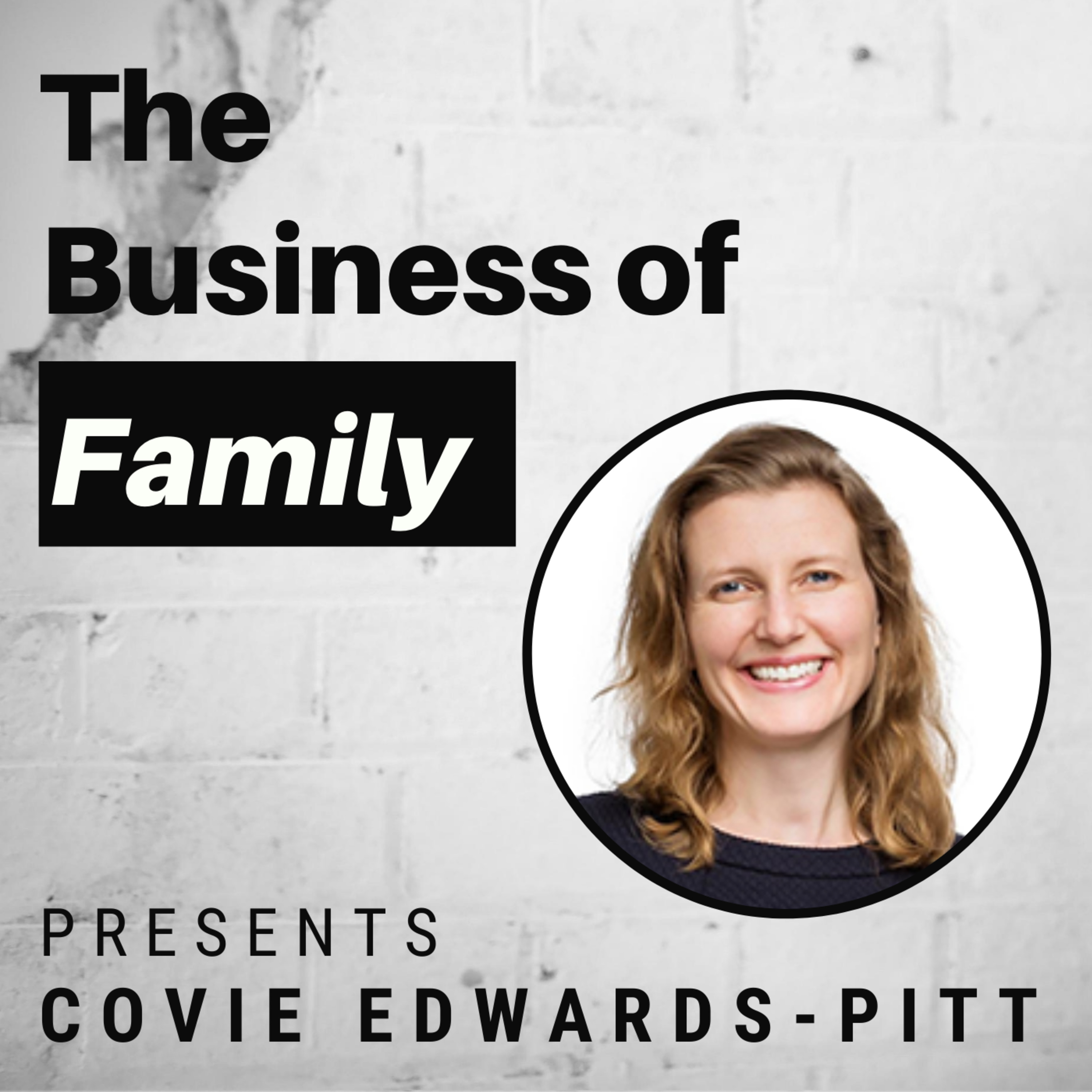
Episode 7 · Season 1
Raised Healthy, Wealthy & Wise
Key ideas from this conversation
Sit on your hands: the parent remembers the struggle as torture, the grown child remembers it with pride.
The test for a role in the family business: as an adult, can your child say they hold it because of effort, not their name?
The most valuable inheritance may be a narrative that lets a child fold the money into a story of their own.
Read the full show notesBio, standout quotes and the episode timeline
Covie is a Partner and the Chief Wealth Advisory Officer at Ballentine Partners where she is responsible for the development and management of the firm’s family education, family governance, and philanthropic offerings. Covie also leads several of the firm’s large family client engagements and specialises in helping her clients manage the impact of their wealth and ensure that their wealth management strategy reflects their families’ values and goals.
Covie is the author of a two-book series based on interviews that highlight success stories of family wealth: the first, Raised Healthy, Wealthy & Wise (2014), focuses on raising children to be grounded and successful adults amid wealth, and the second, Aged Healthy, Wealthy & Wise (2017), focuses on designing a vibrant and purposeful later life and legacy.
Episode Timeline
- [1:52] How Covie got into family wealth advisory
- [6:12] Ideal clients and what clients are seeking when they come to Ballentine Partners
- [9:00] Looking at the bigger picture when looking at client’s needs and investments
- [13:20] Increased percentage of uptake in trust built client relationships
- [16:18] Patterns when creating investment and wealth management plans
- [19:58] The primary sources of initial wealth for first generation families that Covie sees
- [20:58] Why more money can actually make parenting harder
- [25:34] Next generation success being driven by successes in life and self-motivation
- [27:38] Finding the balance to give children fulfilling lives of meaning
- [33:33] Focusing on the communication of values when discussing shared assets
- [38:12] Inheritor’s guilt for advantages they received and how to counteract that
- [41:55] Covie’s advice to a driven entrepreneur who inspired to be the founding generation
- [45:10] The four success factors Covie believes all successful next generation members share
- [47:50] The role Covie plays in helping families in philanthropic legacy and impact projects
- [55:12] Covie’s belief in wishing for our children to have the confidence to handle the struggles of life
Standout Quotes
- "You do need to have a pretty good degree of self-awareness and being able to look in the mirror as a parent to understand how you might need to evaluate and potentially change your own behavior relative to a child, in order to allow that child to become independent and financially self-sufficient." – Covie Edwards-Pitt [15:12]
- "If you have very little money, it's very challenging. Then as you get more money it gets easier, and as you get more money it becomes harder again. I definitely see that to be the case. I think the reason is, having money, having an abundance of resources essentially, more than you would need, has a way of complicating every single parenting interaction with your child in a way that, to no fault of the parents, might essentially deprive the child of a lesson that they would have learned by default if their family have had less” – Covie Edwards-Pitt [21:31]
- "Content, productive, driven by their inner sense of motivation, grounded, satisfied, passionate in their career choice. That sort of list of characteristics was evident to me because I recognize it all the time in the next gens." – Covie Edwards-Pitt [26:19]
- "Fulfilling lives have as part of them, struggle. Something that the person can think back on as something they have overcome in their life that gives them a sense of pride." – Covie Edwards-Pitt [28:45]
- "Communication is key. Communicating the values and the framework that are driving parent's decisions in a clear, transparent way is very important. I coach my clients to try to think about, what are the types of things we'd like to support? What are the types of things that we would like to help children with, when they reach those milestones in their lives? – Covie Edwards-Pitt [34:39]
- "The most important advice I would give is to say... that your child, when they look in the mirror as an adult... When they ask themselves do I have this job or do I have this responsibility or title because of my name or because of my effort? They can answer, my effort." – Covie Edwards-Pitt [42:09]
Key Takeaways
- Think of a client relationship and services provided as a much larger conversation about the client and what they hope to achieve as a whole
- The ways to recognize patterns when creating investment and wealth management plans for ultra high net worth families
- Ways in which parents with substantial means can still raise well-rounded children
- How success in the next generation can be different as it is more about the inner sense of motivation and satisfaction
- Why it’s important to allow children to struggle to attain a fulfilling and contented life
- The communication involved when managing shared family assets
- Inheritors will often find a true sense of purpose when they develop their own sense of contribution and passion in life
- Having family constitutions and clear frameworks for inheritor’s to truly feel they deserve their position
- Covie’s four success factors she has found all successful next generation members share
Links:
- Wealth Management | Ballentine Partners : Ballentine Partners is a client-centric investment and wealth management firm dedicated to integrity and independence.
- Book: Raised Healthy, Wealthy & Wise: Lessons from successful and grounded inheritors on how they got that way : At a certain level of wealth, money makes parenting harder, not easier. Raised Healthy, Wealthy & Wise breaks new ground in the field of raising children amid wealth by hearing the success stories: real-life children raised with wealth now grown into happy, healthy, and productive adults.
- Book: Aged Healthy, Wealthy & Wise: Lessons from vibrant and inspiring elders on how they designed their later lives : There is much about aging that we can't control. But there is much more that we can. Nationally recognized wealth advisor Coventry Edwards-Pitt applies the success-story format of her highly acclaimed first book, "Raised Healthy, Wealthy & Wise" (2014), to one of today's most pressing issues: how to age well--given our increased longevity--and ensure that our later years have a positive rather than negative impact on our families.
Read the transcript
This transcript was generated automatically and may contain errors, including in names. Listen to the episode for the exact words.
MikeWelcome to The Business of Family. I'm your host, Mike Boyd, and this is my look into the world of multi-generational wealth creation, family enterprise, stewardship, family office investing, and the curation of a legacy. On the podcast, I interview members of some of the world's most interesting families to hear how they pass knowledge, resources, values, and wealth to the next generation.
I hope you'll enjoy sharing this learning journey with me and would greatly appreciate any feedback, resources, or referrals you have to offer. To sign up to my weekly business of family newsletter, go to newsletter.mikeboyd.com.au. Our guest this week is Coventry Edwards-Pitt. Covey is a partner and chief wealth advisor at Ballentine Partners, where she is responsible for the development and management of the firm's family education, family governance, and philanthropic offerings.
Covey also leads several of the firm's large family client engagements and specializes in helping her clients manage the impact of their wealth and ensure that their wealth management strategy reflects their family's values and their goals. Covey is the author of a two-book series based on interviews that highlight the success stories of family wealth. The first, Raised, Healthy, Wealthy, and Wise, focuses on raising children to be grounded and successful adults amid wealth. The second book, Aged, Healthy, Wealthy, and Wise, focuses on designing a vibrant and purposeful later life and legacy. Covey, it is a great honor to have you with us today.
Thank you so much for making the time to join us.
CovieThank you, Mike.
MikeI'd love to start with a little bit on your background, please. Prior to joining Ballentine Partners, how did you find your way into family wealth advisory.
CovieYes, it's a long story, which I will try to make short. But I actually enjoyed telling people about this because I think family wealth advisory is not a career that you necessarily know about when you're in college. And it has been one that's been so fulfilling for me. So I like to explain to people what it is. So I was actually pre-med during college and I did all of my pre-med requirements. I took the test to get into medical school. And then I spent one day a week during my junior year actually volunteering at a hospital. And although I love that experience, I actually had some reservations about how some of the structural aspects of the medical career were changing in the States and whether I'd be able to
sort of have the bedside manner and spend the time with my patients that I wanted to. And sort of long story, but a lot of doctors were like, not sure we'd actually recommend this field at this time. And so I came out of college needing a job. My mother was quite clear that she was going to help with college, but then it was on my own to support myself. So like many people, I went into finance because they came on campus, they were hiring. So I got a job at Goldman Sachs, even though I had had no economics training, but they hired me into what at that time was a sales job. And things evolved and it was a fascinating time to be at the firm. The firm grew from 12,000
to 17,000 people in the four years that I was there. But I got very lucky that within three months, I was placed in a group that was Goldman's beginning steps into open architecture. So for the first time, they were evaluating money managers outside the firm and packaging those offerings into products for their clients. And so I got just an amazing training in the investment industry.
Literally, my job was to travel around the world and interview the best money managers out there and decide whether they were worthy enough to be hired for our clients. These people must've been like, why am I having to talk to this 22 year old? But I had a fantastic mentor, the woman who was hired to run that group, Tracy McHale Stewart, who now runs an excellent hedge fund of funds.
And it was just a wonderful experience and great way to learn about the investment industry. But after this four years, I really found that I was missing the reason I had gone into, I'd wanted to go into medicine to help others. And even though I could maybe make a line to helping others, it was sort of like too many steps. I was maybe ultimately helping pensioners buying our investment products. But I really had a seminal moment where a woman I knew in another group at Goldman, tragically, went on a family vacation and passed away in a car accident. And she was in her 30s.
And I thought to myself, if this happened to me, would I feel like I had really been true to my purpose in life, which was really to help others in a deep way? And I thought, I don't think I could answer that yes yet. And so I went seeking and through the process of seeking and looking around and doing some consulting on my own after I left Goldman, I literally happened upon the world of what was at that time called fee-only financial advising.
but essentially advising clients with no products to sell. You're truly just sitting on the same side of the table as them. You help them in a very deep human way. Hopefully for many, many years, you get to know their family. And I was struck by the complete similarity to medicine. It actually, I looked at this and this is like being a doctor, but in a different way. You have this technical expertise, which is really just the door you walk through to have a human relationship.
but really what you're there to do is to help this person on their journey through life. And I thought, that sounds like the thing for me. And I sought out a firm that I thought was excellently practicing in that way. And that's how I came to my firm, Ballentine Partners. And that was, oh, 16 years ago now. Yeah. So that's how I got here.
MikeWhat a wonderful story that is. I mean, like most great stories, it's completely unusual and meandering and I loved where you ended up. So let's dive into that. Tell me a little bit about your work at Ballentine Partners in the last 16 years. And specifically, I would love to know who is the typical client? What's the profile of your typical family wealth client?
And what are the services that they're seeking from you?
CovieSure. So we have two practice areas. So one is our family office practice, which I'd say the typical, and that's probably about 90% of our sort of assets that we advise on. And that's someone who is typically entrepreneur founders, business founders, inheritors, very successful corporate executives, but people essentially with somewhere north of around 20 million, but on average, say 50 million or so that they need investment help with, but maybe $100 to $150 million net worth. And these are really people who require complex financial strategic advice and are typically multi-generational wealth holders, or certainly that's their intent. Often it's the founding generation, they're looking for help with, they come to us typically looking for more nuts and bolts help, investment help,
estate planning help, wealth transfer help, tax mitigation help, all sorts of very nuts and bolts things. What they find after many years of working with us is that the help that they, of course we do all those things. You can't be in this business without doing all those things and doing those things well. But what I do find is that what clients really value after multiple years of working with us is the help that we give to their families, helping them understand how to pass money onto their children in a way that does not demotivate their children or make their children not content with their lives in general. So it's interesting because people never rarely
think that that's what they need help with when they seek out an advisor like us. So it's a fascinating journey that people tend to go through in terms of what they think they need help with and what they then really truly value. And then our other practice area is with people sort of more in the 3 million to 20 million area who might be building their professional careers, might be inheritors themselves, and they're typically seeking primarily investment help.
But for whatever the situation, I really think that what we bring to the table is we work with almost 200 families. We've seen this movie play out across the spectrum of wealth and across the time horizon of wealth in terms of a multi-generational family. And so when someone comes to us, we're skilled at knowing where they are in that journey and where we need to help them go to.
And essentially, that means bringing to the table ideas and questions they probably have not thought of yet. because they haven't seen the movie play out in the way that we have.
MikeI love this. I think this is going to be a fascinating conversation. A follow-up there, if you don't mind. You mentioned that oftentimes clients come through the door looking for one thing, the nuts and bolts, technical investment advice, but it's often something else that they end up valuing the most. Do you have difficulty in convincing them of the need for this other advice or does it end up just being delivered in the course of your investment advisory work?
CovieThat's a great question. And we charge one fee and we do that on purpose because if you were to say to a client, here's all the things that we do for you, my experience is most people coming in the door would say, I'm not sure I need that family stuff. You know, no, my kids are too young.
Really what I need your help with is my investment portfolio and making sure I'm getting good investment returns. Or maybe I need you to do a review of my estate plan and make sure it's okay. But all this other stuff you're talking about, family continuity, education for the children, maybe that is of some value to me, but it seems more remote.
And essentially, they may never raise their hand and say they need that. What ends up happening is when we charge our one fee, we view it as our job to bring to people, of course, we're doing all the investment advisory and that's how we start the relationship. And we start the relationship usually within the first year, just getting on top of all the things that are top of mind for the client as problem areas, things they're worried about, which tend to be these more nuts and bolts things. But we view it as our role to bring to them these other ideas. So I'll give you a perfect example. A client might ask in a meeting a
seemingly simple question about, oh, we're hearing that we have the ability to gift our children a certain amount every year and not have to pay taxes on that. Should we do that? Now, an advisor like us could answer that question from a pure tax perspective. Yes, that would make sure, you know, yes, of course, that would maximize your ability to transfer wealth to your children tax-free.
But we view the answer that we have to give as part of a much larger conversation about how this family will feel about those children's path in life and whether those children feel like they are sufficiently well-equipped to handle everything that comes to them in life. And so that is not a simple conversation. We use a simple question like that as a way to begin a larger conversation about, hey, these are issues that families tend to need to think about when they are passing wealth to their children. How are you feeling about your child in general? How are you feeling about their sense of their own work ethic? All these other questions that we then
take it upon ourselves to ask. And what I was saying earlier that people don't necessarily know they need this advice, but then they really value it. When you start to ask questions like that, people's eyes tend to open and think, huh, I didn't really think about that. But now that you're asking that, I guess that is really something that I need to be focused on.
And then they seek out our advice in that area in a way that they would not have necessarily realized they might have when they first joined as a client of ours.
MikeI'm seeing the parallels here to medicine. Someone comes in with an ailment or something that they think they need, they ask for the Band-Aid, but you're making sure that they get the great nutritional advice at the same time.
CovieI'm so glad you said that, Mike, because there's a second piece of the... I've thought about this myself a lot, as you could tell, probably from my pre-med experience. The second component of that is that just like a doctor cannot exercise for you, but it's critical to your health conversation with a doctor, there are things that we cannot do for our clients. Take the entire parenting realm, for instance, where there's so much that the parent needs to do themselves.
We view it as our role to educate them, to encourage them, to coach them, to hold them accountable, but they need to actually do those things in their interactions with their children. And I think that is part of what is challenging for clients. I think often they are seeking an advisor to do the thing. Can you do financial literacy 101 with my child? And there are a lot of advisors who will, of course, do that. And of course, we will do that. But for this to be effective, the parent really needs to also do things in their day-to-day interactions so that we view it a big part of our role is working with parents to help them understand what those things
need to be.
MikeContinuing along with the medical example, a lot of people hear the advice from the doctor, but still don't do the exercise. Are there some people that just check out and say, no, I'm here for investment advice? Or do you typically get the majority of families self-select in simply because they've come to Ballentine Partners and that's what you're all about?
CovieThat is such a fascinating question. I'd say I feel pretty good about our percentage of uptake in terms of, I think there is a degree of self-selection. I also think that we have the great benefit of having worked with most of our families for many, many years. And so maybe there isn't as much receptivity to this kind of work in the first couple of years or the first three or four years, but then you've got the children are growing up and where you might've entered the conversation with a client where the child was 16 or something. By the time they're 23, 24, now they're having major life things. Like what is their career? Where are they living? Are the
parents contributing to rent on that place of home. All these questions that start to come up and start to weigh on our clients' minds. And I find that it's when those things tend to happen that then they are receptive, they're seeking advice, and they know that they have a trusted relationship with us where we talk about things related to money and related to wealth transfer.
So it sort of organically leads to people being more receptive at exactly that time when they need to be receptive. There are situations where parents can't see how their own behavior may be destructive to a child's sense of independence. And I think every advisor in our field has probably been in a situation where they're trying their best to communicate to that parent why the parent should change their behavior and the parent can't see that. So I'd say you do need to have a pretty good degree of self-awareness and being able to look in the mirror as a parent to understand how you might need to evaluate and potentially change your own behavior relative to a child in order to allow that child to become independent and financially self-sufficient.
MikeA bit of psychology with your wealth advice. I like that.
CovieThere's a lot of psychology, Mike. There really is. And I view it more as none of us are practicing therapists or have that training. That said, we have a lot of training in, as well as just on the job experience in human nature and the issues that come up all the time in our work. And we have a lot of training through multiple years of working with a gentleman, Jim Grubman, who's actually a trained wealth psychologist. And so we know how to recognize these issues when they come up and know how to coach parents through them. And it does become an important factor in doing this type of work well. You can't successfully manage family wealth without having deep training
and understanding of these issues.
MikeI'd love to jump in now and understand the typical sorts of investment and wealth management plans that you're putting together for ultra high net worth families. Is there such a thing as a typical plan for a $20 to $50 million or $50 million plus portfolio or is every family situation unique?
CovieIt's sort of like everyone's on this arc of a journey and there are patterns that we see all the time that repeat through those journeys. But of course, everyone is different in their specifics. So as an example, a more typical story is a business founder, either they have just sold the business, they now have turned their life's work into a pile of cash. And of course, the first thing in their mind is, I need to do something responsible and invest this cash well. And so that's why they're seeking out our advice.
We, of course, know that what's really going to happen with that client is they're going to turn from a business-owning family to a wealth-owning family, and they're going to have all the issues come up that relate to that. How do I successfully educate my children about this wealth? How do I successfully pass this wealth onto my children? All the decisions, should I buy homes for my children? Should we invest in a family compound? How do we make that go well? Should I help educate the grandchildren through an education fund, all these types of issues that they probably are not yet aware that will come up for them. We know that those will come up for them. So we view our role
as helping them think through all that. Then you'll have the inheritor people where they are the recipient of that sort of experience. And now they've inherited a lot of money, probably more than they ever thought they would or necessarily that they want. And they tend to have other issues come up. I didn't really ask for this. How do I make sure that I am managing this money in a way that I feel like I'm being grateful to the opportunity my family has given me, but where I feel like I can live out the values that I have if I perhaps am sort of bothered by the fact that I have all this money relative to others in the world.
And so they tend to be very impact focused, very philanthropy focused. And so we're working with them on all those issues. But then you'll have, there's a whole other segment of our clients who made their money in the investment profession, private equity people, hedge fund people. You might think, why would they seek out our help? The funny thing is they tend to actually really want and need investment help in all the areas that wasn't their area of specialty. Plus they need all these deeper family dynamics issues.
They may not quite know it yet when they first hire us, but they end up seeing the value as I was talking about before. So there's all sorts of different issues we're helping with along the way, but across the spectrum, we view our task, our scope as handling all the investment issues, bringing to them great objective ideas that will manage their investments responsibly. We don't sell any of our own products. And then of course, there's all the risk mitigation issues, you know, insurances, estate wealth transfer, tax minimization or mitigation. And then there's all these other things we've been talking about, which fall largely under either the family dynamics headline or psychology headline. But what's interesting and what I've found in my 16 years,
you can't put that last bucket in its own standalone bucket. It has a way of intersecting with all of these decisions and all of these other issues. As I was mentioning, a simple question about, should I give my child the minimum 15,000 annual gift? That has underneath it all of these other issues that come up. So we sort of feel like we're here understanding all the family dynamics issues, and we will bring that up through all of these other interactions when and if it's necessary to do so, so that the family ends up ending up in a good place 10 years down the road.
MikeYou mentioned a few different types of wealth creation or a few different types of families there. I'm curious what the primary sources of initial wealth are for first-gen families that you see. Is it typically an entrepreneur with a private company or is it a real estate that dominates? Is there one particular asset class that stands out?
CovieThere are buckets. So I'd say about a third are founders of companies. And that can be anything, biotech, industrial. We have a sort of a whole swath of business founders who have now sold that business, or highly successful corporate executives who've sort of grown up in a business and now may own significant portions of that company. And then you have the inheritor section.
And then you have sort of another third is these people who are just very successful professionals, typically investment professionals, who have made quite a lot of money in the investment business themselves and now want to know how to pass that well onto their children and become sort of a multi-generational family of wealth.
MikeYou mentioned in your book that at a certain level of wealth, money actually makes parenting harder, not easier. That was something that really stuck with me and I reread it a couple of times. I'd love for you to elaborate on why that is and how parents of substantial means can still raise well-rounded children.
CovieYes. Isn't that crazy? I know. It is true. And I think that came from Malcolm Gladwell in his book, David and Goliath, had this great image of this inverted U-curve that essentially, if you have very little money, it's very challenging. Then as you get more money, it becomes easier. And then as you get more money, it becomes harder again. And I definitely see that to be the case. And I think the reason is that having money, having abundance of resources, essentially, more than you would need, has a way of complicating every single parenting interaction with your child in a way that through no fault of the parents, all well-intentioned parents, might essentially deprive the child of a lesson that they would have learned by default
if their family had had less. So a good example might be a child who's growing up in a family without a lot of wealth is probably given some pretty clear message in their seven or eight-year-old experience in life. Like you've got to be a good citizen of the house. You've got to make your bed. You've got to pick up the dishes.
You've got to do all these things because we all need to help out here. Whereas a child growing up in a more affluent home, there might be a part-time person or even a full-time live-in person whose job description entails doing all of those things. So essentially that child is not getting the messages that the first child is.
or roll the clock forward to when those children are able to drive. The first child in the less affluent upbringing is probably doing the math in their head like, hey, I'm going to want to be able to drive. I need some money so I can go buy a car. I therefore need a job so I can earn the money. All of these things, sort of natural consequences. Whereas the second child is probably just given a car as a gift for passing their driving test. So there's like 150 examples that I've seen in my life where essentially the first child would have to probably figure out how to earn something or would have to do it themselves. And the second child just doesn't
have that experience. So essentially that second child is deprived of lessons, even though they grew up amid abundance. And what I tend to try to talk to my clients about is when you have wealth, if clients have gotten to the point where they're self-aware enough that they need to educate their children about this wealth issue, they tend to come to the point where they say, I want to educate them about the wealth. But people tend to think that that is the piece they need to educate them about, which is the money itself. That is important. But as you can see from these examples, it's far beyond that. It's how the money impacts parenting behavior in these subtle ways. And that's why I said before, we end up spending most of our time
working with parents, because this is really about how parents behave relative to their children. And it applies through all ages, really. You can start really young, but it's extremely relevant too when kids are in their 20s, 30s, trying to make their own way in the world. That's when wealth transfer can be quite detrimental to a child trying to go through those life milestones on their own.
MikeIt's a terrific example. And as soon as you say it, and as soon as I read it in your book, it was an aha moment for me because it seems so obvious in hindsight, but I guess until you've lived it or until you've witnessed it, it's non-obvious, I think, to the average person. So it's a terrific example.
CovieYeah, it's non-obvious. And beyond that, it's actually sort of counter to what... There's a fascinating statistic in the States that 80% of wealth is newly made wealth on a rolling basis. So many of the people who come to us did not grow up wealthy. They grew up middle class. Some people grew up very poor. So the sort of driving impetus for a parent who may have grown up with less is I want to provide more to my child than I was provided in my youth. I don't want my child to feel that sense of scarcity the way I had. That is their driving emotional motivation. And part of what I hope to bring to my clients is some education around the fact that even though that is a completely understandable
motivation, trying to save your child from the very struggles that helped you become successful is not necessarily a good thing. In fact, it could be very damaging.
MikeWhen we talk about successful inheritors of wealth, does that assume that the inheritors have to replicate or surpass the wealth generated by their parents? Is the whole concept of this multi-gen family that the subsequent generations have to level up to the founding generation? Or is there an entirely different approach?
CovieI'm so glad you asked that. Yeah, no, there's an entirely different approach. I had to think really carefully when I was writing this book about how I was defining success. And I wanted to be really clear that success was not, gee, I replicated my parents' financial success and I've earned as much as they have or more. I've surpassed them. What it really meant was clients, kids now grown into adults who were successful in life, content, productive, driven sort of by their own inner sense of motivation, grounded, satisfied and content and passionate in their career choice.
And that sort of list of characteristics was evident to me because I recognize it all the time in the next gens I have the good pleasure to work with who are like that. You sort of look at them and think, I would love it if my kid were like this. They're sort of happy with life, content with their lot in life. And you also, if you, sadly, if you work in this industry, you have seen the opposite. So I was very focused on how do I create, how do I help my parents I serve create in their children these characteristics and how do we sort of help them develop these capacities for life and living life well. And that's what the book is about. And sometimes
they do go on to replicate their parents' financial success, but actually more often, I just see in the life experience with these kids, they're often inheriting more than they would ever need or want and are looking to do the opposite. They're looking to try to share that wealth in some way with causes that they find meaningful. You touched on it briefly earlier, but I'd love to follow up on this. Wealth generators, the founders of wealth, typically first generation, you mentioned earlier, 80% of wealth is new wealth. All of those parents want to make their children's lives easier, or at least minimize their struggles somewhat compared to their own upbringing. But a balance has to be struck between providing a wonderful life for them
and teaching them to independently strive. How do you, as a wealthy parent, actually achieve that balance? Because it sounds easy to say, I imagine it's incredibly difficult in practice. It's very difficult in practice. What I would say is first, think about the goal. I think that as parents, and I'm a parent myself, you would love your child to be happy. You sort I want my kid to have this happy life.
I don't want them to have struggles. But when you really think deeply about that, I think what we really all want is for our children to have fulfilling lives of meaning. Ones that they derive deeper, longer lasting contentment from rather than happiness per se. And fulfilling lives have as part of them struggle. Something that the person can think back on as something they've overcome in their life that gives them a sense of pride. So when we try to deprive our kids of having that struggle, we're really depriving them of that sense of contentment and fulfillment. I have a great story from the book about, I interviewed a young woman, she was about 24 at the time,
and she was telling me about how she had found her first job out of college. And she was so proud of herself. The conversation was such a joy for me to have because she was just sort of oozing. I could hear this pride in her voice coming through the phone and how it took her a long time. It took her many months, but she finally got the job and how even though she wasn't 100% financially independent, she was almost there and all this amazing stuff. And then I went to talk to her dad and he said, yeah, that's all true. But my side of that story is she came to me and she asked me to help her get a job, asked me if I knew anybody who could help her. And I truly didn't
because he's in a different field than what she was interested in. And he said, it was so painful for him as the parent. It was so painful watching her out there for months and months and months, struggle, really having a fear that she wasn't going to get a job, really sort of torn up inside about, should we help? What should we do? Should we send her money? All this stuff. And what's amazing to me is two years on from this experience, she did not go into that when she was talking to me. And I truly don't think it's because she didn't want to talk about how she asked for help from her dad. I think it's because two years on, her emotional memory of this is that she did it.
It was hard, but she did it on her own. And the parent's emotional memory was, literally, he used the word torture. That was torture watching. And so I share this example with my clients because I think that is such a good image of how the parents and children's sort of emotional experiences of struggle are like two trains running on totally separate tracks. And what the parent experiences is this torture. And it stays. I mean, years later, that's what he remembers.
The child, although they might experience the struggle and the hardship at the time, what they take from that struggle and hardship is this deep sense of contentment that they were able to succeed on their own. And so I think you just have to almost sit on your hands as a parent and prevent yourself from helping. And the way you, I think, motivate yourself to be able to sit back is to say, I do not want to deprive my child of that sense of contentment and pride that they did this on their own. But it takes a lot of strength. It really does as a parent to not help. And I think sometimes it takes recasting what you're doing, not as not helping.
Sometimes I say to my clients, it's not that you're saying no to helping. You're saying yes to your child developing these capacities in their life, the sense that they can do these things on their own and the sense of confidence, because that's really what's going to help them for the rest of their lives.
MikeThat is just a fantastic example. Thank you for sharing that story.
CovieI just have to give credit to these amazing people who were willing to share these stories with me because, and I really hope that these stories will be gifts to others. And that was sort of my hope with this book to really get inside of these real stories of how parents have done this hard thing, which is to raise kids amid affluence, but in a way that these kids feel happy and content and grounded in their lives. So I am so grateful to the people who are willing to share all of these life stories with me. And I do hope it helps others.
MikeThat was one of the things that I most loved about your book, that it actually took a contrarian, in my opinion, a contrarian approach and shone a light on success stories rather than all of this media and books and things that we consume about spoiled brats of wealth. It's wonderful to actually see some success stories and how it was achieved.
CovieThank you, Mike. I'm a positive person and that's what drew me to it too. Of course, I've seen the opposite. You can't work in this world and not, but there's a concept that we use in our work, appreciative inquiry, you know, seeking out the positive, what can go well and trying to highlight that and focus on that. And I really tried to take that approach. And I've heard from a lot of people who've read the book, not only that they liked that approach, which was so gratifying to hear, but that the stories really stick with them. And just as they live in my mind, what I'd hoped and what I see to have become true is that parents recognize in the stories of these now grown children, their own
children, and where something might've been hard for them to see with their own child, because it's your own child. When they see the story of another child, they think, huh, yeah, that's interesting. And I would like my child to grow up to sound like that child over there. So I think it's easier for them to hear some of these lessons when it comes from the mouth of a now grown child who's lived it.
MikeOne thing I'd love to explore is how families typically go about sharing and determining access to common family assets like a family holiday home or a ski chalet or something like that compared to individual entitlements or income streams that a family member may be entitled to from a trust or a distribution. We're talking about multi-generational wealth after all.
We want to raise motivated children with their independent capability to strive, but there is still this substantial wealth, and I imagine some substantial family assets that they still gain benefit from. So how is that typically managed by families to ensure that access is fair and that siblings all benefit? I can imagine that could become a thorny issue at times.
CovieYes, it definitely can. And there's a lot of different ways. This could be a big answer, but I'll try to just share some of the headlines. I think communication is key. I think communicating the values and the framework that are driving parents' decisions in a sort of clear, transparent way is very important. I coach my clients to try to think at the outset about what are the types of things we'd like to support? What are the types of things that we'd like to help children with when they reach those milestones in their lives? And laying that out and also being clear that it's impossible to make everything completely equal. Essentially, what we're trying to do is be there for people at their life moments when needed in these ways, following these values.
And I've just seen it go better when parents are transparent about the values and the goals that driving their decisions, but are clear that that might lead to things that in the short-term look unequal, I think that's easier for families to understand than, okay, we're going to make everything completely equal because quality, as we all know, is very subjective. I mean, you can try to the nth degree to be equal as a parent and kids can still go back to when, you know, I got the ice cream cone after you did when I was five or whatever. You know, if people are seeking out ways in which they have been unfairly maligned relative to siblings,
It's easy to do that. So I think that it's better to just try to be transparent. The other thing is that I think akin to what we've been talking about, raising children to be grounded, two things are very important. One, to educate children to have a facility. It's almost like a speaking a language. You want them to be able to operate comfortably in all aspects of sort of level of luxury in the world.
So if you have a plane you can fly them on, great, do that sometimes. but also it's important that they can fly coach and not feel like that's an incredibly difficult thing for them. Same thing, if you go to a lovely private home you're renting or owning, great, but also they should be able to go to sort of a budget hotel and be okay with that.
So I think it's important to educate children to be able to experience all that life has to offer because that helps them understand everyone else whose life is only those other things. It's important for them to be able to have that perspective. And so the way I think sometimes people do this in reality is the parents will, and this is another piece of this, that parents often have reached a stage in their lives where they can enjoy all these luxuries.
They've worked very hard. They have the plane. They have the five homes. They want to experience all these wonderful things. And that's great. But where your children are is in a different stage in life. So sometimes I see parents feeling very guilty that their children cannot experience all the luxuries that they are now able to experience. And I say, you know, it's okay.
That disparity in lifestyle is okay because people are at different stages in life. So how parents might do this well is, okay, if we want to see all of our children and their children, let's plan a family trip and we'll pay and we'll fly everyone there and we'll do all that. But, you know, the rest of the year, if my kids want to go on a vacation with their children, they're going to go on their own or they have skin in the game or they're generally supporting their lifestyle on their own.
So it's a blend. It's a blend of sharing the wealth of the first generation in discrete ways, often at the parent's behest, essentially, so they can get everyone together. But the rest of the time, allowing kids the space to lead their own lives at a lifestyle that is more within their affordability.
MikeOne factor that I think isn't discussed often enough is the feelings of guilt and pressure that inheritors often feel for the advantages that they've received in life. What's been your experience coaching clients in that position? And is it possible to plan around and avoid?
CovieThis is such an important topic, Mike. You literally could write a whole book on this topic alone because it's real. I mean, it's really real. In our world, in our industry, those feelings of shame and guilt can really interfere with someone's happiness in life. for many, many years. So I think it's really critical for inheritors to understand how to process all of that. There's a couple thoughts that I have on this. One is that there's this wonderful quote from, I think it's a Goethe quote, and I actually think it was written in the context of democracy, but the quote is, or freedom, but that which you have inherited from your ancestors, you must acquire by your own effort in order to truly own it. I have seen this be so true.
And you might ask, well, what is the effort that could possibly acquire the 100 million that I've inherited? And my book sort of goes into that a lot. But what I've seen to be true is when inheritors develop their own sense of contribution in life, their own career that they're passionate about and invest it in. Take an inheritor who's become an emergency room physician. That person gets up every day and understands that the way they are spending their time is deeply valuable to the world. When they have that sense of confidence in their own contribution to the world that they are doing through their own achievements and work effort each and every day, it's much
easier for them to then say, okay, and I've inherited this pile of money over here. And let me think about how to actually integrate that into my sense of purpose that I'm already deriving from my contributions. It's much easier for them to make that integration, which is so key. I once heard an inheritor get up at a conference and say the most valuable thing that a family of wealth could give to their child is a narrative that helps that child essentially incorporate the money that they're inheriting with their own personal narrative in life. And it's storytelling.
It's how do I tell a story of my life that helps me incorporate this money that I have and use it to further the values that I have and the goals that I have. And I'll say one last thing on this. There's another wonderful guy in our industry, David York. He's an estate attorney. But I've heard him use the analogy of back when people used to inherit land, this was really not as much of an issue. Because if you inherit land and you do nothing to work that land, the inheritance has no value. The work is part and parcel of the value that you've inherited and that work has to come from you. The challenge when you are inheriting money instead of an asset like that,
that has the requirement of work as part and parcel with it, is how do you create that sense of work and effort yourself? And so there's a lot of ways that I coach inheritors to try to do that.
MikeIt's a great analogy and I think that there's some wonderful farming families out there that are great examples of stewards because they've inherited land over generations and ensured that it will last four generations by preserving the quality of the soil and the natural environment. That knowledge is passed down within the family and everyone knows it's important. I think that's a great analogy of what you've just shared.
I'd love to ask you, what advice would you give to a smart, driven entrepreneur who aspires to be the founding generation of a multi-generational family enterprise?
CovieI think the most important advice I would give is to say, and actually when I listened to your Rob Robson interview, I think they've done this. It's structure things in a way as it relates to your family business that your child, when they look in the mirror as an adult, and when they ask themselves, do I have this job or do I have this responsibility or this title because of my name or because of my effort, they can answer my effort. There are a number of ways to do that. I interviewed actually a gentleman for my first book who did inherit a family business. And I asked everyone I interviewed, Is there anything your parents did that you regret?
And I actually heard very few things. He gave me one answer to that, which is I regret that my parents hired me into the business right out of college. He said, I wish I had spent more years. And he actually did spend every college summer working at a different business in the industry, but he wished he had spent more years, say into his late twenties, working at a different business so that he would have known in his own heart when he was hired into his family business that he brought his own contributions to the table.
And he said, he was in his 50s when I interviewed him, he said, I've spent the last 30 years proving to myself that I deserve this job. So I think there's a lot of ways that families can do that. They can have family constitutions, they can have business practices where it's very clear how that family member will demonstrate merit that is equal or more significant than someone you would hire from the outside.
But it's really clear that it's really important that those types of frameworks are put in place so that inheritor will understand that they truly deserve this job. I think that's really, really key. And of course, this goes back to what we were saying before. That is not what most parents want to do. Most parents want to when their kid is 22, having come out of college and looking for a thing, they want to have them come right in the business.
They've got this great situation set up for them. It'd be fun to work together. You know, there's all these ways in which for a parent, it would be nicer if that child could just come work for the business. But I have seen that be really hard for the child themselves.
MikeIt's a great story. In fact, we've had a couple of guests on the podcast already that come from multi-generational families that all have some sort of rule in place that dictates that if a next generation family member wishes to join the family business, they must first obtain a certain number of years work experience elsewhere after college or university. And in some cases, that must be overseas or must be at a certain level. So I think it's a great idea. I don't know if it works for every family and every business and every situation, but it certainly resonates based on all of the families that I've spoken to to date.
CovieWell, you know, and there's a why behind that I talk in my book about the four success factors that I found that all these successful children shared. And just really quickly, the first was that they'd had some experience in life of being financially self-sufficient. It didn't even have to be long. It could have been just one year, but they could point to some time in their lives when they felt truly like they had lived off of their own earnings rather than money that the family gave them. And that gave them confidence that they could do the same if the family wealth went poof tomorrow. And the second one was that they had a sense of their own career and vocation as one that they had chosen and that
they had been able to achieve success in on their own merits. And the third is that it sort of relates one and two. If you have supported yourself at some time in your life, and if you feel like your career is one you have chosen and that you feel like you have been able to work your way up through your own efforts, you have the third, which is a very deep and foundational sense of self-esteem that is driven largely by your own efforts and your own achievements versus what you feel like has been provided to you. And the fourth is that you have had the ability over some period in your life to get yourself out of problems of your own making, the sort of earned resilience.
That thing went wrong, but I fixed it on my own. I didn't have my family come in and save me. If you think of how those four factors, and I've found that the people I interviewed all shared them, and they are really critical for kids to be able to develop these capacities, those tend to come online in the 20s. Those tend to come online in that critical period where the child has finished their educational experience and now they're out in the working world.
So if you can give a child the gift of having those sort of early to mid-20s years be on their own somewhere so they can experience those feelings and develop those capacities, they can then bring those capacities back into the family business. But if they don't have a chance to develop those, there's almost nothing you can do later to help them build that sense of confidence in themselves.
MikeIt's fantastic. I'm so glad you shared the four success factors too. I was hoping that we would squeeze those in, but I also didn't want to give away all the great content of the book because I expect everybody to go out and buy a coffee straight after this.
CovieWell, thank you, I'm like, it is still worth reading because the stories really, you can say the success factors, but what people really need is they need to go around every day with these stories in their heads so that when they are faced with a decision as a parent, they can think, oh yeah, what did that other person do?
Okay, let me try to do that.
MikeYeah, you're absolutely right. It's the stories from your book that I carry around and remember and relate to. So I think the case study examples is what it's all about. And it really helps click the lessons that you're sharing. Now, I'd actually love to switch to the topic of your second book. I'm curious what role you or Ballentine Partners play in helping families with their philanthropic, legacy and impact projects as they get perhaps to later stages of life. I assume that in a lot of cases, it turns to what impact am I having? What legacy am I leaving? How can we make a difference?
What coaching role do you play as families reach that stage?
CovieYes, a very significant one. We sort of view our role as understanding the life arc that people go through and helping them in a deep coaching human way at all of these moments. So, you know, what we've been talking about is typically people in their 30s, 40s, 50s, they're raising young children. Now their kids are in their 20s. The parents are typically in the prime of their career and wealth generating years. So what we've been talking about so far tending to be the issues they are focused on. Earning more money myself, growing my balance sheet, and starting to think about how to transfer this wealth to my children in a way that will not demotivate the children.
Then what happens is people get older. They might start to wind down their own career efforts. They might have a grandchild be born. All of these types of seminal moments that start to happen in life that begin to change how you think about things. And I've seen it be a very transforming period of life where people finally, it's like their eyes are opened. And as David Brooks, the Times columnist in the States says, people go from thinking about resume virtues to eulogy virtues. And you know, gee, as I've talked to people about 30 years from now, if I'm dead and gone, I'm looking down and I'm seeing what either my wealth has wrought or what my family relationships
have wrought in terms of what I look down and see is what my family is doing. Will I be happy with that. And so we view our role for people at that stage of life as being as critical. And we talk about everything. What is all this money for? You can't take it with you. So is it for your children? If so, how do you feel about that? Do you feel like they really need it? Let's talk to the kids. Do they want it? All of these deeper questions. Okay, if it's not for the kids, well, what are you going to do? Are you going to give it all to something at your death? How is that
going to feel? Would you rather be doing it now when you're living and you can see the benefits in your life. And then there's a whole other component, which my second book really delves into, which is all of the work, just like a younger person might be needing to do a lot of parenting work about not demotivating their child. These people at this stage in life need to be doing a lot of work in terms of thinking about how will I not burden my child when I die based on the thinking I have done or not done about what's in my estate documents. Will people understand it?
Will they wonder why I made these decisions? Do they understand how I want to spend the last five years of my life? Will my children be fighting over that because they haven't been clear about where I want to live or how I want to die? All these deeper questions. We sort of view a big piece of what we do as being in the family harmony business. And the issues we're talking about here toward the later end of life are often top contributors to family conflict. You know, I don't agree with mom moving to this place or that place. No, I don't agree with the fact that mom left you the family compound, but left me all the stock, all these types of issues. So we view
our role as bringing these issues up again, sort of asking the questions that people might not have had on their mind, but we know they need to be having on their mind and thinking through, asking the questions, coaching them through answering these questions, and then coaching them through communicating their answers to their children in a way that is clear and transparent to stave off the possibility of family conflict after death.
MikeI feel like there's 20 more topics there that we could spend an hour on each one.
CovieYes, there are. Thank you, Mike. It is something we're probably all living through. Like all my books, you don't need a lot of money for these issues to come up. It's just that when there is money involved, the opportunity and the risk of conflict is that much greater.
MikeThat's right. In so many ways, money amplifies, whether it's good or bad. And I think that to your point, you're dealing with so many hot button issues and it's all about harmonious family dynamics to successfully build multi-generational wealth and sustain it. If after all, that is the goal, it may not be. I'd love to hear the answers to all of those questions that you pose as well to clients, because there's probably a few interesting variations of each.
So beyond your own two excellent books, which we'll definitely link to in this episode show notes. Are there any other great books or resources that you'd suggest the audience looks into if they've been inspired and want to follow the thread into this topic a little bit further?
CovieActually, Rob Robson mentioned the Jay Hughes books. I mean, Jay Hughes, I really give credit to as sort of being the founder of incorporating this whole concept of family dynamics and the deeper aspects of family wealth, human capital, social capital. He sort of began the conversations about that in our field. So I do recommend for your family, multi-generational family wealth clients, I mean, listeners, I recommend that. I have sort of two books for each of my two books that I'd say to follow up on. For the children topic, I really like the book, The Opposite of Spoiled by Ron Lieber. He's a New York Times columnist. If my book is for these stories and more anecdotal experiences, his has some very specific nuts and bolts things like,
do I do an allowance? Do I not do an allowance? How much of this purchase or that purchase should I pay for for my child versus not? And so I actually think they're a good, I've heard from people that it's sort of like a good companion piece to read those two together. I also liked when I was researching for my first book, the Paul Tough book, How Children Succeed. I think that's very good. I mean, it's all about essentially the character attributes that as parents, we want to inculcate in our children more than the financial knowledge per se. And And I found that to be so true that very few of my people I interviewed had had any sort of financial literacy 101 training, which surprised me.
What instead they had was parents who clearly communicated values. And then because the kids had been raised with these strong, sound values about wealth and what was important in life, they sought out the financial knowledge they needed when needed in their life. You know, I'm getting a credit card. Let me learn about credit cards. So I really like how children succeed.
on the aging book. I love the book Younger Next Year. It's essentially all about how important exercise is. I didn't cover exercise in my books. I feel like there's a lot out there, but I had the good fortune to read a lot of... In my literature review, I read a lot of books talking about how important exercise is as you're aging. And that's just a very inspiring book.
And then I also think Being Mortal by Atul Gawande touches in a very deep way on some of the issues we were just talking about as you're preparing for the last years of your life and death. How can you do that in a way that not only will sort of give you some peace of mind, but more importantly, give those who will be left behind a sense of peace that they executed on your wishes. So I love that book too.
MikeThank you for sharing some excellent resources there that I'm looking forward to diving into as well. We've got time for one final question. And this is a question that we ask all of our guests. Imagine you're writing a letter to your children, what is one lesson or idea that you don't think many parents would mention, but you consider important to understand?
CovieYeah, I thought about this. It's interesting. I don't want to imply that parents wouldn't necessarily think this way, but I will just share that I think this is one of the hardest things for parents and for me too. I think that We all want our children to be happy and therefore we all kind of want to save them from experiencing pain and hardship. But I think when you really deeply think, that's sort of what you think of for your child. I want my child to be happy.
When you really think about your child as a grown adult, like you are, you know, when you think, okay, now my child is going to be a grown adult in their own life, going about their own day, having their own responsibilities, probably parenting as well. What do I really want for that adult? And what I think I really would want for that adult is for them to possess a deep sense of confidence that they know how to handle whatever life will throw at them.
It's not happiness per se. It's a sense of capability to handle the vagaries of life, which as we all know will happen all the time. And so I think if you're trying to raise a child who will become that adult, that's a different thing. Then what you're doing as a parent is trying to imbue that young person with a growing, burgeoning sense of confidence in their capacities to handle life. And to create that outcome in a youngster, you basically need to prevent yourself as a parent from doing things for your child because they need to do those things for themselves to develop that sense of confidence.
So it sort of reorients what you think you should be doing on a daily basis. And it steals you through what happens to you as a parent, which is the child complaining. You know, no, I don't want to make my bed. No, I don't want to do my homework on my own. All those things that the child will say that if you're thinking just about a child being happy, you say, oh, let me help so that you don't have to experience unhappiness.
But if you think about your child growing up to an adult who is confident in their capacities to do things, you think, no, I'm helping you develop that sense of confidence by not helping you right now. So I think that's really what I would encourage parents to think is just a little bit tweak what the ultimate goal is and then keep that goal in mind in every single day-to-day interaction because that, just like they say, you know, life is a collection of moments in the present. An adult child is a collection of all these moments in the present of parenting, which are hard. It's always easier to say yes than no. So I think as a parent,
you really need something to sort of steel yourself through those difficult moments.
MikeWonderful lesson and such a great lens to look through a fresh perspective. Covey, this has been an incredibly enjoyable conversation. I wish we could go on for hours and hopefully there's an opportunity to have a follow-up conversation at some point in the future. thank you so much for the stories, your books, and this wonderful conversation today.
CovieThank you, Mike. It was a real pleasure. I loved your questions. And I do hope that people will read these things and perhaps it will be helpful to them. That was sort of my goal, my hope in writing this, that this would reach people who I will never meet as clients, but hopefully could help in some way in their lives with their children and to help these children grow up to feel confident and happy in their own lives. That's sort of my deep goal. So thanks for the opportunity to share those lessons, Mike.
MikeTo find more episodes of the Business of Family podcast, go to businessoffamily.net. You can also sign up for my email list at newsletter.mikeboyd.com.au. After you sign up, you'll receive immediate access to all past issues and then one email per week. You can also follow me on Twitter using at Mike Boyd. If you enjoyed the show, please leave a quick review on iTunes, which will help more people discover the business of family. Thank you so much for listening.
Keep listening
If this one landed, start here next.

Avoiding the Entitlement Trap of Raising Children in Affluence
Rules, rituals and a family economy for children raised with plenty.

The Family Board Meeting
A simple rhythm of one-on-one time with each child.

How Big Of An Impact Do You Want To Have?
A founder choosing to say no when he could say yes.
The Business Family Diagnostic · Rising gen
Sit on your hands.
Covie has heard grown children describe the struggle their parents found hardest to watch as the thing they're proudest of. Do the young people in your family take on real responsibility suited to their age?
“The next generation has a clear path to understanding what it will own, whatever role each person chooses.”

Every family wishes someone had recorded the generation before.
I built Enduring Stories to do it for yours: a guided voice conversation, from home, that keeps your family's voices, values and history.
The newsletter
The most useful things in these conversations are the things families rarely say out loud.
I share them in my newsletter once a week. Sign up to receive the ideas directly and start building the foundations for your family today.