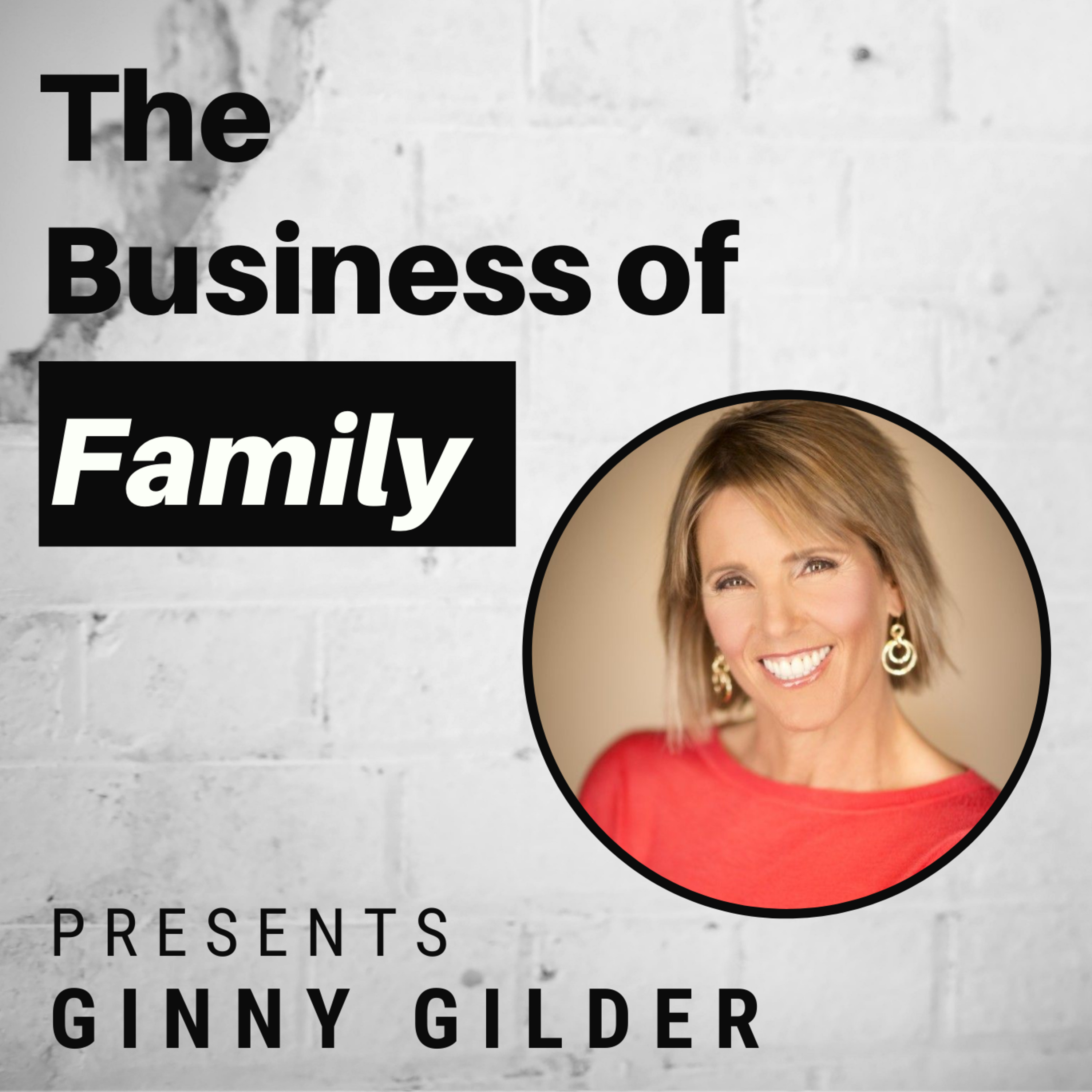
Episode 26 · Season 1
Olympic Medalist, G2 Family Office Founder, Social Entrepreneur & Owner of a WNBA Team
Key ideas from this conversation
She chose an investment office over a full-service family office, so her children would keep running their own lives.
Ask why you want to be in business together before you start. She had that talk with her sports partners, not her siblings.
Her father's one rule for the stock account he gave her: never take out more than 5 percent in a year.
Read the full show notesBio, standout quotes and the episode timeline
Ginny Gilder, is an American former competitive rower and Olympic silver medalist. As a second generation entrepreneur, Ginny’s day job is running her family investment office, Gilder Office for Growth but her heart leads her to focus on expanding access to opportunity in the realms of sports and education, especially for youth.
A serial social enterprise entrepreneur, co-owner of the WNBA Seattle Storm, and a writer, Ginny continues to look for ways to expand the footprint of women's professional sports in the U.S.
Standout Quotes:
- "The way that people really become good at something and grow wealth is by concentration" - [Ginny]
- "There are gifts hidden in tough times" - [Ginny]
- "You should keep doing something only as long as you're learning and growing" - [Ginny]
- "For any family that's lucky enough to have financial wealth you've got to think about whether you are going to insist that people get along, and at what price" - [Ginny]
- "The biggest thing that's probably shifted is recognizing what we really want, which is adult relationships with our adult children" - [Ginny]
- "If you want to see change in the world, well, you've got to invest, cos nothing's going to happen if you're not going to invest" - [Ginny]
- "What's really most important to most people is Human Connection... and if you really want to be connected, you've got to deal with the stuff that's the toughest" - [Ginny]
Key Takeaways:
- After making many mistakes starting a nonprofit, Ginny set up a business that helps start-up nonprofits avoid similar mistakes and achieve their goals.
- Early in her career, she had goals that were not related to working in the family business.
- Having a financial cushion had benefits, like the freedom to work without being tied to a focus on amassing wealth, although it came with less attention from their father.
- When the time came for a transition of the family business, she knew she had to step up to the responsibility placed on her despite her lack of knowledge or passion in the family business.
- There has to be a lot of very direct conversations if you want to be in business with your siblings.
- Ginny clearly explains that she has no passion for the investment business, but got involved, for the love of family, the financial security, and the business relationships that come with it.
- Having an investment office rather than a family office with bells and whistles was geared at equipping her kids to be independent, self-sufficient, and capable human beings.
- Honesty has been hugely instrumental in navigating the family dynamics in Ginny's family, she also had to understand the importance of having adult relationships with her adult children.
- When things go wrong, that's when you have to figure it out and it's also when you find out the relationships that are solid.
- The importance of dealing with difficult family relationships: it's so easy when life is good to think everything is fine but as soon as life gets hard if you haven't dealt with challenges and learned how to disagree and resolve differences, you're not going to make it through the hardest parts of life.
Episode Timeline:
- [00:49] Meet Ginny Gilder; sharing her personal and professional background.
- [01:34] Her family history and the origin of the family business
- [08:20] How Ginny got into the investment business.
- [22:50] What was your father's position when you started your nonprofit organization?
- [29:00] Ginny describes how the family dynamics affected the transition of the business to her generation.
- [30:42] What would you say that you've learned from the separation of roles between family and business?
- [33:22] What is the family business structure going forward?
- [40:05] How do you differentiate your investment office from a family office?
- [41:20] About Gilder Office for Growth
- [48:56] How do you navigate through your family dynamics in the world of wealth?
- [53:15] Tell us about what you're most passionate about in terms of one of the businesses that you own today.
- [01:00:40] Ginny's letter to her kids
Links:
- Seattle Storm : Ginny Gilder is the co-owner of the WNBA Seattle Storm
- Gilder Office For Growth : Ginny Gilder is the CEO & Founder of Gilder Office for Growth
Read the transcript
This transcript was generated automatically and may contain errors, including in names. Listen to the episode for the exact words.
MikeWelcome to The Business of Family. I'm your host, Mike Boyd, and this is my look into the world of multi-generational wealth creation, family enterprise, stewardship, family office investing, and the curation of a legacy. On the podcast, I interview members of some of the world's most interesting families to hear how they pass knowledge, resources, values, and wealth to the next generation.
I hope you will enjoy sharing this learning journey with me and would greatly appreciate any feedback or referrals you have to offer. To sign up to my weekly Business of Family newsletter, go to businessoffamily.net forward slash newsletter. Ginny Gilder is an American former competitive rower and Olympic silver medalist. As a second generation entrepreneur, Ginny's day job is running her family's investment office, Gilder Office for Growth. But her heart leads her to focus on expanding access to opportunity in the realms of sports and education, especially for youth. A serial social enterprise entrepreneur, co-owner of the WNBA Seattle Storm, and a writer, Ginny continues to look for ways to expand the footprint of women's professional sports in the United States. This is a fascinating and
wide-ranging conversation, which I'm sure you're going to enjoy just as much as I did recording it. Ginny, it is a pleasure to have you on the show today. Thank you so much for being here.
GinnyThank you for inviting me. I'm excited to talk with you.
MikeIt's going to be a lot of fun. Now, I would love to start with the origin story of your family enterprise and your family wealth. I understand that your father was very successful in business and a great philanthropist. Can you share a little bit of your history and how all of this came to be, please?
GinnySure. So my father grew up in New York City, pretty much lived there his whole life. He grew up in a family that came from Mississippi. They were Jews who were cotton brokers originally. And then probably his grandparents moved north. And my mom was an immigrant from Sweden. They found each other on Fire Island and got married.
And she ended up being his first of four wives. But she was the mother of all four of his kids. So he graduated from college. He went to Yale. He graduated in 1954. And my mom got pregnant in 1955, right after they had gotten married. And he had to get working on a career. and he went into the investment business. He started working at a company called A.G. Becker and in 1969, he decided to go off and start his own investment firm. I don't know that it's a quirk, but he decided that he was only going to invest individuals' money. So he never worked for institutional clients. You could give him $5,000 and he would invest it. But he had a few kind of,
I don't know that they were policies, but kind of the way he did things. First of all, he went into the investment business partly because he loved it, but he, I think, discovered it because he realized the way that people really become good at something and grow wealth is by concentration. So he decided he was going to apply that to the investment business.
And he only invested in public equities. He was not in real estate, private equity. And again, in the 50s and 60s, public equities were kind of, there was really not a lot of private equity. New companies would pretty much go through the IPO process. There wasn't all of the side stuff that happens now in the private equity world or in the venture world. But he, I remember once he told me he didn't think he was smart enough to start and actually run a business, which I don't know. I don't know that that was true, but he decided that he was going to find growth companies, not necessarily IPOs, but companies that were on the early start of their own growth in terms of
what they were trying to offer service or product. And he was going to invest in them. And he was going to invest in a very concentrated manner, which of course, in the world of wealth management is really kind of not done today, right? The idea of concentration is anathema. But that was what he did. And he told his clients that they were going to bet on themselves.
They should rely on the money, on his investing their money, not for the present, not to live on, that they should rely on themselves in terms of their ability to earn a living. And they should just leave the money they invested with him, not look at it. and he would build it and not worry about the volatility.
And there was a ton of volatility, like a lot. And that was kind of what he did. So he started with his own clients in 1969. He did really great in 1969. And then he got killed in 1970 and kind of went from there and learned the humility that the stock market can often teach. And from there, he went and built his firm.
It's called Gilder Gagnon and Howe. And he worked there until really a few years ago when he finally retired in his early 80s.
MikeIncredible. Incredible. And he must have been pretty good at what he did, I imagine.
GinnyHe did. He was quite good. And not only that, it was a lot of fun. At times, after dinner, if I went and hung out with him, he'd go, come sit next to me and let's read this prospectus. I'm like, seriously, Beth? But there were companies he invested in that were fun, like Dunkin' Donuts. I remember I was going to boarding school and we would have to sample Dunkin' Donuts.
So we would go driving up from New York to Boston and, of course, have to stop at Dunkin' Donuts. And he was an early investor in Denny's. So it wasn't it wasn't all, you know, really dry. And I did learn things just about how much business is about relationship and connection. And back then, you know, he could call CEOs and talk to them.
And I was in his office when he talked to a few CEOs telling them, I'm selling and telling them why. So I learned a lot about the importance of really maintaining relationships and building relationships from him.
MikeWould have been an amazing and formative upbringing, I imagine. I want to touch on his philanthropy too, because I believe later in life, he was quite the philanthropist in New York. Can you share a little bit about that?
GinnyYes. In fact, there's a street corner in New York City on the corner of 77th and Central Park West, which is where the New York Historical Society, the American Museum of Natural History and Central Park meet. And he was very involved in all those entities. And in New York City in the early 90s, he created a three-way challenge grant. He put in a third of the money, the city of New York put in a third, and then the new Central Park Conservancy had to raise a third to refurbish Central Park.
And that really led to the transformation of Central Park and in the context of a public-private partnership. And that was something that he always really loved to do. He loved challenge grants. So he created the Gilder Graduate School at the American Museum of Natural History, first graduate program at a museum. He was a huge lover of American history, especially Lincoln.
And he created the Lincoln Prize with a friend of his named Lou Lehrman. There's the huge organization called the Gilder Lehrman Institute, which takes original documents and makes them available to teachers and professors, really starting from elementary through college, and teaches them how to use these documents in teaching democracy. So they create, he and Lou Lehrman together created the biggest private collection of American history documents and then donated it to the Historical Society.
So that's the kind of stuff he did.
MikeIncredible. What a legacy. So growing up around this, being in the background when he's calling CEOs, sampling the Denny's and Dunkin' Donuts on the way, did all of this lead you straight into the investment world early in your career? Or let's get into the path that you took to where you are now, ultimately, as G2 running the investment office.
GinnyWell, the short answer is no. I kind of went running in the opposite direction for a few reasons. First of all, my father, one of the lessons, one of the things he's always saying was do what you love. And I saw how much he loved what he did. And I also saw how good he was at it. And he was, he was as fun as he was in a lot of ways. He was also kind of intimidating and he had pretty, I mean, quite high standards. And I don't think I ever thought I could meet his standards.
So I wasn't really comfortable with the idea of going to work for him. And frankly, he never said come work for me. It was only years later that he said that. And also I was a woman and he was a guy and, you know, I went to the same university he went to, but I fell in love with something very different. I fell in love with sports. And this was kind of right after Title IX was passed in the U.S., really opening up access to opportunity for women to compete at the college level. At that point, when I started at Yale, it was only a few years into co-education, which I didn't realize. But what I did know about Yale was it was still very heavily male.
And I had gone to all-girls school. So I was kind of looking for a way to kind of find my people. I was looking for where can I kind of connect with women. And I had seen rowing when I was in high school and thought, oh, I really wanted to try that. So I became a rower. And I fell in love with it. The Canadians actually introduced women's rowing to the Olympics in 1976. That was right during my first year of college. And for some unknown reason, I decided I wanted to become an Olympian, which really kind of crazy. I was, you know, as a New York City kid, I was asthmatic. I wasn't really particularly athletic, but the bug bit me badly. And on my college freshman team,
there were two women who ended up rowing in the 1976 Olympics. So it was a little case of, oh, see these other people doing it? They open a window. It's like, oh, maybe I can do it. And that really changed the course of my life in many ways. So with that as my passion, I did have my father tapping his foot like, you know, I paid for your education and this is, you know, you're supposed to go out and get out there in the world and make yourself productive and be of service. This isn't really about childish things like sports. So I didn't want to live in New York City, which is where he was. When I graduated, I had just made the 1980 Olympic
team. I moved to Boston and found a job so I could do what my father expected of me. And it's not like I didn't expect myself to work. Let's be clear, right? I mean, I was his daughter. I knew I needed to take care of myself. And even though my father ended up being very successful financially, he really, that really happened in the 1980s. And I graduated in 1979. So it's, listen, I'm a upper middle class white girl from New York City. Let's not kid ourselves, grew up with total privilege, but it wasn't the situation financially that our family ended up in really at the end, towards the later part of his career. So I got a job, but I also kept rowing and training.
And I trained through 1985. So my first five years in the business world, I worked in the computer software industry back when it was mainframes. I was training twice a day and working. And my father had started a stock account for each one of his four kids and each of us was born. And he gave that to me either when I was 18 or 21.
I don't remember. And he said, basically, this is what I started for you. It's yours. You're in charge, which didn't mean pull the money and you manage it. It meant he gave me what I call the 5% rule, which was don't take more than 5% in any given year out of the account. I'll manage it. Don't worry your pretty little head about how it's doing.
don't look because it's going to go up and down. And he didn't say pretty little head, but really what he meant was you don't have to worry about the ins and outs of investing. So I didn't honestly. And because he had created this financial cushion, it didn't change my commitment to having a career, but it changed my attitude about, well, do I have to worry about amassing a lot of wealth because, oh, my father's already done this. And like, how much money do you need. So that was literally what I thought in my 20s. The other thing it allowed me to do was it freed me up to think about what kind of work I wanted to do without necessarily being tied to
how much money I was going to earn, which may or may not have been. I don't think it was a mistake, but I know that when my kids hit that age, I had different ideas about what to talk about and what not to talk about because I ended up being really lucky because my money kept growing because I did follow the 5% rule. My father continued to do very well. And I'm just not a big spender, as it turns out. But not all my siblings felt the same way or followed the same life trajectory. And maybe we all could have benefited from a little more guidance. But my dad was really focused on building his career, building his wealth, living his life, and not worried so much about what was
going to happen with his kids. He thought he was providing for us and he did provide for us, let's be clear. So does that give you a little sense of what you're looking for?
MikeSure does. It's an incredible story. And a couple of things I want to follow up on there. You mentioned that all of your siblings were set up with a stock account. Did everyone ultimately sort of land where you landed? Did everyone follow the 5% rule or did different sets of behavior influence different outcomes in terms of how the wealth grew?
GinnyDifferent sets of behavior definitely influenced outcome. And I think what really happened was as my father got wealthier, he kept giving us money. So no one ended up in dire straits. But, you know, my brother has a PhD in classics, is a teacher. He's definitely created a career for himself. My older sister never really developed a career. And my younger sister had a career and then left that career and worked with my dad in the investment business as he started to transition or think about retiring. So we've all worked in different ways, but at least for a couple of us, I would say half of us really held onto it and grew it. And half of us probably
had depleted that money by the time we were 40 or would have if my father had not added more.
MikeIt goes to show the difference that it can make. So I'm curious then, post-college, Olympic career, congratulations for meddling, by the way. You were too humble to mention that. Where did you go from there in terms of the career? When did you ultimately come and join the family enterprise?
GinnyIt was a while. So I moved to Seattle from New York or from Boston, East Coast in 1985. I had gotten married to a guy who had lived in Seattle and I had a sense of he we would do best if we went where he had a community I wasn't sure I was done with rowing I was thinking about training for 88 and Seattle had a great rowing community I was kind of trying to create some distance between me and my family as well because as much as I loved my parents they also were very strong personalities with very established ideas of what constituted kind of the right kind of way to live life, what's a good life and what's a good path to pursue and what's maybe not.
And I think I sensed I wanted a little freedom to explore on my own. And the Northwest certainly provided that. And in the 80s, I really did want to work. I wanted a career, but I also wanted to have a family. And I didn't want to be a person who worked 80 hours a week and had a nanny who was there at all the critical moments.
And I would come in at the end of the day or the beginning. I wanted more than that. And mind you, I don't have anything against people who want to work and have that kind of a career. It just wasn't what I wanted. And I felt like I would have more freedom in Seattle to do that. And that, in fact, was true.
And what ended up happening was I went to business school at the University of Washington and was trying to figure out something that would kind of quench this thirst for meaning and allow me to be in the business world. And what happened was, and this is kind of a little bit of my personal story. I don't know if you want to talk about this, but my first child was a girl who was a full-term stillbirth.
So she died two days after her due date. It was really tragic. It was really rough. And this happened in 1986. I was planning on taking a year off from training and then go back for 88. But that really ended my rowing career because it took me a long time to get back to a place where I could figure out what life was really about and what was meaningful.
And rowing no longer felt meaningful. And in some ways, look, it's always true that there are gifts hidden in tough moments, in tough times. And that was one of the gifts was that she got me out of sports at a time when I probably should have gotten out. One of the things that my dad used to say to me is, you should keep doing something only as long as you're learning and growing.
And in retrospect, I can't help but wonder if I had stayed in rowing, if I had stayed through 88. And, you know, it's very alluring to be in a single-minded pursuit where you have a chance of glory. Granted, you have to love the day-to-day, but still, there's something that's very alluring about it if you get yourself into that kind of environment.
but I'm not sure honestly how much I would have kept learning because I knew how to train at that point. So I don't look at that part of it as a bad thing, but I ended up because of that. My second child was my oldest son and he actually also almost died. My doctor told me like four days after his birth. So I was starting to think, ah, this pregnancy thing might not be such a good, good idea. So my husband and I adopted our second son. He's now our second kid. And we ended up adopting his birth sister 13 or 14 months later when she came as a surprise. But before she came along, I met my son's birth mother and had a whole conversation with her about why she was giving up
Max. And she was Caucasian. The father of her, actually, she ended up having three children with the same guy. She kept the first one. So my son was her second child. He was black and she was, she had a high school diploma. She was living with her parents, raising her son, living at her parents. And she just told me, I can't afford to have another kid and raise him without really hurting my other kid. I can't make this work. And I just thought in 1990s America, this was 1991, I cannot believe that women are faced with this kind of a decision. And I ended up starting a nonprofit to work with women on public assistance. She was not on public assistance, but that was
what I did. I just thought we need to create access to opportunity for more women to be able to keep their children, raise their children, create their own ability to support their families and themselves and pursue their own dreams. And so that was what I did. I went into the nonprofit world. So I was an entrepreneur, but kind of the worst kind in terms of like, I wasn't trying to make money clearly because it's hard enough to start a business, but then to start a nonprofit, it means you're raising money. I poured some of my own money into it, didn't make very much money into this dream. And I ran that for five years, learned a ton,
really almost killed the business because I didn't know enough about management. And it ended up merging with another organization that exists today. But that was kind of the ramp of my business career.
MikeIncredibly admirable. What a story. Are you still involved with the not-for-profits today?
GinnyI'm not involved with that nonprofit, but I've kind of combined that passion for generating social change and social change with business through my love of sport because I came back around and got back involved in the sports world. so that experience which also i should say i had an experience when i was caught in college where i really discovered what discrimination felt like when i was at a university that didn't have adequate facilities for women for at the rowing at the boathouse and ended up doing this big strip in my freshman year with my teammates led by our captain and that whole experience really did radicalize me and make me realize how important access to opportunity was. So starting this
nonprofit was building on that very personal experience, combining it with my experience as a mom and adopting my son. So all these little personal things contributed to the path I've taken in life. And I don't really call it a career path because I really have always followed what my father said, which was do what you love. I went from working at that nonprofit, you know, starting that nonprofit back into a business that I started as a consultant to work with other nonprofits so they could figure out how to deliver on whatever their founding dream was. And I felt like I'd made enough mistakes starting and running a nonprofit. If I could stop a few nonprofits from making the
mistakes I'd made, that would be a good thing. And then my father came calling.
MikeThat's what I was going to ask. So I wondered through all of this, you mentioned, you know, when you were in your rowing career that he was tapping his foot, sort of wondering when you were going to get serious and pursue a real career. Did that sort of persist through your exploration of nonprofits or was he supportive of that? And then ultimately, how did he come calling?
GinnyHe was supportive. He was a little skeptical. My father was a conservative Republican. I have to say he would not have voted for Trump. He did not vote for Trump. I have to say that in this climate. But I'm a liberal Democrat. I'm a liberal Democrat. So we had a lot of really interesting discussions about the work I was trying to do and the role of government in individuals' lives.
But he contributed to my nonprofit and he gave me guidance. And he also ended up being a huge supporter and saying things to me that he had never said to me before, complimenting me in ways that I had never heard. And he really infused me with a lot of strength to just keep going when things were inevitably hard, as they are in life.
So he was a supporter, even though he would always rib me about stuff. And that was OK. He ribbed me about rowing. For years, he told me rowing wasn't a sport until he finally gave in and let me teach him. And then he fell in love with it and bought a rowing shell and rode miles and miles on his own in Maine.
So he had a way of, you know, kind of needling, but listening. So what happened was, let's see, I was in my late 40s and he was in his early 70s. This is over 15 years ago now, I guess. Yeah, this was 2004. And he was starting to think about his own transition. at some point he would retire. And he had hired my younger sister to work with his clients and help them start to think about the transition away from him. And he came to me one day and said, look, Britt Louise, my sister, she's working with me and my clients, but no one's working with the family. And one day I'm not going to be here. Would you help build the family's financial
bridge to the future. That was kind of the terminology. And he did not want me to come into his firm and work with his clients. Mind you, I literally did not know what a hedge fund was. I had an MBA. I had been working in the business world, but I knew nothing. And he said, I'd like you to start by managing my investments that I'm not managing. The far bulk of his financial assets. He was investing for himself, right? Alongside his clients. He ate his own cooking, but he had always invested in friends, hedge funds, various endeavors that they had come to him, you know, to see if he'd invest alongside them. So he handed me that list. And literally,
it was a stack of K1s and an Excel spreadsheet that his compliance officer had been keeping. and that was what I was given. And I was like, he said, just call these people up and ask them questions. So I researched, I mean, talk about diving into the deep end. I should say that the reason I was willing to leave what I had been doing, so I had been in the nonprofit world for a long time by then and I was feeling a little burned out.
I was feeling like, the thing about the nonprofit world in the US is that it comes from a place of scarcity. There's never enough. You always have to just settle for whatever. And it's wearing after a while. And I was starting to realize that I wasn't earning any money. And maybe I should rethink how I was approaching this aspect of my life.
Look, I wasn't poor. I wasn't, we weren't going to starve. But it was just starting to feel like things were maybe a little unbalanced. And so my father came to me at that time. And the other thing was, you know, my father asked very little of me. He gave me a ton. And he never asked me anything.
And even though I wasn't from the investment business, I wasn't wild about going and trying to follow in someone's footsteps who was incredibly successful. It wasn't something I was passionate about, but I adored him. And I had a huge amount of respect for him and appreciation. And if he was asking me to do this and he had enough faith in me, even though he shouldn't have as far as I was concerned, I was going to step up.
and I also felt you know tremendous loyalty to my family both to my three siblings and their kids and my kids and if I could help build a financial future for them too well I would pick this up this gift that my father was giving all of us and do what I could to prepare all of us for the future so that was how I started I started literally calling hedge fund managers his my dad's friends in New York who he had some money with and just going in and saying, you know, I don't really know anything, but here are my questions. And they listened to me. I mean, it's not like I was giving them advice. They listened to my questions and they treated me very well. Why? Because of my
father and how much respect they had for him. And that was how I learned about investing.
MikeWhat an incredible way to get an education, incredible access and the opportunity to just ask whatever you like. And to have that answer, it just sounds incredible.
GinnyYeah, it was fascinating. And I always felt like I was okay because I had very little of my father's money. So if I blew it, all right. And the only mandate he had given me was, look, Jenny, you are going to invest this part of my asset base. I want you to take some risk off the table. So he wasn't expecting me to generate the returns he was generating. He actually wanted me to be more conservative, which was great because I have a very different personality, conservative or more conservative is fitting with me. And he said, you invest my money and then we can talk with your siblings, see if they want to come in in some way. And that was what happened several years later.
It really wasn't until 2013 that my siblings came in. They came in as part owners in the investment business. And for five years, I ran the business with all three of them as my partners until really 2018 when we realized we didn't really see the business the same way. We didn't really have the same set of values in terms of how we wanted to run the business.
They weren't necessarily all comfortable with me being the CEO of a business when we were equal as siblings. That was a hard transition to effect. So two of them I bought out and my younger sister and I are still in the business together.
MikeWow. I can imagine that that was incredibly complex working through the sibling relationships as well. And so when you say buy them out, did you separate investment funds at the time as well? And now they're responsible for managing their own money? Or did you buy out their equity in whatever sort of holding company or family office structure that was in place?
GinnyBoth. They didn't have the same vision about how they wanted their funds invested. Frankly, they really didn't trust me enough, which is a product of, I think, some of our own family dysfunction. And I'm sure you know, I'm sure anybody who listens to this podcast has their own stories. And even if they've made everything work with their siblings today, there's a path that every sibling group has to walk to figure out that as adults, they're not the same people that they were when they were children and how to treat each other differently. And some people can make that transition and some can't.
and I was not able to do that with all three of my siblings.
MikeAnd so fast forward now, what would you say looking back on that you've learned from the separation of roles between family and business, or in this case, family and investment?
GinnyWell, I would say that I'm thinking of that line, the one way to kill a business is to pass it on to your family. That's not quite, I mean, it's not exactly our situation because no one passed it on to us. I created this business with my father and then brought my siblings in. But I think there has to be a lot of very direct conversation if you want to be in business with your siblings, whether it's a legacy business that you all are coming into together or whether you start it together, however it works, is really being able to identify the pressure points from your past as siblings and figure those out in a way that you can have create some peace and
agreement as to how you're going to work going forward because you really can't bury things and think they're not going to grow out of the soil and come and affect you in the future life just doesn't work that way so one of the ways i think families can do that frankly it's the same way I started my business when I went into the sports business with my two partners is there's a lot of discussion about why do we want to be in this business together?
What's the goal for the business? And what are our values? Like, what is, like, how do we want to run this business? What's our value set? What's most important to us? If I had had those, if I had known enough to have those conversations with my siblings, we probably wouldn't have gone into business together. We would have done it differently.
But I learned an enormous amount. I mean, it's kind of a tough price to pay because I don't talk to two of my siblings anymore. But I know that on the other side of that is I got my job done, the job my dad asked me, which is for five years, my siblings were part of an organization that was managing their money in a way that they had full transparency.
They learned a ton, whether they admit that or not. and they got to push up against an investment process and see the results and whether they liked them or not, they thought about their money in a way that was different from when my father had been investing all of it for us. So they ended up qualified, I think fully qualified to take the reins of their own financial futures. And at the end of the day, that's what my job was.
Mikeincredible and you talked about understanding values and what we're doing it for shared vision now that you've been through that experience of trying to unite for lack of a better phrase a sibling partnership and struggled with that what have you taken forward now what is the structure going forward you still got one sibling involved you've got adult children i understand have you sat down and talked about, well, what's our purpose? These are our values. What is it that we're doing with stewarding this money?
GinnyYes, absolutely. I think one of the things I've realized is I was 30 when I got pregnant with my son and I was never raised thinking explicitly about values and how to invest legacy money. The whole idea of having legacy money was not something that I was really aware of until I was in my late 40s. And by then, I became a lot more aware of my father's financial situation. It started to dawn on me with kind of like terror.
Oh my God, there's a lot of money here. And how is this going to change me? And at that point, I started grappling with, oh, wow, my kids. What's going to be like, oh, how do I prepare my kids? And it was when I started the family investment office and made a very explicit decision to start an investment office and not a family office that would provide all the bells and whistles that a lot of family offices provide, that I really started to think about the value set that our family cherished and started to craft a way of thinking about how I was going to work with my kids.
But already at that point, you know, when I, that my kids were teenagers and, and older than teenagers when I started this and then it took more years to get things going and they, I had not raised them explicitly to be prepared in any way for this. So there was a lot of kind of what I felt like was behind the eight ball, you know, kind of running to catch up learning.
So with respect to our family investment office, there's one more thing I want to say that will get us here. One of the things I learned in things not going well with my siblings is this idea that everybody has to do things the same way, like you have to be together as a family and do it all, is not true.
And it can really damage families. It depends on your values. If the most important thing is that the family stays together, then you have to be ready for the cost. And of course, I'm an American, right? I believe in individual freedom, right? I mean, I believe in being able to chart your own course. My father was like really, really believed in independence.
And the way he crafted his estate, he didn't leave a pot of money for all four of us. He gave each one of the four of us our separate part, separate bequests. Because he didn't want us on top of each other. he recognized that we're all different people. So that is a very important part of what I think of when I think of our family values. And to me, that means that for any family that's lucky enough to have financial wealth, you got to think about whether you are going to insist that people get along and at what price. Coming to your question about the family investment office, I had a choice about whether I wanted to go in the investment business. And I did it for a very clear set of
reasons. And I will say right now out loud, and my father knew it, I am not passionate about the investment business. I don't do it because I love it. I do it because I love my family. And I also do it because I love what it's made possible for me, both in terms of the business partners I have in the investment world and in the investment business, and because of the financial security that it's given me. Me, aside from what my father has bequeathed. So as I thought about this, and my investment business is also 3,000 miles away in North Carolina, in Raleigh, North Carolina. So I did that because my first employee that I hired in 2011 was there.
And I felt like it was better to have this sited on the East Coast near New York without having to compete with New York salaries than to have it in Seattle, given that I traveled to New York all the time. And it's worked out quite well for the business. But it's not like my kids could grow up and intern at the office or anything like that. And I have, you know, my kids are now in their late 20s and early 30s. And I've supported them to go off and invest in their own futures, bet on themselves, which is another one of my father's sayings, in the way that they see fit, not talking about the investment business. I mean, I didn't get into the business until my 40s. Why would I
expect or want them to do anything else? I want them to follow their own dreams. And not one of them, and I have three kids and two steps, has indicated any interest to date in being in the investment business. So I have actually, and I've created a path for our investment business with my employees of developing an RIA that is separate from our family office, assuming that one day the family office will go away, that my kids won't want it, they'll go in a different direction. But my employees who are my partners in the business will have a career path and a reason to stay with our firm. And by the way, this is also something I learned from my dad
because my dad adored the people he worked with. They were a whole nother part of his family. and he tried to take care of them. And I don't mean that in a paternalistic way, but they were building something that really mattered to him. And I feel the same way about my investment team at Gilder Office for Growth.
So that's really, I've separated it out. That part of my business life, I assume, is not gonna continue in terms of my kids being engaged. Now, something could happen. You know, one of them, my daughter's married to a guy who's really interested in real estate. My oldest is incredibly smart and interested in numbers and interested in business. We'll see. Life is long, but that's not the plan right now.
I have another business that I care about, but I don't know. Do you want to talk about that now?
MikeWe're definitely going to get into that, but I have so many follow-ups that I want to ask you about what you've just shared. So first of all, let's go back to your definitions of how you consider your investment office compared to a family office. You talked about a family office with all the bells and whistles, and you instinctively chose not to do that. So, in your own words, the difference between the two, how do you see it?
GinnyI wanted to focus on the area that I felt would support the growth and development of my children to become independent, self-sufficient, recognizing they had money that most people don't have in their back pocket and capable human beings who could run all the minutiae of their lives. So focusing on the investment part, I mean, it's a complicated part of life.
Being able, you know, having someone handle your private plane, having someone handle the art collection, which we don't have either, having someone be able to step in and hire your household help, even handle your insurance, I felt would undercut my kids' sense of responsibility and capacity to take care of what life really demands and needs if you're from people.
So that's the distinction I'm trying to make.
MikeTerrific. And Gilder Office for Growth, your investment office, what's the makeup? You said it's in North Carolina. how many employees, what does the team look like in terms of running that business?
GinnySo we have four employees, really big. The president is a guy. He comes from the banking world and he does all of our client management. And he's also in charge of starting to develop our RIA on the client side, which starting that in a pandemic was really interesting. So we're looking for maybe two families that want to join us, but that's what he does. And then we have our head of our investment team, who is a woman, our CFO, who is a woman, and our person who manages all of us, who is a woman. The investment committee is Emily, head of investments, Robert, and me.
The executive committee running the business is Don, our CFO, Robert, and me. Very small. We have regular meetings. We're on the phone with each other all the time, trading articles, having fun, laughing, and then holding down the fort at a time like when the pandemic hit and really figuring out how are we going to negotiate this whole climate, this landscape.
MikeAnd has the investment office continued to stay in public equities following your father's path, or now are you diversified across asset classes?
Ginnyreally interesting question a really great question no we've diversified we also don't invest with my father's firm and part of it is because the difference between our firm and our clients and my dad's clients is that my father invested with first generation family members is the way i think of it and created wealth for those families that then those families kids could have access to money that they would want to use on a regular basis. I mean, my father taught me, you know, it's better just, you know, the power of compounding, don't pull it out.
But at one point, are you just growing your money to grow your money? That's not really how it's supposed to work, right? You're supposed to put it to work, both in your own life and in the investment world. All of it is about forwarding human progress. so i came about the whole idea of investing from the perspective of people are going to need to take money out on an annual basis so we are going to work a plan so that we understand how much money people want to take out and we do it on a basis again percentage of AUM my kids have guidance on that i have my own guidance on me and my sister so we really say measured growth so you're not
going to find us in bonds. We are invested in hedge funds. We do have public equities that we manage ourselves. I, in fact, for the first time, manage my own IRA, and I'm very proud of how well it's done. And we're in real estate and private equity, a combination of funds and direct investments. So we are much more diversified. And we've also educated our G3 clients on our portfolio, educated them about asset allocation so that we can adjust everything, adjust the risk up, the volatility up or down depending on what they're comfortable with and also what their long-term financial goals are.
MikeNow, you mentioned clients a couple of times. Are the clients all family members or are you now building it with external clients as well or external money?
GinnyThe RIA will be external money. And one day we'll get our first client, probably when we're out of the pandemic and can actually meet people again.
MikeSo for now, you treat each individual in the family that has a portfolio as a client and they make their own investment decisions or not decisions, but their own risk appetite and adjust accordingly.
GinnyThat's right. And the best part about it is the person in charge of clients is my president and I am completely divorced from that. So my children and my nieces and nephews, although they're all still quite young, have the freedom to make decisions about their money and I am not involved. So really trying to maintain respect for confidentiality and acknowledge that they are adults and I should not be in their business, which for me is a lifesaver.
I'm very tempted to know everything. And when I know everything, I just get worried. Like, really, they're doing that? And the truth is they get to make their own decisions.
MikeAnd you talked about investment education that they're receiving. Are they receiving it through the investment office, through that team? Or is that something that the family that you're trying to pass down in terms of education and values around financial wealth directly to your children and nieces and nephews?
GinnySo there's two types of education. There's investment education, which my team does because they know what they're doing. And we wanted our client family members to develop a relationship with them where they felt like they could talk to them and trust them. So by now, after we started this in 2013, so they know it. Our kids know that.
And now they are, I mean, they're so much more knowledgeable than I was through my 40s. I mean, they are 25 years ahead of me. So I have a lot of confidence in their ability to evaluate investments, think about what feels comfortable to them. And it's not like they have to do this by themselves, right? I want them to be able to evaluate someone who's investing for them. And if they want to invest too, great. And then there's the other part, which is how do you deal with life? How do you deal with each other? And we've just really started going down that road of how do we as a family, how do you guys as a generation build your ability to connect and work with each other,
not just in the easy fun times, but in the hard times. And the backdrop of all of this has been my communicating with all five kids. And of course, my stepkids have money too. Do they have the same amount of assets as my kids? No, the truth is no. And we could certainly talk about that, but that's one of the topics for all five of them that they have to work through together.
But there is a value set that accompanies this wealth. My kids especially know because they grew up from birth about what it means to be part of a family that is privileged. Even before the money started, it was privilege. And the sense of anything you get from the family is actually not there for you to go on vacation. You want to go on a vacation? Go. Great. Go earn some money to go on vacation. This is about you becoming your best self. It's not about you entering the investment business or doing what I say. It's about you figuring out what you have to offer the kind of the human community and doing the best you can. So it's not a dollars and cents
conversation. It's about betting on yourself and growing into the best version as you define it. So there are strings attached. My daughter and I were just talking about this the other day about she's now 28, talking about how 10 years ago, eight years ago, she really did not. She said to me, I thought I was the poorest rich kid around. I had money and I couldn't access it. And now I understand why. I took it as a huge compliment.
MikeYeah, that's a great saying. And incredible values that you've passed down as well. I was going to ask about family dynamics because they're so incredibly complicated. And I think, you know, understanding a little bit about your story, you've taken complicated to the next level, if you don't mind me saying. You've got the introduction of adopted children. You've got stepchildren. You've got a second marriage.
How do you navigate this in the world of wealth? Would you mind sharing a little bit about that side, please?
GinnyWell, it's actually a lot easier now than it was even five years ago because I've realized how little control I have over my kids' decisions. And I've started separating my sense of my being a good or bad parent from their decisions. And I've realized I did make a lot of mistakes, just like every parent out there. So I've kind of calmed down about this fantasy that I was going to be perfect and they were going to be perfect. And I've just been able to admit, ah, it's not harder than I thought it would be, but it's fraught.
I would say the number one thing that I've really learned is to be really honest with my partner. I tell her kind of everything that I'm thinking, my frustrations, whether it's with her son or my son or whatever. And we've developed a lot more capacity to listen to each other's frustrations about any one of our children, and that helps.
and we've developed a way to kind of troubleshoot and figure out how are we gonna behave? And I'd say the biggest thing that's probably shifted is recognizing what we really want, which is adult relationships with our adult children. And that means we have to change as parents. That if I want an adult relationship with my 29 year old, I better treat him the way I treat my adult friends.
So that's been a huge, I mean, I wish someone had told me this when my kids were 20. So that's helped a lot. And really just recognizing that each one of our five kids is very different and they have a right to make their own mistakes. And I don't say that like they're making good or bad decisions. But when I was 29, when I was 30, oh my gosh, if I could go back and tell myself, don't do this, don't do this. I wish I could. I made a ton of mistakes. And yet that's where the learning is, right? It's, you know, maybe I shouldn't say this on your show, but when the shit hits the fan is when you have to figure it out. And it's also
when you find out the relationships that, you know, are solid. So I've just developed a lot more capacity to take a step back and have some faith in our five kids, even if at any given moment things don't look so good. And I do trust long-term the values that we live, that Lynn and I live together will show up at some point if it's not showing up right now and everything my kids, each of the kids do, they will show up. And the last thing I'd say is that we have really invested in having honest conversations. And when one of our kids comes to us and says, I'm unhappy with you, is we've developed our capacity to listen and also to share more as adult to adult again,
kind of our own woundedness with them, not necessarily about what they've done, but just to give them more perspective on who we are as humans.
MikeSo powerful. And I think we could probably have a follow-up conversation of this one and just spend an hour on family dynamics. You've got a lot to share there.
GinnyBut you know, Mike, one thing I would say about that is not every kid is ready for that when you might be ready for it. So I think recognizing that just because someone's 28 or 29 years old doesn't mean that they're ready to walk into looking at their parent as a human being who's separate, you know, has an identity that's separate from being their parent.
I wish I had figured this out about my own parents, you know, when I was a lot younger than I did finally figure it out.
MikeYeah. And as you say, adult relationships with your adult children. I think that's a wonderful takeaway. I want to get into what you teased us with before, which is all about the business that you truly love. I'm not going to spoil it. Tell us about where you spend your time and what you're most passionate about in terms of one of the businesses that you own today, please.
GinnyI am one of three owners of a WNBA franchise called the Seattle Storm. The WNBA actually has been in the news a ton this week because of the election of Pastor Raphael Warnock to the U.S. Senate from the state of Georgia. He ran against another WNBA owner who is a huge Trump supporter and who also really denigrated the Black Lives Matter movement.
Bear in mind that the players in the WNBA, 80% are Black. So the WNBA players, there are 12 teams all across the U.S., played last year, 2020, during the pandemic in a bubble in Florida. And they dedicated the entire season to the Say Her Name campaign in honor of Breonna Taylor. so when the owner of the Atlanta dream came out running for u.s senate and was so critical of the black lives matter movement the all the teams got together and decided to support reverend and transformed his campaign in early august and he ended up winning two days ago anyway so I'm one of 12 owners. I became an owner in 2008 when the men's and women's team in Seattle were
sold to a businessman from Oklahoma. We were able to carve off the women's team, which isn't nearly as valuable as the men's. What I say about this business is that it lives at the intersection of business, sports, and social change. And that is a corner, like it's where I live. It's where I belong. It's where I love to hang out. And that's where I spend a lot of time.
MikeIncredible. It certainly sounds like the right fit for you. And so what does the future look like? Is that an investment or is that considered a family business? Is that a legacy asset? How do you see it in your mind?
GinnyMaybe. Do you remember your three questions? So is it an investment? Well, I think people, there's all kinds of returns that people look for. One is financial, one is kind of benefit to the community, or humanity, if you want to get a little hoity airy fairy. In my case, I really believe that women deserve the chance to play their sport for a living just the way men, men have that opportunity.
and I couldn't do it in the world of rowing. Rowing is not a professional sport, but there's women's pro basketball. And if you want to see change in the world, well, you got to invest. Nothing's going to happen if you're not going to invest. So is it an investment? Yes. Not only that, the league will not survive if we cannot sell our team at some point for a profit.
Not because we have to make money, But that's the way the business world works. So we have to build the league if we want a financial return. The league's survival depends on our being able to get a financial return. So it's an investment. Is it a family business? It's a family business because I'm involved. Three of our five kids live in the Seattle area, love the game, and love talking about sports, love learning about sports, loving having a little bit of an inside track, knowing that their legs will get broken if they ever say anything in public that I've told them privately.
So yeah, it's a family business.
MikeAre people involved on the board of directors or anything like that yet?
GinnyNo. And that's where you start getting into the conversation about legacy. I have started conversations with one of my kids about interest level and are you becoming more involved now becoming more involved doesn't mean going to work for the business I would never foist that on my CEO right but becoming involved from an owner perspective I mean my co-owners and I do a huge amount I mean we're really engaged and involved in the business and I'm really the strategic, long-term, crazy thinker, if you will. I'm the one who comes up with big ideas and then drives to try to make them happen. My co-owners are much more operationally focused and are involved in, Jenny, that's okay. How do we try to make that idea happen? And they provide
the thinking and the management, you know, kind of the rigorous thinking to test out those ideas and then the management to realize them, if you will. So I've just hired a consultant who I'm gonna start working with who is expert in guiding families through transitions of legacy businesses. And this is a little different because we could sell this team.
And I wanna go through this process with some of my kids. I'm not gonna go through it with all of them because they're not all interested. If at the end of the day, no one's interested, great. no harm, no foul. We will have had a huge opportunity to deepen our relationship and learn more about each other. And they will have learned stuff that will hold them in good stead for the future. And if by some miracle, one or two of them want to do this, awesome. So that's how I view it. And I'd say the odds of it working in terms of it staying in the family are probably pretty slim. So I don't have expectations that are going to get in the way here.
MikeIt's fantastic. You're not dictating terms, but offering the opportunity to expose them to it, nurture them into it if they have a passion just like you do.
GinnyRight. And that also is from my dad. My dad used to say family is business. And there was part of me that really resented that. Like, really? We can't just hang out and have a good time? And what I've come to realize is there is nothing I like more than doing projects with my kids, with human beings.
And the first project I did with my dad was raising money for the Yale University Boathouse back in the mid 90s. And it was an amazing project. He basically said, here, I'll put up this money. You raise the rest of the money. You deal with the university president and all the other stuff. And here, what are the criteria we want for the gift?
And then off we went. And that experience was amazing, especially because the first thing that happened was when I went to talk to the university president. he told me and my best friend, you will never be able to raise this money. So the first thing we got was a no. And then we turned around and did it.
And like just having my father's backing and his support, it was incredible. And, you know, that's what I dream of with my kids, whether it's a project I bring to them or they bring to me.
MikeI love that. There's nothing like getting a no up front to motivate you to get it done, especially saying it to a competitive sportswoman like yourself. Incredible. Ginny, this has been amazing. And it's time for our final question now. Imagine you're writing a letter to your children. What is one lesson or idea that you don't think many parents would mention, but you consider important to understand?
GinnyI probably would. I mean, I think it's something that I'm already talking to them about, but it's critically important is the importance of dealing with the difficult in relationships. Like, it's so easy when life is good to think that everything's fine and not sweat the stuff that might be under the rug. But as soon as life gets hard, if you haven't dealt with challenges and learned how to disagree, resolve differences, and get on the same page in some way or another, you're not going to make it through the hardest parts of life.
And at the end of the day, what's really most important, I think to most people, is human connection. And that's certainly what all of us in the pandemic are missing. And if you really want to be connected, you got to deal with the stuff that is the toughest.
MikeWonderful lesson. Ginny, thank you so much for being so generous, so transparent, and telling such a wonderful story. I hope that this is the first of many that we get to do over the coming years. Thanks again for making the time. and sharing with us.
GinnyThank you, Mike, so much.
MikeTo find more episodes of the Business of Family podcast, go to businessoffamily.net. You can also sign up for my email list at businessoffamily.net forward slash newsletter. After you sign up, you'll receive immediate access to all past issues and then one email per week. You can also follow me on Twitter using at Mike Boyd. If you enjoyed the show, please tell a friend or leave a quick review on iTunes, which will help more people discover the business of family. Thank you so much for listening.
Keep listening
If this one landed, start here next.

Using Financial Capital as Force For Good in the World
Another family office built around a purpose of its own.

Building a Family-Focused Office for Sam Zell
A family-focused office, with as much effort on people as on money.

Building Your Family Bank to Owning an NBA & NHL Team
A family bank with written policies and a say that is earned.
The Business Family Diagnostic · Rising gen
What should a family office not do?
Ginny chose not to have hers book the flights or hire the help, so her children would keep the capacity to run their own lives. Do the young people in your family take on real responsibility?
“The next generation has a clear path to understanding what it will own, whatever role each person chooses.”

Every family wishes someone had recorded the generation before.
I built Enduring Stories to do it for yours: a guided voice conversation, from home, that keeps your family's voices, values and history.
The newsletter
The most useful things in these conversations are the things families rarely say out loud.
I share them in my newsletter once a week. Sign up to receive the ideas directly and start building the foundations for your family today.