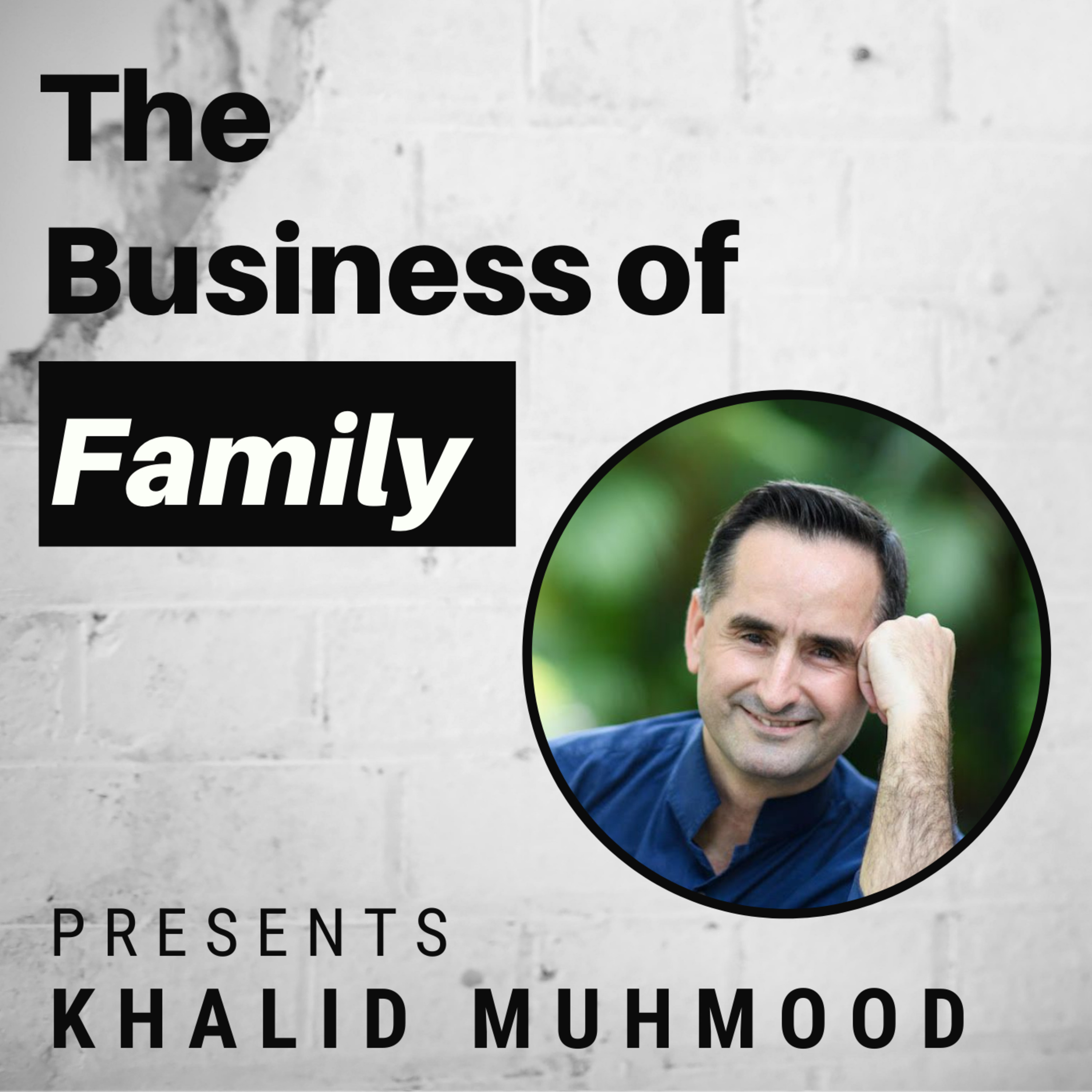
Episode 25 · Season 1
Using the Family Holding Company to invest in Education
Key ideas from this conversation
Most competitors sold to private equity. Khalid and Arabella chose to hold, because they'd found purpose.
Prepare the children to be good owners, not to be the CEO, and take that pressure off them.
Three rules for raising siblings who can own together: punish both, never compare, never be the judge.
Read the full show notesBio, standout quotes and the episode timeline
Khalid Muhmood is from the UK and through the family business holding company Dragonfly Education Group, is an operational investor in education.
He has been active in the business of education since 1994 when he and his wife, Arabella Peters, co-founded Apollo English and then the British University Vietnam. Since then they have invested in a number of businesses all focused on education.
Khalid and Arabella see themselves as the founding generation of their family enterprise and intend to never sell their Dragonfly Education hold co. They’re actively involving their young children in business conversations and laying the foundation for generational wealth, legacy and impact.
Standout Quotes:
- "What's your biggest headache?"
- "Learning from successful family businesses; so many of them do not load up on debt" - [Khalid]
- "The future of education is blended, that means you've got to incorporate online with offline" - [Khalid]
- "Sophisticated multi-generational families.. have taken generations to figure out that they need to separate the Governance from the Operations, and that the family needs to be excellent stewards and owners first before they can consider playing an active role in Operations" - [Mike]
- "A well-run family business is difficult to beat, especially during downtimes" - [Khalid]
- "Why trade anything in, when we've found purpose?" - [Khalid]
- "If you’re building any business, I'd say that 'Focus' is the thing that's often lacking, especially if the entrepreneur at the beginning thinks they have to say yes to everything" - [Khalid]
- "Look for the good in life... because it really helps you enjoy the journey" - [Khalid]
Key Takeaways:
- If you want to be truly in control of your journey in a business, you need to be the owner, not the manager.
- At the very beginning, the vision was simply to get the business to survive.
- It's only when you move from surviving to thriving that you can ask, "what do you want to do?"
- When asked "what is your biggest headache?" at an event, many of the entrepreneurs answered "My father".
- If you're not happy with 60000 pounds per year, then any more money might not change anything.
- Khalid describes the challenges of Covid-19 as a learning period for the business as a whole.
- Finding a way to create balance and incorporate online with offline learning is pivotal, that will be the future for the family business.
- Khalid and his wife, Arabella involve their kids as much as possible in the family business even at the early ages of 8 and 10, with some tests to determine their level of interest and perception of the business as a whole.
- In the future, the key role for the kids is going to be "Good Owners"
- The stewardship role is critical
- One of the tips to help foster togetherness among children is that if one of them does something wrong, punish them all.
- Other points to note is to never elevate one sibling above the other and to always leave them to sort out their arguments without being the judge.
- Khalid shares that the preferred investments taken by DragonFly are those in which a controlling stake can be bought.
- A major mistake that was made at some point was accepting an offer from Nokia when it should have been turned down because it was distracting from the core competency of the business.
- Khalid shares that his source of knowledge includes mentors, peer to peer learning, and mistakes.
- From Khalid to his kids: Look for the good in life because it really helps you enjoy the journey.
Episode Timeline:
- [00:49] About Khalid Muhmood and the inspiration for starting the business of education
- [06:01] Khalid explains some of the reasons behind the choice of Vietnam as a location for starting the business
- [08:59] What was the vision at the time of starting the business
- [15:03] The new vision for Dragonfly Education Group
- [19:41] How did the business hold up in this period of Covid19, do you have an interest in online learning?
- [24:34] Is there a vision of bringing your kids into the business if they're interested?
- [31:20] Do you have any other family structures aside from stewarding Dragonfly as the main asset?
- [32:53] Khalid shares some of the values, principles, and parenting approaches to raise well-rounded children amidst wealth.
- [36:37] Where does this family business DNA come from?
- [41:17] Where do you think you'll make the next operational or financial investment?
- [43:01] One of the major mistakes made in running the business: Losing focus
- [47:50] A letter from Khalid to his kids
Links:
- Khalid Muhmood : Khalid is the Founder and Investor in education with a passion for delivering education that develops global citizens and fosters prosperity.
- Trung Tâm Anh Ngữ Apollo | Chương Trình Học Tiếng Anh Với 100% Giáo Viên Nước Ngoài : Khalid has been active in the business of education since 1994 when he and his wife, Arabella Peters, co-founded Apollo English and then the British University Vietnam. Since then they have invested in a number of businesses all focused on education.
- Dragonfly Education Group : Khalid is from the UK and through the family business holding company Dragonfly Education Group, is an operational investor in education.
Read the transcript
This transcript was generated automatically and may contain errors, including in names. Listen to the episode for the exact words.
MikeWelcome to The Business of Family. I'm your host, Mike Boyd, and this is my look into the world of multi-generational wealth creation, family enterprise, stewardship, family office investing, and the curation of a legacy. On the podcast, I interview members of some of the world's most interesting families to hear how they pass knowledge, resources, values, and wealth to the next generation.
I hope you'll enjoy sharing this learning journey with me and would greatly appreciate any feedback, resources, or referrals you have to offer. To sign up to my weekly business of family newsletter, go to newsletter.mikeboyd.com.au. Khalid is from the UK and through the family business holding company Dragonfly Education Group is a founder and investor in education. He has been active in the business of education since 1994 when he and his wife Arabella Peters co-founded Apollo English and then the British University Vietnam. Since then, they've invested in a number of businesses all focused on education.
Khalid and Arabella see themselves as the founding generation of their family enterprise and intend to never sell their Dragonfly education holding company. They're actively involving their young children in business conversations and laying the foundation for generational wealth, legacy, and impact. Khalid, thank you so much for being here today. It's great to have you with us on the show.
KhalidGreat to be here, Mike.
MikeI understand that your family has quite a rich history with education, but you're not actually the second gen in a specific business from my understanding. Tell me about the inspiration that you've had around the education industry and how you got your start.
KhalidYes. I think I was very, very lucky because I was brought up actually in Kuwait. My mom's from the UK. My dad's originally Iraqi and spent my childhood in Kuwait. Whilst we're in Kuwait, my parents founded, they didn't own, but they were the couple that got it off the ground, an international school called the Kuwait English School, which is still running today.
They're still operating today, working very closely with the owners. That's what I was fortunate to be exposed to as a child. And that's where the seed of how rewarding and purposeful it could be to operate in the education field, that's where the seed was planted in life. Later in life, originally, I think I wanted to become a pilot.
That never... And I'm sorry to say, not even a jammy, not RAF or jet fighter. No, no, no. Airline. I actually wanted to become an airline pilot. And that didn't happen. but I always had it in my mind that I want to do something in education. So at the beginning, the agenda was not family business at the very beginning.
It was build a business. And I was also very fortunate that I met the person who today is my life partner, Arabella. We both ended up building what today is Dragonfly, but building that up together. So that's really the seed. The seed was watching my parents do what they're doing. and then me realizing that if you want to be truly in control of your own journey, not that I was a control freak, but it was like to be truly in control, you need to be the owner, not the manager.
You need to be the owner. And that's the role that in my mind, when I saw the dynamic between the owner and my parents, the takeaway number one was how rewarding and impactful in so many ways it would be to do something in education. And then the second one was, if I'm going to do something, I need to do it as the owner.
MikeVery interesting. And did you say that they're still operating today in Kuwait?
KhalidYes, that's what's amazing. And it's testament to their relationship with the owner that here they are, the school's been going. They're going to hammer me for getting the exact year, but it's maybe about 40 years now. And my mom's still the school principal. My dad's still director of operations, they're still very involved working on the school together. If I maybe continue the thread, what happened with Arabella, she was my girlfriend at the time, but my wife now, what happened with us was I've got one of the things I'm quite proud about when I reflect back is at the age of in my late teens, I wrote to Lloyds Bank in the UK, which is where I had my
student bank account. And I said, one day, I'm going to need capital from you to open an education business. Can you sign this letter and send it back to me? So I've got some evidence that when I do approach you, it's not a pie in the sky, rabbit out the hat idea. And I've got that letter. They did that. They did that. Signed it.
MikeThey did it, really?
KhalidThey did it. They did it. Signed it. Sent it back to me. So the determination at the beginning was there. And then it was a huge leap for... Arabella and I, we both met at uni. It was a huge leap for us in our early 20s. I'd left uni. I was in Singapore teaching maths. She was in the UK working in leading the marketing function of one of the insurance companies. And we both just jumped into Vietnam together to start our initial business, which we still own today, which is Apollo English. And then 18 years in Vietnam, building up Apollo English, and the British University of Vietnam. And then-
MikeIncredible.
KhalidYeah. But that's like the thread, the early day thread. I'm simplifying it all, but that's the early days thread.
MikeSo help me understand that key leap. You were in Singapore, Arabella was in the UK, but you went to Vietnam. What was the attraction? Was that simply because you saw the opportunity to teach English from what you were doing in Singapore? Or was there some other link to Vietnam that took you there in the first place?
KhalidWell, when I reflect back on all of this, it's the fact that neither Arabella nor I had any connection at all with Vietnam. It was literally... We didn't know anyone, didn't know anything. But we traveled. We went there a few times to look at the suits, see the lay of the land. And we both felt that there was, with the limited seed capital we had. We had two things in our favor. One was some seed capital from family. And the second one was a lot of love and support from the family, both our parents, to say, look, whatever you want to do, we're with you. And so we took the plunge. I quit my job in
Singapore. She quit her job in the UK. And we moved to Vietnam. And the logic was back then, the memory of Vietnam in everyone's minds. This was like 1992, 1993, when the initial research was kicking in. Everyone, even in places like Singapore, would look at Vietnam as being this sort of backwater, war-ridden country. It was not on anyone's radar. Everyone was looking at Indonesia back then under the Suharto regime. But Arabella and I could see in Vietnam, we could see there was so much potential that we really we believed in the country we believed in the people and we felt that there's there's it's really worth us giving this a go make really seeing what we
could do and we literally started with nothing on the ground at all and spent like i said i think it was about eight nine years initially in hanoi then another eight nine years in ho chi min city And we were there. Even when Vietnam did come on the radar, Asian financial crisis quickly took the attention away. So, Mike, this is the way I like to explain it. On the ground of Vietnam, initially, we were like the adventurers.
And then Asian financial crisis comes along and everyone looks at this part of the world and thinks, OK, now we're the losers. Because what are we doing operating in this part of the world? And then fast forward today. Today, we're the visionaries because we could see all of this thing. But the reality is there was a lot of luck involved with this. We chose Vietnam. We put our heart and soul into building the business during a lot of every single challenge you have with building any business in any country.
All the normal issues, cash flow management, brand building, retaining talent, all the challenges you have. We had it in a country where we're also learning how to operate in what was to us back then a foreign land.
MikeHugely challenging. So tell me, the vision back then, was it start a business, be successful, be sustainable? Or was there a grander vision of family business or a holding company or generational business? wealth or interests at that time? Was there always some North Star guiding the bigger purpose, or was it, we're going to go to Vietnam, we're going to build Apollo English, and we're going to make a real goal of it?
KhalidWell, here was, for us at the very beginning, it was build a sustainable, build, I have to say, in the very early days, the word family maybe didn't come into it so much at the very beginning, in terms of we felt we're going to build for the next generation. Why? Because at the very, very beginning, you're just so busy surviving, trying to get this business on its legs. And so it was all about, can we get this business to first survive and then move into thrive mode? And it's only when we move from survive to thrive, which took a few years, took a while. So only when you get to that phase, and then you get approached, you know, all these, almost every other competitor we have in Vietnam has
already been acquired by...
MikeReally?
KhalidYeah, yeah. All being acquired, nearly all of them by private equity. So it's only when that starts happening, you start to figure out, okay, what do you really want to do? What do you really want to do? And that's when slowly you start thinking, well, why don't we... A big advantage for us is we don't have to think about, we need to exit in two years or three years or five years, or we can actually do what's best for the business, best for our students and parents, what's best for our team, long-term, medium to long-term. You can look at things at a different horizon.
That soon became one of our competitive strengths, that we could look at things on a medium to long-term horizon. So that kicked in. Then I remember, Mike, in one of our previous conversations, I mentioned to you a huge turning point. So we had Apollo, and we also had the British University of Vietnam. It was an event I went to. There was a family business event. I went there, and the speaker from the US came over and asked a question to the audience. What's your biggest headache? I was sitting there as one of the few, let's call it the first gen. Almost everyone else in the room was second gen, third gen, fourth gen. The chaff said, bite down, what's your
biggest headache. And it was eye-opening for me that 80% of the results in that room were my father. And I was expecting people to write cash flow or retaining talent or how to diversify or scale up. I was expecting all of that. And actually, when I saw that most of the people in the room wrote my father, that was eye-opening. And then the second thing that was eye-opening, we're seeing the realization that there were so many businesses all around the world that are super successful, and they've got the family business DNA built within them.
Tata, Ikea, Walmart, Samsung. So that helped then plant another seed in my mind thinking, well, why not start thinking differently? Why not start thinking that I've got the opportunity to lay a foundation, work with Arabella to build a foundation, and make this a family business?
MikeIncredible. And I love that. Also, as a founding gen and entrepreneur, having that opportunity to gaze a little further ahead and look at enduring companies and the longevity of what you're building and not being forced to sell, I think is also an interesting piece. I'd love to go back and touch on that. As you said, everybody else was acquired by private equity. So I assume you've had a number of approaches for the business or businesses. When that first occurred, did that make you sit up and think about it? Did yourself and Arabella actually consider, well, we really could take our chips off the table. We've worked really hard with this for many, many years. We could take a big chunk of capital off, diversify the family,
have a safety net, or we could say no and keep building. Was there a bit of a wrestle in terms of that decision in the first place? Or was it always a clean cut? You knew the answer from the beginning?
KhalidThere was a wrestle, but a very, very short one. A very, very short one. And one of the things that really swung it, swung the thinking for us to say, no, no, no, don't just build and sell. Just keep building, building, building. It was this realization that many of us get hooked on, we get hooked on money. And you see people get hooked on money and it becomes, it's never enough. Whatever you have, you want more and more and more. I've seen this around me so much.
Then you've got research. I think it was Purdue University in the US, which came up with this research. There's a sum. It's something like 60,000 pounds a year is the amount of money you need to be happy. So what they're basically saying is that if you're earning £30,000 and you then earn £40,000, yes, you will feel happier. And if you're earning £50 versus £40,000, yes, you'll feel happier.
But once you reach £70,000, if you're not happy, if you're not happy by the time you've reached £60,000, £70,000, then actually, whatever you win over that, it's not going to change. You're still going to have this sort of unfulfilled feeling inside you. So it's actually looking at that and also then realizing, do you know what? What would we prefer to do? Grow a business. Grow a business in this impactful sector. We've been so lucky to operate in education versus sell out and become money managers. And that which doesn't appeal at all.
MikeInteresting. And great philosophy, which I subscribe to. So tell me about how that evolved for you? What's the new vision? When did Dragonfly Education Group come into it and this hold co-model?
KhalidThat came out of the realization that actually, we do as a family business, we need to diversify all within the education sector. It's all within the education sector, but we do need to diversify. And if you look at every single successful family business, you look at how they operate, so many of them, it's either through geographic diversification or through business line diversification.
But they start with the core, and then they slowly move into the diversification. So for us, it was, right, we start with English language training, which we do under the Apollo English brand. And that today we've got an excellent CEO, Chang, who's running that. And then we looked at it and thought, well, what do we want to do beyond that?
And so we started work on this one a while ago, British University of Vietnam was a separate entity. It took us from English language training to higher education. And so everything we do under higher education is under British University of Vietnam. Then if you're looking at the third pillar, what we want to do going forward in the future, we're actually looking into the areas of math enrichment. And we're also looking into the areas of preschool. And then we do do some investing in education businesses where we feel someone else has already started something.
we feel we can be their big brother. We feel we can add value to their journey. It's not just through the finance. It's got to be more than that. We feel what's much more valuable is our time, our experience. So we look for businesses where there's someone we can really add value to, bring from all the learnings that we've had on our journey, help them make much faster progress on their journey, and much more through our experience than just the money.
And for that, by the way, to put it in perspective, it's like maybe one investment a year. It's not like we try and do a lot. We're very selective.
MikeYeah. Yeah. Very aligned. You have owner, operator, investor experience. And for the right candidate, that's a perfect alignment.
KhalidCorrect.
MikeAnd great alignment for what you're looking forward to, I imagine, in the whole code.
KhalidNo, correct. Correct. And I think the other big shift for us as a family is also focusing, realizing that, okay, we want to be active in education, but the role has to transition from us being the operator and us being the managers to us being the owners. Let's learn to be good owners. And that's taken time. And that's taken time and it's involved making sure that we set up a board, make sure that there's actually more non-family on our board now than family.
We've got very, very competent. If you go on our DEG website, you'll see, including people you've interviewed, Richard Eu, and then people you haven't interviewed, like Dougie Cameron. We've got a very strong board that helps us become good owners. And that's something I'm working on right now. It's a constant effort, constant learning to say, how can we now make sure we're good owners?
And then we support the CEOs and the management, everyone under us. We support them to succeed.
MikeAmazing. And so just so I get the structure right, Dragonfly Education is the holding group or the umbrella over the top. Then you've got Apollo underneath, British University, Vietnam, and this new pillar in maths and preschool and other investments.
KhalidCorrect.
MikeAnd so from a Holdco perspective, the existing businesses that are up and established and cash flowing, I assume they spit out some profits up to the holding company, which allows you to make other investments across the group or into new ventures. Is that right?
KhalidYeah, that's correct. That's correct. And we're very, very risk averse. So that's where, again, it comes to learning from successful family businesses. So many of them don't load up on debt. And we know that we've got within, if you look at Apollo English, for example, and then even at Dragonfly, zero debt, because we want to keep the business strong. And many outsiders would look at us and say, that's a lazy balance sheet you've got there.
But when COVID first came, that's what protected us. That's what enabled us to stand strong and say, we will figure out a way to manage through this. We will figure out a way to come out of this because we didn't take on debt.
MikeAnd that leads me into an interesting topic around COVID. How have you responded? How did the businesses hold up? And also a follow-on question about online education. Do you have an interest in the space? Do you see a future in the spaces? All of this virtual learning that we've been forced to experience, how do you think that's going to play out in the future?
KhalidRight. I think, okay, take the first part of your question. We were very, very fortunate through COVID that if you look at BUV, British University of Vietnam, under the CEO, Ray, did an amazing job, him and his team, of switching to the online learning when there was a complete shutdown. It's a little bit easier to do with the teenage students all at the university age.
It was challenging then. If I look at Apollo with Chang and her team, they did the same. And I'll say it was more challenging just because they've got, how many at the time, 45 locations throughout Vietnam. And young kids, young kids, as young as three, as young as three who study with us, you can't go to the three-year-old and say very easily, right, get your iPad out.
And on top of that, the parents are all stressed because COVID just hit everyone. And so the parents are stressed, and yet you're asking the parents, can you please support your child? you end up putting a burden as well on the parents. So the positive side is as a stopgap, as something to help keep everything going during COVID. It was amazing what the team did and how our team responded and how our clients, how our students responded. It also opened our eyes to the limitations, the pros and the cons of what's in online learning for the future.
I have to say, I link it back to our kids at school in Singapore. We went through the same thing as parents. When the school was shut down, we all had to switch to online learning. It was also eye-opening for us. What's the impact on the students' learning experience? And what's the impact on the parents, the burden you put on the parents?
And we had amazing conversations with our kids about what we can learn from this and what should we be applying to what we're doing in Vietnam and what we should not be applying because they're experiencing all of this in Singapore, where we've been for the past nine years. So it was a real learning, real learning period for us.
MikeWe can come back to the online piece in a moment, but I'm curious what the kids had to say about their experience of being forced to do online learning from home. And what was some of their advice for you in terms of what you should adopt and what you should ignore when it comes to the business interests in Vietnam?
KhalidWell, it re-emphasized the future. And this is something we believe in for anything Dragonfly does. We passionately believe the future of education is blended. That means you've got to incorporate online with offline. And if you can get the balance between those right, that's what's going to hold us strong and steady for the long term. And historically, over the past few years, pre-COVID, I was always a bit sort of looking over our shoulder at all these online players, especially in China, these online players that are doing round A, round B, round C, round D of financing.
And each round, Mike, each round is not like $10, $15. Each round is like 200 mil round C, 500 mil round E. And so you're looking over your shoulder thinking, well, hang on, are we going to get completely wiped out by these pure online providers. And the learning for us, the big learning for us is, no, if we can get the balance right, if we can get that blended model right, that's what's going to be the future for us. I was even having a chat with my daughter, Sophia, and son Emil, having a chat with them about even homeschool. I was interested. You've heard about these pod schools where parents have been developing these pod schools. And I was
asking them, look, guys, should we leave? Let's leave the school there. Why don't we create a pod school? And that was a very clear reaction to that. No way. No way. Why? Why? Because actually, it's the social element. At school, it's not just about the learning from the teacher. They love the social element that comes through sitting in a class of 15, 20, 25 students. They love the social element that comes with that. And that all goes away when you do the online. It's much, much tougher to replicate that. So sorry, I'm rambling. But in a sentence, the future is blended. That's the big learning that my kids and I, and Arabella, we all subscribe
to.
MikeIt's a fantastic answer. And I'm curious what other conversations you have with your kids about the business. Now that you've come through as a founder, you've turned away acquisition attempts. You've decided to do this for the long haul. Is there a vision of bringing them into the business at some stage if they're interested? And what sort of exposure do they have today, whether it's the conversations around the dinner table at home or questions about homeschooling during COVID? I'm curious if there's more of those conversations that take place.
KhalidI think it's absolutely key. And the moment we decided we are building a family business, and Arabella and I, we want to get the role of first gen right. And the test for that is when Sophia and Emil go on a workshop when they're much older, and the speaker asks them, what's your biggest headache? I just hope they don't write down father or mother.
and if they do write father or mother it's not because of business reasons it's for other reasons um so that that's like the test for us that that's like the test for us we involve them a lot in the business oh really yeah yeah and it's never even less they're so young they're so young Sophia's 10 Emile's 8 they're so young that we involve them a lot they bring some great ideas For example, again, if I relate to what they're exposed to in Singapore, I'm always asking for their advice. How's their school using AR, VR? Can we use any of this for what we're doing in our business? They come up with great suggestions. They're wanting to show us what some of the apps
out there can do, what some of the tools out there can do. We fly to Vietnam. We spend time. They actually come to our business to get a real feel to understand exactly what we're doing. And we explain, we even explain to them how the model works, what really, really matters to us for our business to be successful.
We have those dialogues early on, even not related to our business. We just watched Christmas. We just watched Christmas Carol, Disney. We just watched that together recently. And that didn't do very well. So after watching it, I asked the kids what they felt about it. And they said, oh, it was good. It was good. It was good.
and I asked them, did they think it made money or it didn't make money? What do they think about the commercial success? And they said, no, they think it would do well. I actually explained to them it didn't meet. Disney ended up releasing that movie and it didn't meet Disney's expectations. And they ended up losing some good people.
Good people resigned because of that. And then we look and see, what can you do about that? Because you don't want good people to resign when they failed at something. So we have that dialogue early on with our kids. And they love it. They love being involved. I think I mentioned to you the test. My test, I've actually asked them.
I've asked them, hey, if someone offers us... I'm saying I've asked them. I'm testing them. If someone offers us a lot of money, should we just sell everything? And they straight away, no, no, no, no, no, no, no, no. And I love that. I love that. So I'm going to keep... I need to keep testing them every few years on that one.
MikeThat's true. I love these sort of barometers that you have for the biggest headache in business. the answer of hopefully it's not your father and should we sell. It's terrific. And I love that you're involving them at 8 and 10 in these sorts of conversations. So now let's talk about your vision for their participation in the business, if any. Is it something that you and Arabella are actively encouraging? Do you have an expectation that they'll join the business?
Are you trying to train and encourage and nurture them to join? Or is it something that you're simply exposing them to in case they're interested in taking a business or a commercial path one day?
KhalidMike, the way we think about that is the key role for them at some stage in life, the key role for them is also going to be be a good owner. And what that does is it does put pressure because you've got to learn what's a good owner. What does that involve? But it takes away the pressure of saying, I've got to be an amazing CEO, and I've got to be an amazing leader, which is the pressure I see so many family businesses put on the next gen.
So when we start with the goal in mind, and the goal is, how can Sophia and Emil become good owners? You then think, well, to do that, you have to understand the business. You have to do various roles within the business. But it's all with a purpose. It's not about becoming the CEO and leading the day-to-day running of the business because if they want to do that, that's fantastic. But we've shown already today that we've got people that can do... We've got people stepping up to the CEO challenge and doing an excellent job then.
We don't want to put that pressure on them. So it's all about having the goal in mind. And the goal has to be, what does it take to become a good owner? And so that's really what we're focusing on it. And it starts now for them understanding the values, understanding how business works, understanding that business can be a force for good. It all starts. It's never too early.
MikeI think that's such a terrific answer, especially for a founding generation. My research has led me to speak to a number of multi-gen families. And some of the more sophisticated, I'll use that phrase, sophisticated multi-gen families that have put in place family governance have taken generations to figure out that they need to separate the governance from the operations and that the family need to be excellent stewards and owners first before they can consider playing an active role in operations and leadership in the business.
They don't necessarily have to be both roles. In fact, the stewardship role is critical.
KhalidTotally agree. And I think that's where we're very, very fortunate to be a member of YPO, FBN, FBNA, and have people like Richard Eu, who's a multi-generation family business, working very, very closely with us on our board. And he brings all that perspective. You're absolutely right that I think having the right governance and actually getting that right is something that I see so many family businesses of different generations get wrong.
And so if we can just lay it, I come back to my role, our role is just to get the founding generation right and learn as much as we can through the YPO network, through the FBNA network. And then conversations with people like yourself, Mike, who are also on the learning curve. It's, yeah, a lot. I think we're doing good.
To be fair, I think we're doing good. But I know we've still got a lot more to go. Yeah. Yeah.
MikeI'd say you're doing very well. I'm curious, the learning journey and the family governance side of things that you've put in place so far, does it extend beyond the dragonfly governance as the commercial interest? Do you have any other family structures, whether they be regular family meetings or any sort of family charter or constitution or list of values that the family believes in, things like that?
Have you started embarking down those paths as well, or has it all been focused around sort of stewarding dragonfly as the core asset for the family?
KhalidI think at this phase right now, it's definitely about stewarding dragonfly. Right now, it's about that. And the main reason we haven't yet moved on to family constitutions, for example, is purely because I'd love to involve the children in that. And I think right now, although I talk business a lot with them, I think if I sat down with them and said, right, we're going to now work on the Constitution, I'm not sure what look.
I'd get back.
MikeThe eyes might glaze over pretty quickly.
KhalidThat's right. That's right. So I think, yeah, it's just that it's in the plan. And we're already, for example, looking at cementing things like some of the principles and some of the values. We're looking at cementing those. But I'm actually quite excited as the kids get older to pull them into that they've got a voice, they've got a say. I think that's going to be very important.
MikeOne of the topics that we also explore on the podcast is how you go about raising well-rounded, motivated children amid wealth, because wealth can complicate things. I'm curious about some of those values or principles or even just some of the parenting approach that you're adopting to try and keep the kids or inspire interest in the business, but also to have them get along with each other. Because I imagine being good owners, that's a role that they need to share and participate in together. And if they don't get along, that's going to be hugely challenging.
So I'd love to hear your take on that.
KhalidWell, the same... I mentioned to you a while ago about that eye-opening event where a well-run family business is difficult to beat, By the way, especially during down times, when times are good, there's not a huge advantage, but it's during down times family businesses have the edge. In that same event, it was really clear in our heads that we've got to get Sophia and Emil. They really have to work together.
They have to learn to be there for each other. And I think, by the way, even outside family business, it's a sort of general parenting rule that if you've got more than one sibling, at some stage in life, when anything goes wrong with any sibling, the normal default go-to person, it's going to be the other sibling. They're not going to come and bring... When it's confession time, they're not going to come to mom and dad and explain what they've done. They're going to find that sibling and they need that sibling to be their support. So he gave us this advice and he said, advice to help your siblings, pull your siblings together. Rule number one, which is
tricky is if one of them does something wrong, you punish both. And that's tricky. So from the age of, you know, as soon as they, you know, from the age of life, even when Emile's two and Sophia's four, one of them does something wrong. They're both in the corner together. And we call it the naughty corner. So if either one of them does something wrong, they're both, you punish them both together.
The great thing about that is it helps cement in their minds. They realize they're in it together. From the very, very beginning, they're in it together. If one of them does something wrong, they both suffer the consequence. It pulls them together. Rule number two was never put one above the other. So for example, it's so common as parents, you know, eat nicely like your brother or study well like your sister or, you know, it's so common.
So never do that because you're creating a barrier. So we make sure we don't do that. So rule number one is punish both. Rule number two is never elevate one above the other. Rule number three is if they're arguing, let them sort it out. Never be the judge. So look, when they're much younger and they're both in the bath and you come in, you walk into the bathroom and say, right, who's out first?
They're arguing. You go first, you go first. Leave them to it. Just say, guys, if you can't give me an answer, I'm going to walk out and we're going to come back in two minutes. I want an answer. and let them figure it out. And even if we're going to select anything, where are we going to eat?
Where should we go and have a meal? What movie should we watch? Any basic decision, we throw it out to them and we give them the time. They have to learn together how to work this out. And we don't jump in and play the judge. So that, again, never too young to start. And I can already see the impact of that.
I think it's especially important for family business, but it applies for me. That applies to any family.
MikeSome absolutely amazing lessons there. I'm sure there'll be people listening to this taking notes at the moment, which is terrific. I'm curious, Khalid, as a founder, as a first gen, where does this family business DNA come from? We talked about, obviously, the opportunity to sell to PE or to endure. but what we're talking about now is really about how we make it endure, why we make it endure, the values that are important to us. Is that something that you've always inherently had or something that you've developed over time, this DNA for how you want to run business and family?
KhalidI think it's actually something I've had inside for a long, long time, but it just took me time to articulate it. And it took me time to really understand it. So even during COVID, which helped us see how fragile everything is, but it's really helped me to appreciate a lot more fortunate we are to have this purpose and find the purpose that we've found in this amazing sector of education, which what impacts life more than education. Even if you look at COVID, the doctors, the nurses, the heroes that have stepped up. It's the education that helped them on top of their effort.
Everything else is taken. It's that education. It's so key. It's so impactful. So why trade that in for anything else? And to succeed in education, if you've got that medium-long-term perspective, it puts you in a much stronger position because you need that. So I think it was always inside. It was always inside. Otherwise, we would have sold years back. Vietnam's had these cycles up and down over time. Whenever there's an up, everyone comes rushing in, wanting to buy and wanting to buy. If you look at what we're doing in the other areas, the same thing.
We get approached a lot, but why trade anything in? We've found purpose. We're so lucky we have purpose. We're so lucky that the purpose is building a business and then making it sustainable for the next gen. What a challenge. Why trade that in? Why throw that out when we're so lucky to have it?
MikeIt's a wonderful purpose, indeed. I'm curious there, something you said in terms of the investments that you're looking to make or the ones that you make, maybe one per year. You're differentiating yourself from private equity buyers, but I imagine you're approaching businesses that maybe started a similar way to the way yours did all those years ago? Or are you actively trying to diversify geography or industry when making financial investments under Dragonfly?
KhalidNow, there's two types of financial investments. The ones we prefer are the ones when we can buy a controlling stake. So through Dragonfly, we can invest and buy a controlling state and then support whoever we're working with, get whatever they want out of the journey. That's our preferred route. And it doesn't have to be like that from the beginning, but at least there's a pathway. There's an understanding on both sides that this is the direction that the trajectory is going. That's what we prefer. I'd say the second option is the one where sometimes we're one of three, four shareholders that the business has taken on board.
and we're investing because we believe in the business. But actually, we found in general with those, it doesn't work out as well as we'd like just because it's normally the main benefit we bring is our experience and our know-how. It's not the money. And I find that when someone's looking and they're raising money from three, four, five different shareholders, actually what they're really looking for is just the money.
So the second option doesn't really work workers, we always prefer to have some pathway to saying we can have a controlling stake of this business. So we can then own it and keep it healthy for the long term, but make sure that whoever we're working with also gets... They want to stay involved forever, that's also totally fine. That's great. If they want to exist at some stage, that's also okay. We can plan for that. That's the approach we prefer.
MikeGreat ownership alignment there. And it's much harder to achieve when you've got other financial partners in a deal and different time horizons.
KhalidCorrect. Correct. And these days, people have got options. Some people want to build a business through, I'm going to do round A, round B, round C, round D, and then sell it or list it whilst it's still losing money. But there's nothing wrong. Hand on heart, there's nothing wrong with that. That's what they want to set out to do. But it doesn't ring our bell. It's not the way we work.
MikeAbsolutely. Nor mine. I'm curious about geography now. Is it remaining focused on Vietnam or is it a Southeast Asian vision for what you want to do with Dragonfly or is it global education? Where does the future lie and where do you think you'll make the next operational or financial investments?
KhalidWe love ASEAN. So initially, if you're saying step one, it's got to be ASEAN. And we've got Singapore. Singapore is our, let's call it the hub, the control tower. Control tower is the wrong word, but it's HQ Singapore. And then key operations today, Vietnam. But we see ourselves as using Singapore as the hub and building on a lot of the talent that we have in Vietnam.
We want to go regional first. That's got to be the goal. And when we've gone regional, then I can come back to you and say, hey, now we're going to go global. But I think the first step for us has got to be focus on regional growth. Now, how are we going to achieve regional growth? One of the things we also want to look to is work with other families.
We love working with other families because they also bring that benefit of medium to long-term alignment. So if you look at the Apollo business in Vietnam, we're looking to franchise that, but franchise it not by working with 200 franchisees. It's actually work. Find a partner for each country, ideally a family, a family business that we can align ourselves with.
And then we work with them closely to build up Apollo in their country and make it successful. So that's our next step.
MikeThat's fascinating. I'd love to hear an update to that in the next year or two.
KhalidI'll make sure you get one.
MikeI'm curious now, this is all very exciting, but one thing I always love to touch on is failure. and whether or not you have a favorite failure or something that defined the journey along the way or shaped the journey that you ended up taking because it occurred. Does anything come to mind for you in terms of a favorite failure?
KhalidProbably our diversification from English language training into what we call professional development. Professional development means sales skills, customer care, all those soft skills. We moved from Apollo. And I can tell you exactly what happened. We were doing training at the time for HSBC. We're training all the staff, English language training for the HSBC staff. And the CEO of HSBC came and said, look, could you also help us? We also need customer care. And I thought, how difficult can that be? And if they're asking in the early days, you're there thinking, look, whatever.
Yeah, let's do it. How can you say no? The CEO of HSBC is asking for training and customer care. Can we do it? As Obama says, yes, we can. So we moved into that. Next thing I know is we've won the contract for Nokia. Back then, Nokia was like the market leader in mobile phones. we tended for and won a contract. Now, this was a contract worth like half a mil, half a mil a year in working with Nokia to train all the team, all the team at the Nokia outlets in Vietnam.
So you would have thought, what an amazing business. You start with HSBC and now you add Nokia. And this has nothing to do with English language training. This is a separate thing. huge mistake huge mistake it distracted it distracted us from our core competency our core competency english language training under the apollo brand it sort of distracted us from that it took us into this whole different area different beast and we decided that the icing we were there we decided we're just going to shut it down we're just going to pull out that area
MikeInteresting.
KhalidYeah. So we shut it down. And then even Nokia came running back to us saying, they want to extend our contract. And we just said, no, thank you. We're done. It was a mistake in terms of losing our strategic focus, saying yes to something we should have said no to. And so that's one. We've made quite a few. We've made quite a few mistakes. But if you tell me one we learned from, that's when I learned the power, really the power of focus and make sure each business, everything we do has got such a clear focus. That was a big lesson.
MikeAnd so do you still do English language training for corporates today? Or have you gone back to purely a student profile with that focus?
KhalidWell, I'll tell you what's great. It's actually credit to our team in Vietnam. They decided that to say we're just doing English language training is not focused enough. They want to make sure it's English language training for children. So we're now getting the business even more focused. And we're fully supportive of that. So I feel when it comes to focus, if anyone's building any business, I'd say that focus is the thing that's often lacking, especially the entrepreneur at the beginning thinks that you've got such a big idea and they've got to say yes to everything because this is going to put the beginning.
and it's going to go in so many countries at the same time and so many products at the same time. It just doesn't work.
MikeI agree. I'm curious how you've gained your knowledge and experience along the way. What role have family or external mentors played in shaping your development?
KhalidOh, Mike, huge. Absolutely huge. I'd say I love reading. Absolutely love reading. I learn a lot by reading, but it's actually through mentors and peer-to-peer learning. That's been through maybe three things, mentors, the peer-to-peer, and then the mistakes. If I put those three together, that's where all the learnings happened. And again, I come back to YPO, FBN, those have been very powerful to be able to meet the right mentors and to have discussions with a peer-to-peer level where everyone is on the same page everyone respects confidentiality everyone's being very very open very vulnerable with each other and there's so much learning that goes on now so it's been absolutely key and then if i'm not making mistakes then i also know i'm not pushing myself i'm not not learning enough so
the mistakes but is also quite it's very important
Mikespoken like a true entrepreneur Now, Carla, it's time for our final question. And it's one that I ask every guest that comes on the show. Imagine you're writing a letter to your children. What is one lesson or idea that you don't think many parents would mention, but you consider important to understand?
KhalidMike, when I first heard your question, I have listened to your previous shows. My first answer in my mind was, well, resilience, the power in life. There's so many ups and downs. You've got to have resilience. built inside. But I thought, actually, I tested this, by the way, on the kids. I asked them, at school, do you hear a lot about resilience? And they said, yes, they hear a lot. And I thought, okay, so I can't bring that one to you because it's actually something spoken about a lot.
I'd say probably the bigger one for me is look for the good in life. Just look for the good, because if you look for the good, it really helps you enjoy the journey. And even when things turn bad, even when you have a bad spell, a bad moment, you can look for the reason, look for the good in that.
And there will be something there. You've just got to find it. And so that was the one that I don't think gets spoken about enough, which is we keep telling people, don't do this and don't do this and don't do that. But actually, I think a lot in life, you can look for the good. It's going to help you enjoy the journey a lot more.
MikeWonderful lesson. Khalid, this has been so enjoyable. I'm so glad that you agreed to do this and I hope we get to do it again sometime. I think it's been extremely impactful and plenty of takeaways for our audience. So thank you again for being here today.
KhalidMike, thank you very much. Absolute pleasure.
MikeThank you. To find more episodes of the Business of Family podcast, go to businessoffamily.net. You can also sign up for my email list at newsletter.mikeboyd.com.au. After you sign up, you'll receive immediate access to all past issues and then one email per week. You can also follow me on Twitter using at Mike Boyd. If you enjoyed the show, please leave a quick review on iTunes, which will help more people discover the business of family.
Thank you so much for listening. you
Keep listening
If this one landed, start here next.

From Built to Sell to Built to Last - The Tugboat Institute Story
What founders who choose to build to last have in common.

Second Generation Vietnamese-American Business Woman
Another family business in Vietnam, handed from father to daughter.

Using Financial Capital as Force For Good in the World
What a family's capital is for, said out loud.
The Business Family Diagnostic · Purpose
Why trade anything in?
Khalid and Arabella decided to hold their education business before their children were old enough to have a say. Has your family talked together about what it wants to be true in twenty years?
“Most adult family members could describe our long-term goals in similar words.”

Every family wishes someone had recorded the generation before.
I built Enduring Stories to do it for yours: a guided voice conversation, from home, that keeps your family's voices, values and history.
The newsletter
The most useful things in these conversations are the things families rarely say out loud.
I share them in my newsletter once a week. Sign up to receive the ideas directly and start building the foundations for your family today.