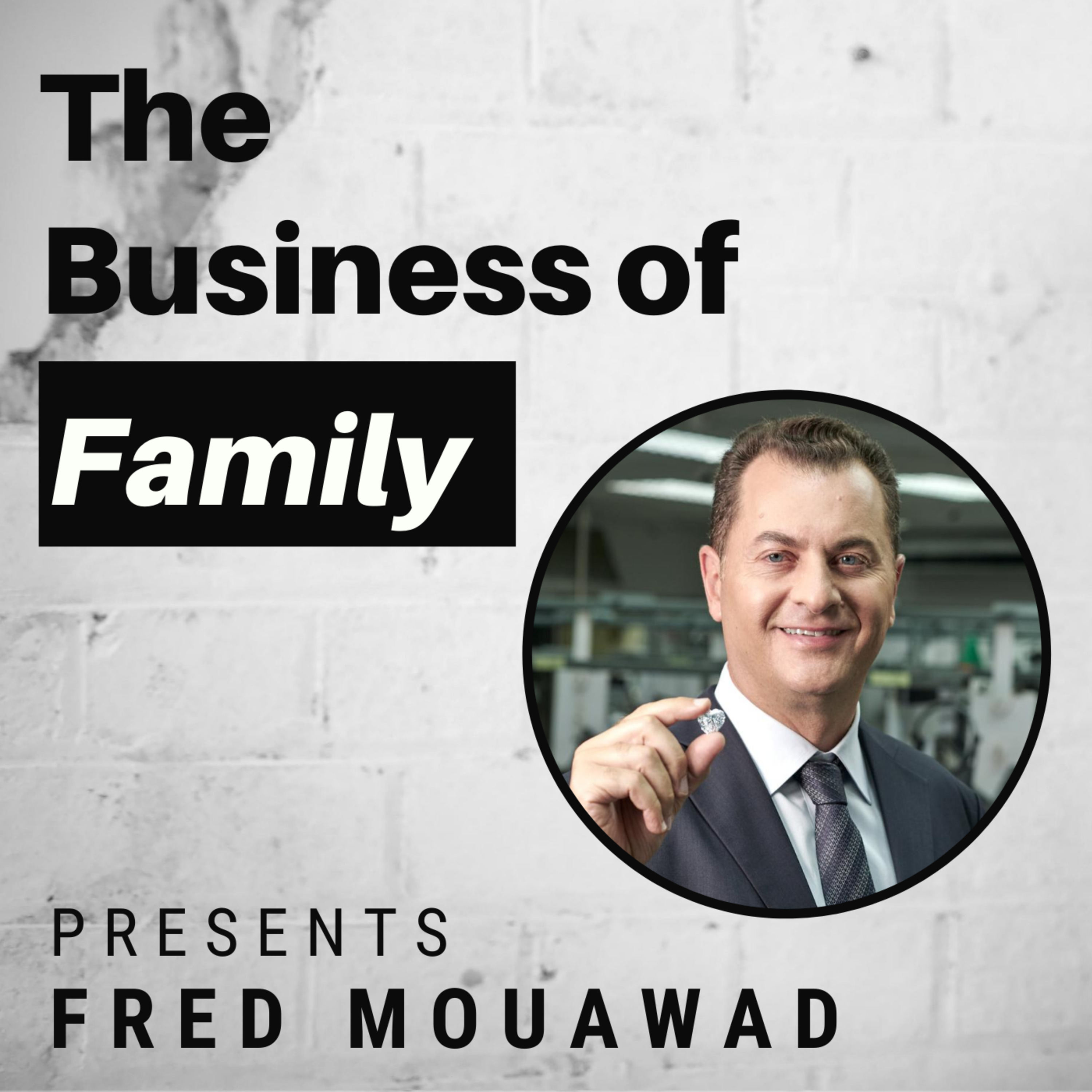
Episode 6 · Season 1
Billionaire Diamond Owner & 4th Generation Co-Guardian
Key ideas from this conversation
His father wanted to manage all of it or none of it, and handed over everything with about four months' notice.
The brothers set strategy as co-guardians and professional managers run the business, so nobody blames a brother for an execution problem.
He left the family firm young and built businesses of his own, and came back with skills he's thankful for.
Read the full show notesBio, standout quotes and the episode timeline
A global citizen, portfolio entrepreneur, and fourth-generation co-guardian of the Mouawad family jewelry business, Fred Mouawad’s story is as incredible as it is impactful. Listen in to learn how he brings a new and enterprising perspective to his family’s multi-generational success.
Fred Mouawad is described often in the media as a billionaire diamond owner but has also accomplished countless entrepreneurial ventures outside of the family business and offers some key advice on stewarding the next generation.
Standout Quotes
- “We have the inventory; we have the expertise. If we create masterpieces and truly craft extraordinary and position the brand at the very top, then we would be able to build a very niche business. That would stand in the marketplace and have a very clear image.” – Fred Mouawad [12:29]
- “It was interesting to see how we had to reinvent our business and reposition it based on where we thought the world was moving towards. It was an exercise of not necessarily innovation but adaptation and being able to forecast how the markets are going to change over the long run and how us ourselves should prepare for that change.” - Fred Mouawad [14:29]
- “Our responsibility was to guard that heritage. That’s why we call it co-guardians to look after it and start thinking long-term because our job is to look after it for only a certain period of time. It’s a transition from generation to generation.” - Fred Mouawad [24:14]
- “All of the day-to-day is done by professionals. We have a CO for the group, he’s a general manager, for the entire operation. Why did we come up with that model? We came up with this model because we did not want to start blaming each other for executional problems.” - Fred Mouawad [27:16]
- “I think it’s all about preparing the next generation to be the right stewards for the organization and how do you get there? You get there by exposing them to the business, by having them get richer with experience. By exposing them to different elements in the business and outside the business.” - Fred Mouawad [36:26]
- “The best investment I have ever made was investing in myself, investing in my education, and having the courage to gain new experiences. Always being an avid learner. This is what I find the most satisfying, gratifying, and what enables me to do what I do. It’s investing in knowledge and experience and trying to share that with your team.” - Fred Mouawad [50:11]
- “The most important thing that I would want my children to understand is that life is a journey and life requires that they take responsibility. They should keep on stretching themselves by learning, having the courage to try new things, by figuring out how to make the lives of other people better. How can they make a positive impact and how can they always behave based on core values that meet high ethical standards.” - Fred Mouawad [58:43]
Key Takeaways
- The incredible and impactful story of the Mouawad family business
- How standardizing a brand image benefits the scalability of a business
- Mouawad’s mission to craft the extraordinary
- How to prepare the next generation of a successful multi-generational business
- What co-guardianship can mean for a family and the business they run
- Why building relationships with capable people leads to scalable businesses
- How your best investment may be investing in yourself
- Instilling in the future generation the skills to make a positive impact and maintain high ethical standards
Episode Timeline
[1:58] The background of Mouawad’s generational success
[8:01] Modern day Mouawad jewelry business and what it represents
[17:38] High-end masterpieces and being recognized for Guinness World Records
[20:58] The value in business of natural vs synthetic diamonds
[22:39] Preparing the fifth generation of the Mouawad family business
[25:20] The idea of co-guardianship when running a multi-generational business
[29:25] Shaping the next generation for business success
[35:43] Teaching the skills to have another successful generation of Mouawad
[39:26] Formation of family guidelines as family business becomes a family enterprise
[42:27] Fred Mouawad’s entrepreneurial successes
[49:58] What Fred’s best investment was
[51:11] What it means to be a self-described global citizen
[52:47] How to effectively raise motivated children in wealth
[55:35] The transition from full control to family business co-guardianship
[58:24] Fred’s focus on allowing his children to have a positive impact in their life’s journey
Links:
- Magnificent Jewelry and Watches | Mouawad
- Fred Mouawad | Official Website
- Fred Mouawad - Wikipedia
- Forbes Interview with Fred and Pascal Mouawad - YouTube
- Mouawad Miss Universe Crown 2019 - YouTube
- Mouawad & Victoria's Secret | Mouawad : A COLLABORATION TOWARD DARING EXCELLENCE AND BEAUTY
- Mouawad Diamond Impact Fund | Creating value by improving the lives of underprivileged communities in diamond-producing countries to honor the journey of billions of years it takes to form and discover a diamond crystal.
- Synergia One Group of Companies
Read the transcript
This transcript was generated automatically and may contain errors, including in names. Listen to the episode for the exact words.
MikeWelcome to The Business of Family. I'm your host, Mike Boyd, and this is my look into the world of multi-generational wealth creation, family enterprise, stewardship, family office investing, and the curation of a legacy. On the podcast, I interview members of some of the world's most interesting families to hear how they pass knowledge, resources, values, and wealth to the next generation.
I hope you'll enjoy sharing this learning journey with me and would greatly appreciate any feedback, resources, or referrals you have to offer. To sign up to my weekly business of family newsletter, go to newsletter.mikeboyd.com.au. I am so excited to introduce this week's guest, Fred Mouawad, who is a global citizen, portfolio entrepreneur, and fourth generation co-guardian of the Mouawad family jewelry business.
Fred's story is incredible and impactful. He's often described in media as a billionaire diamond owner. He holds five Guinness World Records, and he is an incredibly accomplished serial entrepreneur in his own right outside of the family business. Founded in 1890 and now in its fourth generation, the Mouawad family jewellery business is today led by co-guardians Fred, Alain, and Pascal Mouawad, three brothers who each perpetuate a heritage of excellence and bring a lifetime of passion to their respective roles. Fred heading up the Diamond Division, Elaine the Watch Division, and Pascal the Retail Division. Each co-guardian actively embodies the Mouawad commitment to crafting the extraordinary. Fred, it's an absolute honor to have you with us today. Thank you so much for joining us on the show.
FredThank you very much, Mike. It's a pleasure being on your show.
MikeI'd love to start with a brief background on the family business, if you don't mind, its origin story, and how each of the four generations have come to be involved in the business.
FredSo it all started back in 1890 in Lebanon, when my great-grandfather, David Mouawad, had left the country because at the time there weren't many opportunities in Lebanon. And it's interesting to see that 130 years later, the situation in Lebanon has not improved. In fact, it's getting worse and people are also fleeing the country for opportunities outside the country. And I find that interesting to see that as I tell the story, our country hasn't really evolved or progressed over the last century.
So in 1890, he got on a boat and cruised all the way to the US. And he spent some time in New York and then in Mexico, where he learned the art of watchmaking, partly in the US, partly in Mexico, returned to his country and started teaching the art of watchmaking to his son, Fayez. And Fayez was successful. He was commissioned to build some clocks by some nobles, by the city.
And in 1950, he was given the opportunity of going to Saudi Arabia. He had at the time met a prince that used to love Lebanon, used to spend a lot of time in Lebanon, befriended that person, and he convinced him to actually open a shop in Saudi Arabia back in 1950. And so he did. He packed his luggage and went on an adventure the same way his father had done it earlier by going to the US and Mexico.
And so in 1950, he opens that workshop, worked extremely hard, long days, long nights. He was the first watchmaker in the country. And at the time, the country started growing very quickly because of the oil boom. And so he started with repairing watches, fixing watches to bringing watches from Switzerland. He took the agencies of Piaget and a lot of other brands, was one of the first to open that watch shop.
And then from there, he added jewelry and then started expanding very quickly. My grandfather, Fayez, had a heart disease. So he fell ill fairly quickly. and he brought his children into the business. So they all flew from Lebanon to Saudi Arabia. My father was back then young. He had just started his medical school. He wanted to become a doctor.
But after two years of studying, he felt compelled to go to Saudi Arabia to help his father along with his brothers. It didn't last too long. It's interesting to see that it started with the brothers working together, but my father couldn't necessarily work and cooperate with his brothers. So he decided to actually manage the company alone. And at the time, offered my grandfather to buy the entire business over a certain number of years under the condition that he would be the sole owner.
And that's what happened from 1971 to about 2010. My father was alone. Now, coming back to me as a fourth generation, when I finished my college studies, I studied business administration at Pepperdine. Then I studied gemology at the GIA. Back then, the campus was at Santa Monica. I came into the business, wanted to contribute. I had a vision and a drive.
But very quickly, I found out that it was difficult for me working with my father, who at the time was not willing to delegate. He wanted to make all the decisions and was not accepting any significant change in the organization. So I left the family business after three years, having worked in Bangkok, in Saudi Arabia, having flown the world, procuring gemstones, gained great experience.
So I went to business school. I went to Harvard. Then after Harvard, I decided to start my own ventures. And that's what I did. I started a number of different ventures up to 2010, when my father decided to retire from the business. And what is interesting is that my father took it to the extreme. He wanted to either manage 100% or not manage at all.
So at the end of 2009, it was about August, he called me up and he says, yes, you know what, I would like to start transitioning to you and your brothers. And I said, wonderful. I was wondering why he was willing to do it. I said, wonderful. Let's come up with a plan over the next two to three years and we'll help you in the meantime.
he calls me back i think two weeks later saying no now the date is going to be on the 1st of january 2010 so it was about four months and so we didn't really understand why but then we understood that he had to undergo a second heart surgery so my grandfather was sick he had heart disease my father also he had his first open heart surgery at the age of 52 and in 2010 he was about 65 back then and he had to go his second heart surgery thankfully it went well but i think in his mind he was ready to transition and he did it overnight in the most extreme way possible saying i give you the ownership and the management and you can do whatever you want with a company
starting the first of january 2010 and that's exactly what happened so since then the fourth generation has been looking after the business and it's been a decade now.
MikeThat's an incredible story. I'd love to get a sense of what the modern day Mouawad business now represents for the benefit of the audience, perhaps those that aren't familiar with the brand yet. Can you give us a sense of the current business lines, but also the size and scale of the business and the key demographics that you're positioning the brand for?
FredSo in 2010, we had a very strong presence in the Middle East, and we were multi-branded retailers. So we were well-known for being in the jewelry business. My father had, over the years, procured many important diamonds, mostly over 100 carats, deflawlesses. One of my favorites is a 200-carat cushion D-flawless diamond that we sold to Stanley Ho. and Stanley Ho put it in his Lisboa casino back in Macau.
So we had very important diamonds. And at the time, my father bought all these diamonds at auction. And the entire trade knew of our family business because he had the courage. And at the time, he really bought at the highest prices. That's why he got them at auction. Unless you pay the highest price, you can't really own the goods.
So we were well known in the jewelry business. But at the same time, we had a lot of watch brands. Audemars Piguet, Rolex, Piaget, Chopard for a number of years, and Bulgari. So we were a multi-branded retailer. When my father handed over the company in 2010, it was a very interesting period because we wanted to position the company for the next decade.
And so we had to dig into our history. We had to analyze all our financial statements. And very quickly, we understood that being in the watch business is not as lucrative because you have to keep on buying every year to maintain your agency. But at the same time, the stock or the inventory you don't sell diminishes in value.
So at the time, my father handed over the company, we had $100 million worth of old watches. And when I say old watches, they were as recent as one year to maybe 20 years back. And you can imagine, so that inventory, as it got older, became more difficult to sell. But on the other hand, all the gemstones that we had in our inventory, mostly colored stones or even some diamonds, appreciated in value.
So we had a depreciation in value with the watch business, but a really good appreciation of value in the gemstones. So that was a big indication for us in making a decision of firstly going with a monobrand strategy. So we took, at the time, the extreme step of saying we will no longer represent other watches. The Mouawad stores will only sell Mouawad products.
So that was a big change. The second change was to standardize our brand image, the look and feel, the color of our boxes. My father was extremely creative, and every store looked different. We had all kinds of packaging. And so what we wanted to do is modernize it, standardize it so we could scale the business. So that's the other thing we did from a look and feel perspective.
And we started launching collections. At the time, Mouawad was known for being very inspirational, for being in the very high end. And most people were intimidated. They did not think the brand was accessible. So in the last decade, we went through an interesting evolution because at the beginning we said, we're going to democratize the brand make it more accessible we're going to launch boutique jewelry which ranges from three thousand to fifteen thousand dollars a piece and so in the first three to four years we launched multiple collections and although it was successful we quickly realized that we had a difficulty being in the whole range because in one ad you had a small boutique item at five ten thousand dollars and in the other ad you had
a multi-million dollar piece. So we found it difficult managing a variety of different products under one brand. And so within the fifth year up to maybe the eighth year until about two years ago, we realized that in today's ultra-competitive marketplace, we're better off being in the very high end, differentiating ourselves. And that's where our expertise really lies.
We have the inventory. We have the expertise. if we create masterpieces and truly craft the extraordinary and position the brand at the very top, then we would be able to build a very nice niche business that would stand in the marketplace and have a very clear image. And so we went at the beginning from trying to democratize the brand, and we went back to the actual opposite end of really wanting to be in the ultra high end.
And that's where we are today. Today, we want to be known for crafting the extraordinary we buy a lot of rough diamonds initially i told you that my father bought a lot of the important diamonds polished from auction but in 2012 we also did decide to go into the rough business we realized that market becomes a lot more transparent that people can now search for pricing much more easily with auctions publishing their prices worldwide that if we bought polished our margin would be limited so we had to buy rough in order to be able to capture the margin and take the risk from rough to polished so we could actually sell the polished at a smaller
margin and do it competitively and justify the investment otherwise the return investment by buying polish would be too low so those are the three main changes that we we did as an organization in the last decade and the rough business has really paid off we bought some very important diamonds two of them are world records i we bought two yellow diamonds from south africa and one of them turned out to be 111 carats and we named it the mawad kimberly star it's on our website and the second one is called the mawad dragon it's a 51 carat round vivid yellow diamond the largest of its kind in the world in addition to this we bought many deflawlesses but so in our
generation in the fourth generation and only the last eight years we started getting into the rough business. So it was interesting to see how we had to reinvent our business and reposition it based on where we thought the world was moving towards. So it was an exercise of not necessarily innovation, but adaptation and being able to forecast how the markets will change over the long run and how we should ourselves prepare for that change. And now, as we look at the next 10 years, I think we're going to see another change in the way we retail.
People go less to stores. They want experiences. So what we're doing right now is organizing small exhibitions, exclusive exhibitions, inviting guests, inviting new customers, building relationships with them, and doing it by showing our jewelry and also by crafting stories around our masterpieces. One of the stories is the Miss Universe crown. And I'm particularly excited and thrilled about what we will be doing over the next five years because we came up with a story, a story that's meaningful for every single crown that we crafted. So for example, the crown, the Miss Universe crown, the global crown for the winners called the Power of Unity.
And it's meant to remind all the communities around the world to work together, to collaborate together because united we are much stronger than being on our own so it's really encouraging people to work together in order to become more powerful and also that crown has a big canary diamond a 61 carat and it is a shield shape and the shield shape is also meant to remind people to shield against biases.
So we want people to give equal rights and opportunities for everyone, for any gender, anyone from any socioeconomic background, any ethnicity, any religion. So the whole idea is to look at the world in an unfiltered way and to treat everyone with respect and encourage people to work together so we are stronger. So that's the message that we want to convey with the power of unity crown.
And then for Miss USA, we came up with the name of power of positivity. And for Miss Teen USA, power of hope. So for the US, we want people to think of positivity in order to keep on advancing, in order to keep some optimism and not be dragged down by pessimism or any negative forces. and for Teen USA, it's all about youth.
It's about hope, never losing hope, working hard, doing good and creating a better world for future generations. So for us, what's really exciting at this point in time is not only crafting these pieces of jewelry that we're very passionate about and using gems and rare gems, but it's also about coming up with a message that reminds people of how we could all together make the world better.
MikeIt certainly fits with your brand positioning of crafting the extraordinary. I mean, these masterpieces that you speak of and the stories that go with them, it's almost hard to grasp the higher nature of these pieces. I understand that some of them have been recognized with Guinness World Records. Can you tell us a little bit about some of the awards that you've received, the pieces that are attached to them, and how that has helped you to position the brand?
FredYes. So by crafting the extraordinary, we obviously want to create very unique pieces that are valuable, that are beautiful, and that are rare. And so we had a first world record back in 1990 when my father bought at the time the most expensive diamond at auction, which back then was a record. and when in 2010 my father handed over the company we looked at our inventory and we had in our inventory a beautiful purse and at the time with my brother we looked at it and we said you know what it's probably one of the most expensive purses in the world and we looked through the world guinness record and very quickly realized that yes it is indeed the most expensive purse
so we applied and and got the world guinness record for it we got the certificate for it and then from there on we said how can we continue the legacy how can we create how we can we keep on creating these world guinness record items and in fact we had another one too in 2012 the most expensive bra and so this was in 2003 2002 when heidi klum at the time wore it we also applied for a world guinness record and also got it so the purse was actually our number three and then we created the necklace which was number four and then we created a very beautiful jewelry coffer that was our number fifth world record so we basically went from having one two and then
thinking creatively about how to add more world guinness records in fact we've stopped about a few years ago but i think it would be interesting to restart and the question most people ask is have you sold any of these pieces and no we haven't we haven't they're still in our inventory so they are for sale but we're not necessarily pushing to sell them we think these are unique items they could remain our inventory as show pieces maybe in the future even be part of our museum. But we just wanted to create these pieces to show the world that we're able to combine art and create valuable pieces out of gemstones that would be very unique and they
would stand out in the world.
MikeThat's incredible. And of course, I was going to ask whether or not you had sold them or sent these pieces to auction, but to have them in your collection or a private museum is just amazing. I understand the necklace was valued at US $55 million. It's probably worth much more than that now. These are certainly extraordinary pieces to hold the Mouawad brand and for you to storytell about.
FredThey are. They are. And Mike, when I mentioned that the return on assets, as you can imagine in our business is low. So as a family, I'd like to talk about why we've lasted for four generations and why we continue investing in gemstones, even if economically we could potentially generate higher returns elsewhere. But I think it's important to understand the nature of our business.
Our business is not likely to be disrupted from a product standpoint because it takes billions of years to form a natural diamond. And in fact, that's really what enables us to differentiate between a natural diamond and a lab-grown diamond because a lot of people are confused today. Well, yes, the lab-grown diamonds are similar to natural diamonds. They have the same optical, physical, and chemical properties, so why not buy a man-produced diamond?
But the reality is a man-produced diamond has no value. As technology improves, the cost of manufacturing a carrot has dropped from 10 years ago from $2,000 to $300 today, and I think that number is going to drop to $20. 10 years ago, a synthetic diamond used to sell for $4,000. Today, you can buy them for $600. In the future, it will be just a few dollars.
So I would not invest in any lab-grown diamond because it doesn't store any value. So going back to our business, it takes billions of years for nature to create a rough diamond. Yes, we have better technology to be able to get better yields out of diamonds, but the product itself has not changed. So that's number one. Number two, most jewelers have most of their wealth in their inventory.
And that inventory is not liquid unless you have an ongoing concern. So if tomorrow Mouawad wanted to sell old inventory, it would take us years. In fact, it will take years. And so the exit is not clear unless you sell the entire company. And even if you do, I don't think you'd get a premium on inventory. You could, but it would be very difficult to find a buyer.
so you tend to have your wealth in your inventory and to reinvest in your inventory so it's a business that's conducive to multi-generations so in my capacity today as the fourth generation i'm preparing my son who's 23 years old he just is completing his gemological studies at gia he studied entrepreneurship as undergrad he'll be joining us in the next one month and so my goal is to prepare him because eventually it's the only way to continue the business and and there's no easy exit for us but besides that we definitely are motivated by keeping the business alive and that's why we call ourselves co-guardians and the story is back in 2010 being the eldest brother
and I started the business with my youngest brother who's only three years apart from me. His name is Pascal. And the traditional model was I'm the chairman. He's vice chairman. I'm the CEO. I'm the eldest brother. But within three months of running the business, I realized that this model wouldn't work and that we had a responsibility. Our father, as a third generation, handed over the business and our responsibility was to guard that heritage.
That's why we call it co-guardians. to look after it and to start thinking long-term because our job is to look after it only for a certain period of time so it's a transition from generation to generation and so although i've been a fourth generation co-guardian for 10 years i am right now thinking about how to prepare the fifth generation and very quickly put them in charge and have them lead the business for the next few decades and hopefully for them to do the same thing with their children.
So we're thinking multi-generations at this point in time.
MikeIt's just amazing to be already contemplating the fifth generation, to be actively bringing together the stewardship and bringing your son into the business. You're already statistically far more successful than most multi-generational family businesses. And I love that concept of co-guardians or co-guardianship that yourself and your brothers have adopted. Can you explain to me, please, what that means to you and your family? Did you have any pushback from other family members or was everybody united around this idea that this is something to take care of just for a brief moment in time? And we're not really the owners of these assets, we're simply stewarding them.
FredIt came naturally because I think we, none of us could work initially with my father. My father worked on his own. And then when he transitioned, he transitioned and pulled out completely. So we had that experience and we all had worked for the family business at one point. I worked in my initial career for about three years before leaving and the same thing with my other two brothers. We had these experiences in the family business.
So we inherently understood that this is really a transition and that we have that responsibility. And especially after we dug into our history, right? When you go back into your history and you try to understand what the core values of the company are, then you very quickly understand that, well, if you really want to plan for the next decade or two, it's not only about us, it's about how do you prepare future generations.
It comes naturally when you realize that you've been around for so long. So that's how it came. The second concept of co-guardianship is to actually work with management. And I think this is what we've done successfully. Instead of having traditional roles where a brother is a CFO, another one is a CEO, we said, we want to actually bring in professional managers and we want to work with them.
We want to work with them. We want to coach them. we want to be good owners good board members we want to look after the business as co-guardians so all key decisions still go through the co-guardians any important diamond is purchased by a co-guardian and key sales are done by co-guardians although we have a team in place but all the day-to-day is done by professionals and we have a ceo for the group he's a general manager for the entire operation and why did we come up with that model we came up with this model because we did not want to start blaming each other for executional problems.
So I did not want to take an execution or an operating role, or my brother did the same thing, and then me pointing fingers and saying, well, you were responsible for that area and you did not succeed because that's the best way to actually create tension and break the relationships. So we wanted to preserve our relationships. And to preserve the relationship, we had to be involved in the business, but we had to avoid being in a situation where we were responsible for execution.
So we brought management in, we agreed on what the strategy would be and the management reported back to us. And that model actually evolved because as you said it earlier in the introduction, we had three different divisions. I was looking after diamonds, Pascal after the retail and Allen after the watches. But today, and this started about two years ago, we decided to actually no longer look after divisions, but truly be at the board level.
So we renamed ourselves fourth generation co-guardians. And we are on a board and we work very closely with our management. And we try to actually have a good sense of the entire business at the co-guardian level. So although I'm closer to the diamonds, I still convey all the information to my brothers. Whereas maybe a few years ago, I used to make decisions alone.
Today, I get them involved. And the same thing with Pascal. We're more involved in the retail. And the same thing with Alan, where we're all involved with watches. So this is the model that evolved over 10 years, where we started with traditional. We went co-guardian by division. And now we're truly fourth generation co-guardians, working closely with our management, but making our management responsible for execution.
MikeThat's a great model. And I love that you've experimented and allowed that to evolve. I have a follow-up question about how you're shaping the next generation, specifically your son. And before arriving at that decision, was there a cultural expectation that this passes down from eldest son to eldest son? Do your brothers also have children? Is that a contentious issue?
Or is that a very straightforward issue in terms of if a next generation member experiences interest in joining the family business, then they're shaped and mentored into it. How did you arrive at who gets to play a role in the business and who doesn't?
FredAlthough we're the fourth generation, really the first three generations were pretty much sole owners. My father actually bought his father and his brothers out. So he was a sole owner. So for us as the fourth generation, it's the first time we're working closely among siblings. and now we have our children coming into the business so i have a son i have a daughter that's 11 years old so she still has some weight and my brother alan has a daughter that's 21 so we have two fifth generation co-guardians about to enter the business so for us it's all about how to structure it how to structure it at the ownership level and how to groom them and then have each
co-guardian sibling prepare their children to join. So my son would be under my ownership. So he would represent me. My niece, Anastasia, would represent my brother, Alan. And Pascal is not married yet. So he is not grooming anyone at this point in time. Although Pascal is very much keen on coaching both my son, Jimmy, and my niece, Anastasia. So he's very supportive as an uncle. So this is, again, an evolution. And we want to make sure to involve them. And the question is, how are they involved? Again, we're not using the traditional model. We're doing it project by project basis. So I started with my son very early on. When he was young, he went to the factory.
And what we did at the factory is I had him learn how to design jewelry. But then more importantly, I had him design whatever he wanted to do. And we manufactured that piece of jewelry for him. And I'm doing the same thing with my daughter. My daughter just last year designed a crown. I produced the crown for her and she has the crown. And so these are wonderful memories of children creating and then seeing their creation come to life. And they have to walk throughout the entire factory to see how a piece of jewelry is created.
So in essence, they've grown. They've grown with the process. They're accustomed to it. And I wanted to intentionally nurture that passion by not forcing them, but by allowing them to be creative. And I think that's really what I did not have when I was younger. I saw my father buy gemstones, but I was never really given that creative latitude.
And so I wanted to do it differently. And so far, it's worked. My son loves gemology. He's studying at GIA, as I mentioned earlier, which is the Gemological Institute of America. He was in New York, but because of COVID, now he's completing his studies online, so it'll be done fairly quickly. I know that he loves the business. He's creative. He's designed already jewelry. We produced that jewelry as well for him. So he's prepared. He's 23 years old. But because we nurture that passion in him, I think he's ready to step in and start working.
But I mentioned earlier that it was on a project basis. So my son, for example, started the Mouawad Diamond Impact Fund, which is a social initiative meant to help underprivileged communities by providing them with skills or teach them through learnings on how to become more independent. So one of the projects he led was bring in five young South Africans from South Africa.
We flew them to our factory in Thailand where we produced diamonds, taught them how to manufacture diamonds, and then send them back to South Africa. We hired some and the rest replaced in other companies. So more and more, we want to figure how we can make a big impact in our industry. And we've been doing this for years.
This is a small project. We want to scale it to more projects in underprivileged communities. But back in 1997, we supported the GIA in moving from their Santa Monica headquarters to Carlsbad. And so we made a significant donation back in 1997. That's why the whole campus is called the Robert Mouawad campus. And that was an interesting, again, experience back in 1997, where most of the industry members were not willing to support GIA or he did it at a much smaller level.
And when we initially talked to our father about it, he also at the time did not grasp the real opportunity. So what we did is we negotiated, my brothers and I, back in 97, that's 23 years ago, we decided to negotiate with the GIA. And at the time we knew the president very well because we had studied there, Bill Boyajian.
And we went back to our father after negotiating. We went back to our father and said, look, father, we negotiated this agreement and we want to do it in honor for everything you've done in our industry. I think it was very touchy, supported the whole project, and that's why the GIA is called the Robert Mouawad campus. So very early on, I would say the fourth generation had that impulse, that willingness to want to make good, to focus on education, because we realized that we were given the opportunity of getting an education.
And that's something that we treasure and we continue learning today. I continue being very heavily involved in education within YPO, outside of YPO. And we want to keep on doing it with the Mouawad Diamond Impact Fund. So my son, Jimmy, is looking after this project as one of his projects. So they learn and give them projects in different parts of the company.
So by doing all these different projects, they become well-versed with every single part of the business. and they can become co-guardians overseeing the entire business.
MikeI love that your children have those memories and keepsakes of creating their own designs and having them manufactured. That must be incredibly special for the family. And I have no doubt, fast forward 100 years, those pieces will be in the family museum as well. And of course, the legacy project for your father with the GIA campus named after him is just amazing.
and Jimmy starting the philanthropic angle of the family business. I love all these threads and I'm sure we could spend a great deal of time on each one. But one thing I want to get to now is you've already successfully surpassed what is often the most critical milestone, which is surpassing the third generation and already passed successfully to the fourth.
Now contemplating the fifth, what would you suggest are the key success factors for multi-generational family businesses to survive and prosper for generations to come?
FredI think it's all about preparing the next generation to become the right stewards of the organization. And how do you get there? You get there by exposing them to the business, by having them get richer in experience, by exposing them to different elements of the business or even maybe outside the business, For example, in my case, because I could not work with my father when I was a bit younger, I went off and created a number of different businesses.
And I'm extremely thankful for that opportunity because I've learned so much on my own, starting a food service chain, scaling it to 250 stores in seven countries. I have a media company with three magazines. We won over 150 awards. So I've done so much. And I'm very thankful for the experience that I've gained over the years. So when my father handed over the company in 2010, I already had the skills that were required to make the changes to the organization. So for me, the key is nurturing a passion, but educating the children and getting them, exposing them so they get these experiences that allow them to gain the leadership that's required to keep on adapting and evolving and continuing the business without making any major mistake along the way.
So it's having foresight and having the leadership, having a deep understanding of the industry, keeping the relationship with clients, and more importantly, preserving our reputation, which is, in my view, the most important asset we have. So how do you build the core values so they always behave in ethical ways, always do the right things, look after our clients, and become respected business people?
It's not simple, right? You've got to really tackle multiple components, the core values, the experience, the foresight, the ability to work with management, galvanize management, surround themselves with capable people. How do you build a team, trust a team, but yet have the ability to monitor? We're in a business that's of extreme value. It would be fairly easy for people in our factory, for example, to walk out with a multi-million dollar diamond we do have controls in place but we still have to rely on people people and believe in their willingness to do good believe that they're honest in principle so selecting people building that trust in people and we treat people like family for example in our factory in thailand
we've had people that have worked with for us for 30 years 20 30 years i think the average 10 years, definitely in the 15 plus years. So how do you build that team? How do you continue nurturing these relationships internally, externally, do good and have the capabilities of continuing to run the business?
MikeAs a follow-up to that, is there a formal structure for the family? When we talk about family governance, do you embrace things like a family constitution and visions and missions for the family? Or are these principles simply the lessons that you impart on the next generation through education, as you say, and life experience?
FredSo it's a combination. It's definitely something you have to write, discuss, review. And I'm thankful again for all the educational programs we're part of. I happen to be co-chairing a program for YPO called at INSEAD for Global Family Enterprises. So I started this last year and it was a really good session where I went with my two brothers and my niece.
At the time, my son was studying in New York at GIA, so he couldn't join us. And as a result of spending five days together, discussing the business, talking about constitution and so forth, we came up with new guidelines. new guidelines we we refine our thinking we're trying to expand now and work together not only in our business but outside the business so moving more from a family business to family enterprise so all that is leading us to start writing our constitution we started it's fairly simple as of today because we don't have too many family members but we do have an understanding it's written and as much as possible we are documenting all our procedures even at the governance level
in terms of what we have to approve what our management can do without our approvals how we approve internally so it's not uncommon for example for our management to send an email to co-guardians and and have the three of us approve before they move ahead with key initiatives so all that is work in progress and it's it's getting better and it's getting clear as we evolve and i think we want to do a lot more on that front and expand the family enterprise start investing together which we haven't done in the past my father is extremely entrepreneurial and he built he built an empire he has a lot of his assets in real estate and he also has his
own philanthropy, but we don't actually work together. So as a family, we're not still sophisticated in the sense that my father likes to do things on his own. He doesn't necessarily like collaborating. He's a one-man show and he likes it that way. And we're trying to change that direction amongst the three brothers and try to formalize a structure that assures our success as a family on a multi-generational basis.
MikeI'd love to touch base with you in a couple of years and see some of the progress that you've made in that space as this no doubt evolves naturally. One thread that I want to follow there, you briefly mentioned some of your other businesses and life before joining the family business in a formal capacity in 2010. If you look to media articles, you're often described as a billionaire diamond owner. But my understanding is that you're an incredibly accomplished serial entrepreneur in your own right. Can we touch on a little bit of your business experience outside of the family business and how that has helped shape you in the role that you play today?
FredYes, absolutely. So I'll start with my first entrepreneurial venture. Actually, my first was in college. I always wanted, and I don't know why, but I always wanted to build a business. And I was always passionate about not the business itself, but by the organizational aspect. How do you get a team of people to work together in order to create a valuable product or service and succeed in the marketplace?
So that was always my passion from a very young age. It's the organizational side, the management side. So even while going to college, I started a travel agency. I even brought in a singer from the Middle East and I had a tour throughout the US at one point i even promoted the parties at nightclubs i was really extremely entrepreneurial even uh during my college days but my first transaction that really led me to love gemstones is back when i was 21 i was stationed out of bangkok working for the family business and at the time my father asked me to go to sri lanka to hire some sri lankan craftsmen because at the time we had problems recruiting Thai workers because there was a relationship or some tension between
Thailand and Saudi Arabia and we couldn't get visas for our Thai craftsmen so he told me why don't you go to Sri Lanka and see if you find if you can find some good craftsmen so I went there and I went there through connections that we had and the people that I met were actually gem dealers that we used to buy from my father used to buy from them and they showed me this beautiful sapphire And they said, oh, look at this beautiful sapphire.
And at the time, I didn't know what the value of these sapphires were. I had some experience, but it was mostly academic. I had studied at the GIA. But I had a good eye. I had a good eye. And so without knowing much of the value, I negotiated. And at the time, I bought the stone for $60,000 with my own funds.
And I was 22. and I went back to Bangkok and I recut the stone because it was very poorly cut I recut it and it turned out to be far more beautiful far more valuable and I have a dealer that we used to buy from who came to the office two weeks later and said oh Fred I have a client from Italy coming in do you have any beautiful sapphires and I pull out of the drawer the sapphire and I said look I just finished cutting this beautiful sapphire he says well can I show to my client and see if he is interested in it and so a week later he comes back and he says yeah
i sold the stone and it sold for 120 000 and of course i didn't make that much profit on my subsequent deals but this was this was a stone that i bought really well it was probably worth a lot more than 120 because the person who bought it for 120 was a trader who probably sold it for much more down the chain. But that very quickly gave me the taste for gemstone trading. And I started trading gemstones on my own for about 10 years. And that's how I made the cash that allowed me to venture into opening a coffee shop, a coffee chain in Thailand called Coffee World.
I scaled it to 100 stores. I opened a pizza chain in India. And then I opened more food service concepts, an ice cream sandwich, about five brands, and scaled it to about 250 stores over seven countries by franchising. And I've learned a tremendous amount in that business. How do you come up with a brand? How do you adapt to different markets? How do you scale the business?
How do you standardize it? How do you recruit people? How do you train them? How do you put the accounting systems in place, the quality management system? So it was an incredible experience. But I had lots of experiences. I'm a creative person and I started a number of businesses. I started a dot-com and as a result of a dot-com, I built a magazine to support the dot-com. At the time, the dot-com did not make it, but the magazine made it. And I started scaling the media company. I'm in fact in the process of acquiring now another media company in the US.
So we'll end up with potentially eight magazines, eight trade magazines. We have three and we're acquiring another five. And so it was always about seeing opportunities in the market, bringing the right people and giving these people the right incentives. So for example, in my media company, I'm still working 20 years later with the same editor in chief.
And then I had a publisher, a publisher that was a partner for about 15 years. And so I believe in building relationships with capable people and enabling these people to grow companies. So a bit of a venture capital model, but based on an idea that I initially had, I bring people in and I make them partners in the business.
And that's how we scale the businesses.
MikeIt's a true entrepreneurial journey by the sounds of it. It's amazing.
FredYeah. And so not every venture that I started, by the way, was successful. And this, I think, is also one of my strengths. I'm not afraid of failure. I have courage and I try things. What works, I scale. What doesn't work, I stop. So it's been a wonderful experience. And now I'm scaling an IT company called TaskWorld.
It's a collaboration platform. I started that company in 2012. So it's been eight years. And we've pivoted a few times. I would say today we're launching TaskWorld version 3.0. And although initially I started by designing the screens myself, bringing people in. And what I did, by the way, which I'd like to talk about it, is the way I built my businesses is I'm familiar with every single component at the beginning when the business is small.
And then as it grows, I pull myself out by putting people in my position. So with TaskWorld, initially, I was involved with a copy. I was involved with every single page that we created. I was very close to the business. And as the business grew, as we brought in more people, I brought myself up gradually to a position of chairman.
Just a year and a half ago, I got in a CEO and the CEO now is in charge. So I'm a chairman. But prior to that, I built the company from ground up, up to the point where I can pull to a chairman position. And that gives me the ability to understand the business ground up. And so there's not one part of the business that I don't understand.
not necessarily in great expertise. I'm not an engineer. So if you tell me, can you code or do you understand all the technical side of our platform? Certainly not, but I've been very close to it and understand every part of the business in general. And that allows me as an entrepreneur to be able to work with my team and with the management team on setting a strategy and helping them on how to keep on creating value in the marketplace.
MikeSounds like you've mastered the art of scaling. Tell me, is there one most worthwhile investment that you've ever made, whether it's an investment of time or money or energy? Is there something that comes to mind that is the best investment you've ever made?
Fredthe best investment i have ever made was investing in myself investing in my education and having the courage to gain new experiences and and always being an avid learner so this is what i find the most satisfying gratifying and what enables me to do what i do it's investing in knowledge, investing in experience, and trying to share that with your team.
And now at my age, I'm 51, I'm thinking of how to scale my impact outside my organizations. What can I do socially? And that's really what's driving me. For the next decade, when I plan for myself, this is where I'd like to make more of an impact. As I start preparing my son to take over, I want to start figuring how to make more of an impact on the social side rather than just within our company.
MikeThat's a great answer. You're a self-described global citizen, born in Lebanon, educated in Switzerland. You attended business school in the United States and gemology school. Today, Bangkok is home. What does being a citizen of the world mean to you?
FredIt means understanding different cultures and respecting them, not judging, not trying to say this is better than this, but understanding why people do certain things. And that requires that you understand history, that you understand religion, which very much impacts cultures, that you understand politics. But at the end of the day, it is about understanding people without judgment and being curious, curious to listen, and always being respectful of other people, doing the right things, understanding that you're never truly home.
You're always an outsider in somebody else's house. And therefore, you have to behave by the norms of that country. You have to respect the culture and understand it so you can communicate with people through that culture. So it requires a lot of knowledge and the ability to adapt and the ability of not necessarily pushing your point of view, but being more of a listener, being more of a receiver and being a giver, figuring how you can contribute in each society.
MikeOne thing that we're interested in exploring on this podcast is how to effectively raise motivated children of wealth. And I reflect on your story growing up in a successful business family. I imagine you had some of life's comforts. But the thing that really stands out to me is the incredible drive and fire that you've had to passionately pursue entrepreneurship and your own endeavors when, if you'll allow me to make an assumption, perhaps you didn't need to work that hard. Where did that drive and fire come from?
FredYou know, it's a question I think a lot about because it's a very interesting one and one that I should understand to see how I should also guide my children and how I should encourage them to do the same. But for me, what I recall is At a very young age, our parents had us travel the world.
So I remember going to India and being shocked by the poverty, by all the people that came to us just asking for money, seeing children hungry in the streets. Having grown up in Switzerland, for me at the time, I was quite young. It was a shock. We used to come to Asia. And I realized early on that I had two ways of viewing the world.
One is to be comfortable because my parents were wealthy. So why should I do much out of my life? Or on the contrary, realize that I had this incredible opportunity because my parents had the means. And because I had the means, I could make a difference in life. I could be the best that I could be. And I had the opportunity of getting an education.
I had the opportunity of working really hard to make a difference. And I don't know why that's what I chose. It was very clearly what I wanted to do. Even when I was young, I was extremely competitive. I always pushed myself. I always tested my limits, skiing, motorcycling, jet skiing. I always wanted to be better the next day than the previous day.
I was always driven by continuous improvement. And that's really what led me to keep on doing what I did. And today, I keep on thinking about the same thing. How can I be a better leader? What have I learned yesterday that I could apply? How should I be thinking differently by the next decade? So I'm constantly questioning myself, trying to raise the bar, trying to raise the impact that I make in anything that I do.
But to answer your question, I think it's also character. I can't really say it's something that I've learned. It's something that I realized, but I also think it is a character and I happen to have that character.
MikeWell, I think you set a wonderful example for a number of other wealthy families out there that would most likely hope that they're setting a similar example and they're children are also going to follow suit with that same passion and fire in the belly that you demonstrate. You touched on briefly how you've been involved more recently with YPO and the INSEAD program, but how else have you gained your knowledge and experience in managing family enterprise? What role has all of the education that you've explored played or have you had family and external mentors aid in your development in this area?
FredWhen it comes to family businesses, we struggled initially because prior to 2010, I was an entrepreneur. I was doing my own things. I had full control. I didn't have to report to other partners. So when you start working with a brother and then with another brother as well, it's not simple it's something that initially took some time some adjustment and typically what i do is i think about the issue i i write a lot by the way this is something that i do on a regular basis i have a journal and the first thing that i do in my journal is i write about any top concern that i have and it's typically what's what's challenging me at this point in time what problem
I'm facing. And then by writing it, I define the problem. Then I come up with ideas on how to solve it. And then I try to do the third thing, which is predicting the future. And I've learned so much about myself because anytime I try to predict the future, I realize that I'm wrong. And therefore, today, when I think about the future, I understand that it's highly uncertain and that I can't predict it. So you learn how to adjust as a result of learning about how you think, learning about how to solve problems and forecasting what happens and comparing what actually happens with what you thought would happen.
And so this is a good way for me to learn. And I also try to look at two things, my own personal experience on the field and also academically. I do a lot of reading. So when I had an issue in the family business, then the first thing that I did is started reading books. I started reading more articles.
I started going to more conferences just to keep on acquiring that knowledge. And then with that knowledge, I try to practice it. I have discussions and that's how it evolves. So I like looking at multiple sources for additional knowledge and then applying it and seeing what works. So it's that theory, combining theory with actual practice and experience.
And that's what I enjoy, by the way. That's why I like being in different businesses because it's a challenge learning a new industry, being involved in a new area. Although you have some similar foundational issues, there's always something that you learn by doing new things.
MikeIncredible self-awareness and that commitment to lifelong learning is definitely shining through. Fred, we've got time for one final question. And this is a question that we ask all of our guests. imagine that you're writing a letter to your children what is one lesson or idea that you don't think many parents would mention but you consider important to understand
Fredthe most important thing i would want my children to understand is that life is a journey and life requires that they take responsibility and that they should keep on stretching themselves by learning, by having the courage of trying new things and by figuring how to make the lives of other people better. How can they make a positive impact and how can they always behave based on core values that meet high ethical standards?
so live yourself authentically and figure how to live your life by pursuing a passion and doing good for other people and to do this doesn't mean that we have to hand wealth i give enough money for my children to live comfortably but i don't want to give them too much money where they start wasting money so they have to understand the value of money They have to understand the value of getting a good education and understand also their role in life and the journey that they have, the responsibility that they have, and they have to find the right balance between finding happiness and at times working hard or maybe even suffering at times just to learn and to get across multiple challenges so they can become better people.
How do they fulfill their entire potential by getting outside of their comfort zone, by taking challenges at all times, and constantly learning and figuring things out so they can increase the impact they make in life? That's what I would say to them.
MikeThey are wonderful lessons. Fred, this has been amazing. I wish we could talk for hours. I have so many more questions that I wish I could ask, but very respectful of how busy you are. I so appreciate you making time for us today. thanks for coming on the show.
FredThank you very much, Mike. It was a pleasure and I much admire what you're doing. Thank you.
MikeTo find more episodes of the Business of Family podcast, go to businessoffamily.net. You can also sign up for my email list at newsletter.mikeboyd.com.au. After you sign up, you'll receive immediate access to all past issues and then one email per week. You can also follow me on Twitter using at Mike Boyd. If you enjoyed the show, please leave a quick review on iTunes, which will help more people discover the business of family. Thank you so much for listening.
Keep listening
If this one landed, start here next.

4th Generation Heir to B.Grimm, one of Thailand’s Oldest Business Institutions
A fourth-generation Bangkok family on talking about succession.

Family Politics, Consolidating Power, Going Public & Taking Private
Family politics and consolidating control in a Singapore family business.

6th Generation CEO of Italian Family Business
Equal pay for family executives and shares held in trust.
The Business Family Diagnostic · Governance
Brothers govern. Managers execute.
The Mouawad brothers chose a model where no brother runs a division, so nobody is blamed for a missed target. Does your family have an agreed way to make decisions that affect everyone?
“When family members disagree about the family enterprise or the wealth, there is an agreed way to settle it.”

Every family wishes someone had recorded the generation before.
I built Enduring Stories to do it for yours: a guided voice conversation, from home, that keeps your family's voices, values and history.
The newsletter
The most useful things in these conversations are the things families rarely say out loud.
I share them in my newsletter once a week. Sign up to receive the ideas directly and start building the foundations for your family today.